Sunday, April 9, 2017

Nara

From Nagoya I took a train to Kyoto, then change to another train to Nara.  I am so glad I bought the Japan Railway (JR) Pass.  All the trains that I have been taking are JR trains so it's free for me.  Besides, it's nice not to worry about the fare and which train to take.  Trains are so convenient in Japan that I usually have several options.  I use a website called Hyperdia and it gives me several options based on the parameters I put in.  It works wonderfully.  It also has a smartphone app, which I found does not always give you the best options.

I arrived at Nara train station a little after noon.  I had a lot of trouble booking a room in Nara because it's a very popular tourist destination.  Why?  I am not 100% sure.  At first I booked a bed at a hostel just to be sure that I have a place to stay for the night.  I didn't want to end up in a situation like I did in 2011 homeless in Copenhagen.  Eventually, I was lucky and managed to book a room at the Sun Hotel.  According to the hotel, it is only a 2-minute walk from the train station.  Again, I did a big detour, had to ask someone, and finally found the hotel after about 15 minutes.  Indeed, it is only 2 minutes from the station, if you knew where you were going.

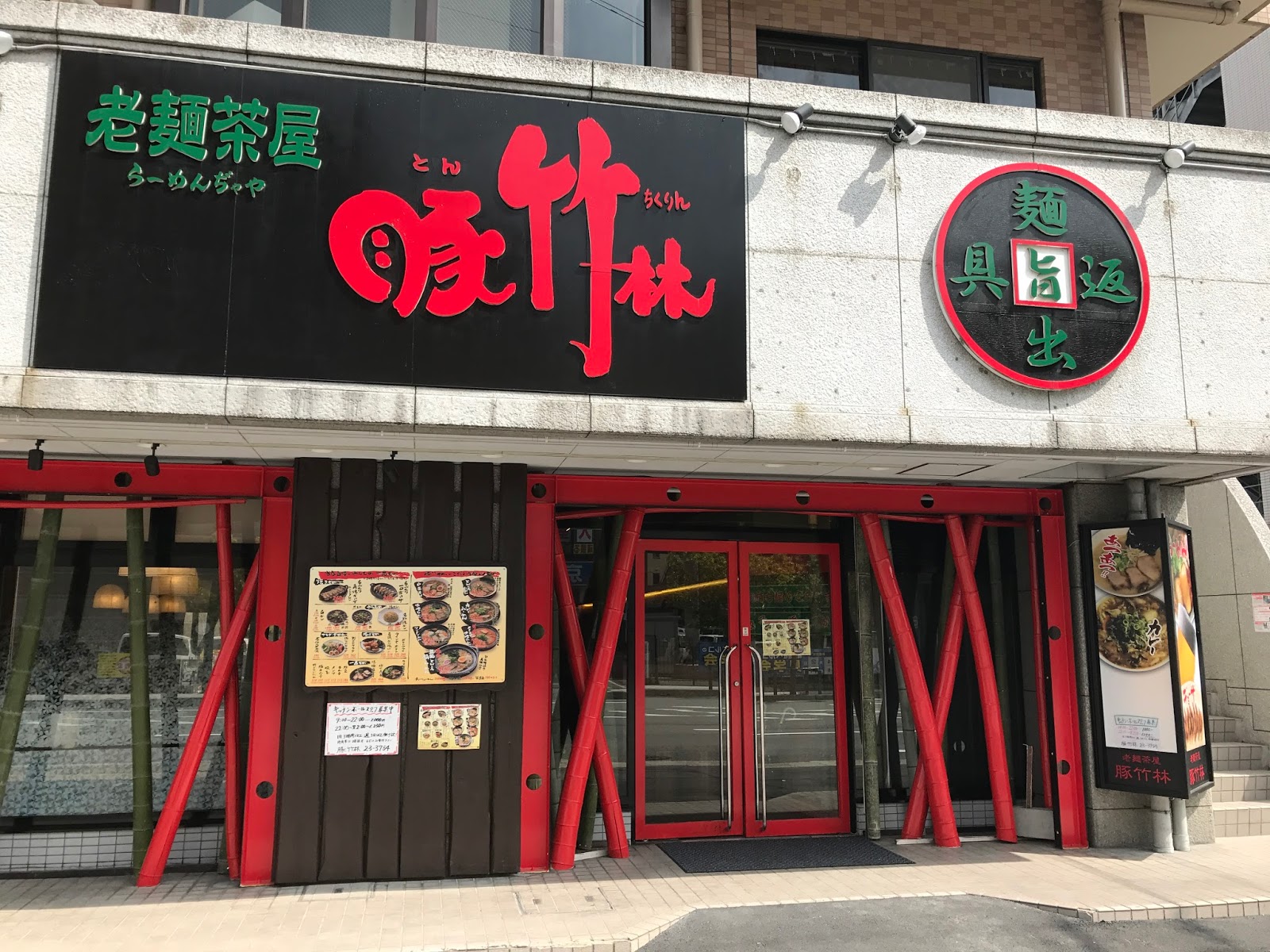
I only have 1 night in Nara.  So, after an excellent lunch at a local restaurant, I was ready to go.

Lunch of curry noodles and a rice bowl with pork for 1000 yens (about $9)

Restaurant where I ate lunch.  Very popular based on the local clientele
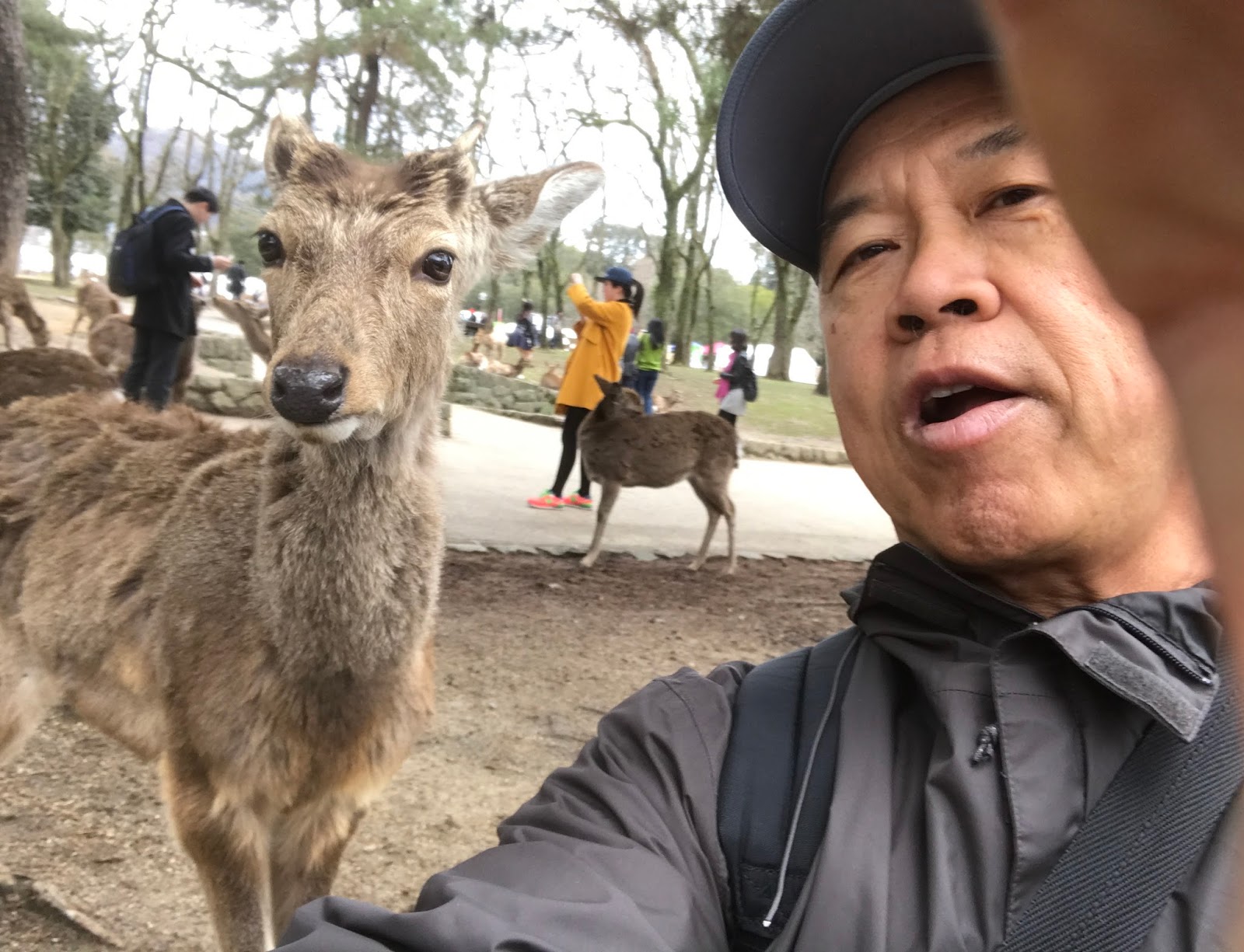
The most popular tourist spot in Nara is the Nara Park.  From the train station, I took the No. 2 bus there, about a couple of miles away.  When I got there, there were throngs of tourists.  Mostly, I think because of the very domesticated deer population there.  Deer were everywhere.  They have no fear for humans.  In fact, they would come next to you expecting to be fed cookies which you can buy from vendors all over the park.  It is an amazing, yet sad sight.  These are supposed to be wild animals but have been spoiled by humans.  I heard a lot of Mandarin so I assume a lot of the tourists are from China.  As usual, they bring their loud voices and bad manners with them.  But, what can the Japanese hosts say; they spend money here.

Taking a selfie with one of the deer

The deer come right to you expecting to be fed

They are all over the park

Deer cookies for 150 yens
I took a Kintetsu train from the Nara Station, changed at the Yamato-Saidaji Station and get off at the Nishinokyo Station, so that I can see the Toshodaiji Temple and the Yakushiji Temple.  But I was too late.  They both close at 5 pm.  I got there at about 5:30 pm.  Both temples are highly recommended but with only half a day, I can only see so much.  It's too bad.  I should've gone there first instead of Nara Park.  Another place I wanted to see is the Heijo Palace, a UNESCO World Heritage Site.  I'll have to try to see these places on a future trip.

I ended up walking around the shopping area in the city centers.  Not much different from other shopping streets in Japan.  There were many tourists here, for whatever reasons.

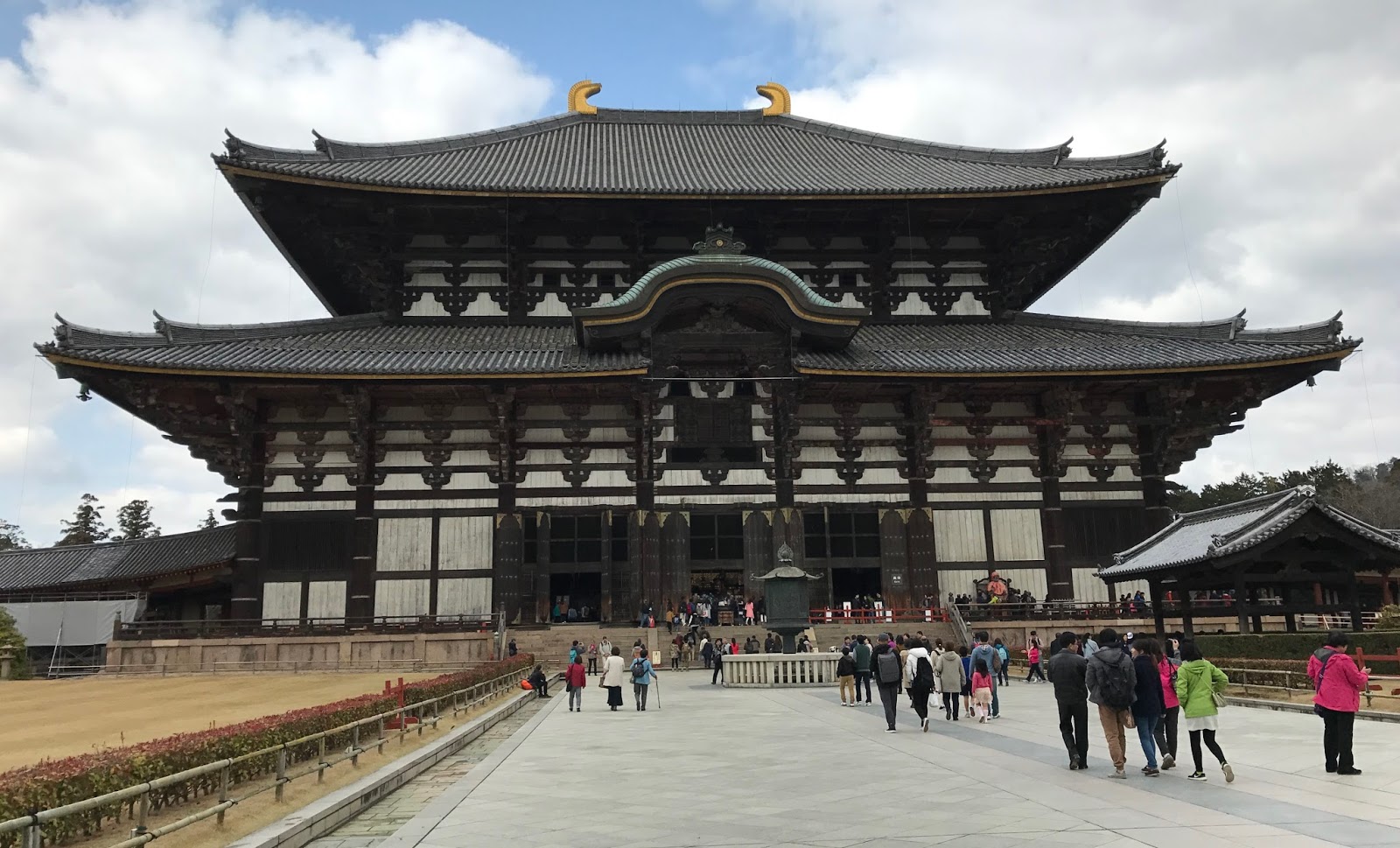
Todaiji Temple

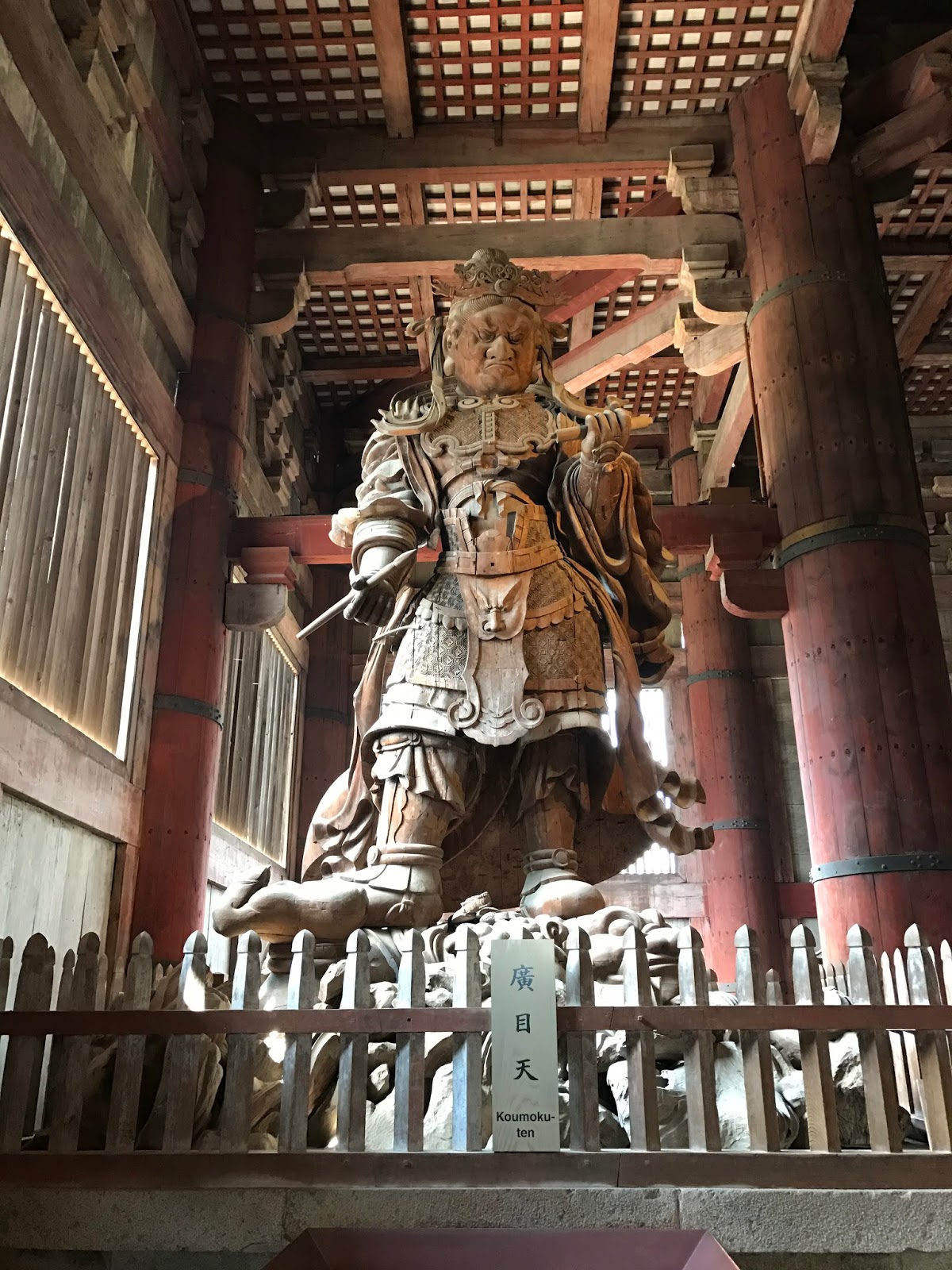
A deity inside the temple

Another deity 

Rice balls on a stick

One of the many shopping streets

Two men pounding a rice pastry

A long line of people waiting to buy these rice pastries

Thursday, April 6, 2017

Nagoya

I took a rapid train from Nakatsugawa station near Magome directly to Nagoya.  It took about an hour.  The Nagoya train station is crowded.  Nagoya is the third largest city in Japan.  It is the headquarters of Toyota Motor Company.  According to the map, it should be about a 10 minute walk to the Toyoko Inn where I am staying.  But it never work out that way.  The map seems to take me on a detour before I finally found a Toyoko Inn.  But it's the wrong hotel.  The one that my friend Soon Kuan booked me in is across the street.  After about 30 minutes I checked into the hotel.

Toyoko Inn is like Motel 6 in the US.  It's a budget hotel, catering to mostly single business travelers. Nothing fancy.  Just a nice clean room with a your own bathroom and toilet and a simple breakfast in the morning.  The staff is friendly and polite.  Like all things Japanese, they pay attention to all the little details, especially cleanliness.  They even have laundry facilities, where I did my 1-week collection of dirty clothes.


A simple breakfast of vegetables and bread at the hotel

We looked for a restaurant for dinner.  Soon Kuan has traveled in Japan many times and love traveling in the small towns and cities.  According to her, typically on the upper floor of a shopping center, there will be a food court or several restaurants.  We went to one next to the train station and found a nice French restaurant.  It doesn't make sense to be eating French food in Japan but here we are with the best possible choice of what is available.  It wasn't expensive, by Japanese standards.  About 3,000 yens or close to US$30 for the dinner.

Nagoya Train Station

Inside the station
It was cloudy the next morning.  We decided to walk to the nearby market.  This is a much smaller version of the Tokyo Fish Market but it still offers an interesting glimpse of what the Japanese love about their food.  Seafood dominates what's being sold here.  They are used for sashimi, sushi, or any version of Japanese cuisine.  Nagoya is supposed to be known for their eel, or unagi in Japanese.  Perhaps that explains why the Japanese are so healthy; many of them living to almost 100 years old.  Plus their food is not greasy at all.  The western world is starting to learn that red meat is not good for you.  The Japanese have known this for a long, long time.

Eels are a popular dish

Mackerels are usually grilled

Many varieties of seaweed are available
Some friends of Soon Kuan's are traveling with her in Japan.  It was going to rain that afternoon so in the morning, while it's still dry, we decided to take a walk in the pottery district.  This is an area where there are many kilns and pottery shops.  None of us bought anything.  It's hard to be lugging around souvenirs while you are traveling.  Besides, I have enough junk at home.  My experience with souvenirs is they look interesting when you first see them but after 2-3 years, they belong to the trashcan or junkyard.

Hello!

Pottery as art

Old pottery are reused to line the walls of an alley

Some interesting artwork

A kiln
It rained in the afternoon.  We had no choice but find an indoor activity.  Toyota Motor Company had its start here in Nagoya.  I think its headquarter is still here.  We decided to visit the Toyota Museum. I drive a 13-year Toyota Camry in the US and it is still a very reliable car.  I keep thinking of a reason to buy a new car but the Camry just keeps running and running.  So it's interesting for me to see the connection between my old car and where it originated from.

I did not know that Toyota started as a textile machinery maker.  The son of the founder had the foresight in the 1930s' to see that automobiles was going to become big.  On a couple of tours to Britain and the US, he learned about car manufacturing.  Well, the rest is history.  Toyota has been the largest car manufacturer in the world for many years, until it was overtaken by Volkswagen (through acquisitions).  It is best known for its quality.  I can understand why now that I've spent quite a bit of time in Japan.  Their attention to detail is incredible, even for their cleanliness in the bathrooms and trains.  No wonder their cars are always the best-selling cars in the US.  No wonder my car is still running well after 13 years.


A machine making yarns

Demonstrating the weaving process

A Toyota engine

Old models of Toyotas
Nagoya is a well-planned urban city, boasting several modern buildings and an impressive train station.  Obviously, there are more places of interest than the two that I've been to.  One of the best known is the Ise Grand Shrine, about two hours away by car.  There is also the Nagoya Castle, Tokugawa Art Museum and Garden, Koshoji Temple, Toganji Temple, Nagoya City Museum, etc.  Like most places I visited, I wish I had more time and the weather was good.  From Nagoya I head to Nara, another popular tourist destination.

Wednesday, April 5, 2017

Sakura

I timed my travel to Japan at the end of March/early April so that I can see the cherry blossoms, called sakura in Japanese.  There are only 2 places (as far as I know) where you can see an abundance of cherry blossoms - Japan and Washington, DC.  The cherry trees in Washington, DC, were a gift from Japan before World War II.  Depending  on which part of Japan you are in, you may see the cherry blossoms during late March all the way to end of April.

When I arrived in Tokyo at the end of March, they were just starting to bloom.  It was a little cold and raining at that time.  While traveling through the Kiso Valley and the Nakasendo Trail, I did not see any.  When I arrived in Kyoto on April 3, I was told that some of the cherry trees have already bloomed.   While walking from the train station to the hotel, we stopped at the at the grounds of the Imperial Palace and saw my first cherry blossoms.  It was quite a sight!  Over the next two days while visiting difference places of interest around Kyoto, we saw cherry blossoms everywhere.  Not all the cherry trees have bloomed but I'd say at least 75% of them have.

I am taking a slight detour from chronicling my travel so that I can show some of these pictures now.  I've yet to write about my time in Nagoya, Nara and Koyasan.  I have so many pictures that I am randomly picking them and putting them on this post.  I may add more later.  So, here they are.


Sunday, April 2, 2017

Tsumago to Magome

This is the most popular and most beautiful part of the Nakasendo Trail (NT).  Many tourists came just to hike this part of the trail.  Evidence of its popularity is seen by the number of tourists at both towns.  As I mentioned in the previous post, Tsumago was the first post town that decided to restore its old buildings and imposed some rules on how you can restore and maintain those buildings.  However, I think the houses in Narai look older and as well maintained.  Perhaps they represent different periods of history in Japan.

I dropped my heavy backpack at a small inn (minshuku) called Koshinzuka at the head of the trail.  It costs only 500 yen.  My backpack will be delivered to the Magome Tourist Information Center in the middle of town.  It made my hike so much easier.  This service is available only after March 21 and probably end right after the tourist season.

A shrine on the main street in Tsumago

An Old House that's been restored

Main Street in Tsumago

Sweeping the floor and getting the shop ready

A Pastry Shop

Part of the Trail
An old-fashion lantern

Hanaya Hotel, where I stayed in Otsumago
There is a little bit of a climb going from Tsumago to Magome.  Maybe that's why I see a lot of people coming in the opposite direction.  The distance is about 6.2 km (about 4 miles), depending on where in Tsumago you started.  Apparently, there are some bears in the forest here.  Bells are set at certain spots so that hikers can ring them and try to scare the bears away.

Bells for scaring away bears

Toilets on the trail

A rest stop serving tea, manned by volunteers
After 2-3 hours of hiking, I arrived in Magome.  It should've taken me 2 hours but it took me longer because I stopped in many places to take pictures.  I was not in a hurry.  When I started at about 10 am, there were no one on the trail.  About an hour later, I started meeting hikers coming in the opposite direction.  Once I enter town, I started running into throngs of tourists.  Some of them came by bus or car.  They may hike part of the trail but most of them just came to visit Magome.

This sign tells you that you have arrived in Magome

One of the first houses as you enter town

Main Street
I found the Tourist Information Center in the middle of main street.  The young lady there was very helpful and spoke good English.  She confirmed that my backpack was there and she told me what time the bus will leave for Nakatsugawa Station.  From there I will take the train to Nagoya.  I had a bowl of soba noodles for lunch, picked up my backpack, walked about 400m to the bus stop, and off I go, on my way to Nagoya to meet a friend.  

This is the end of my hike on the NT.  I wish I had hike more.  But, with a heavy backpack and time constraints, you have to pick the best part.  I met a retired engineer at the Hanaya Inn who is hiking for 21 days, about 2/3 of the entire trail!  This is like hiking the Appalachian Trail or the Pacific Crest Tail or the Camino de Santiago de Compostela.  It's like a pilgrimage or a test of your endurance.  But for me, it's enjoying the backroads and small towns of Japan.