Wednesday, March 21, 2018

On the Inca Trail to Machu Picchu - Day 3

Day 3 is not the most difficult but the longest, about 15km, I think.  Not a lot to dwell on except to look ahead, take one step at a time, and keep going.  By now it's more of a mental than a physical challenge.  You try not to think of the distance.  You think of the next rest stop and when you are going to reach camp.  It's easy to miss the beauty of the mountains.  I try to stop once in a while to take pictures; to record where I've been.  Being a man, I am lucky.  I can pee whenever and wherever I want to.  The girls have a tougher time.  There is no privacy here unless you want to go well off the path, into the thick bushes.  Even the designated banos (bathrooms) are squat toilets and smelly and dirty.  Occasionally, we'll come to a ruin and we'll stop. Santiago will gather us together and explained what this ruin is about:  why the Incas built this here and for what purpose.

One of the Inca ruins on the trail

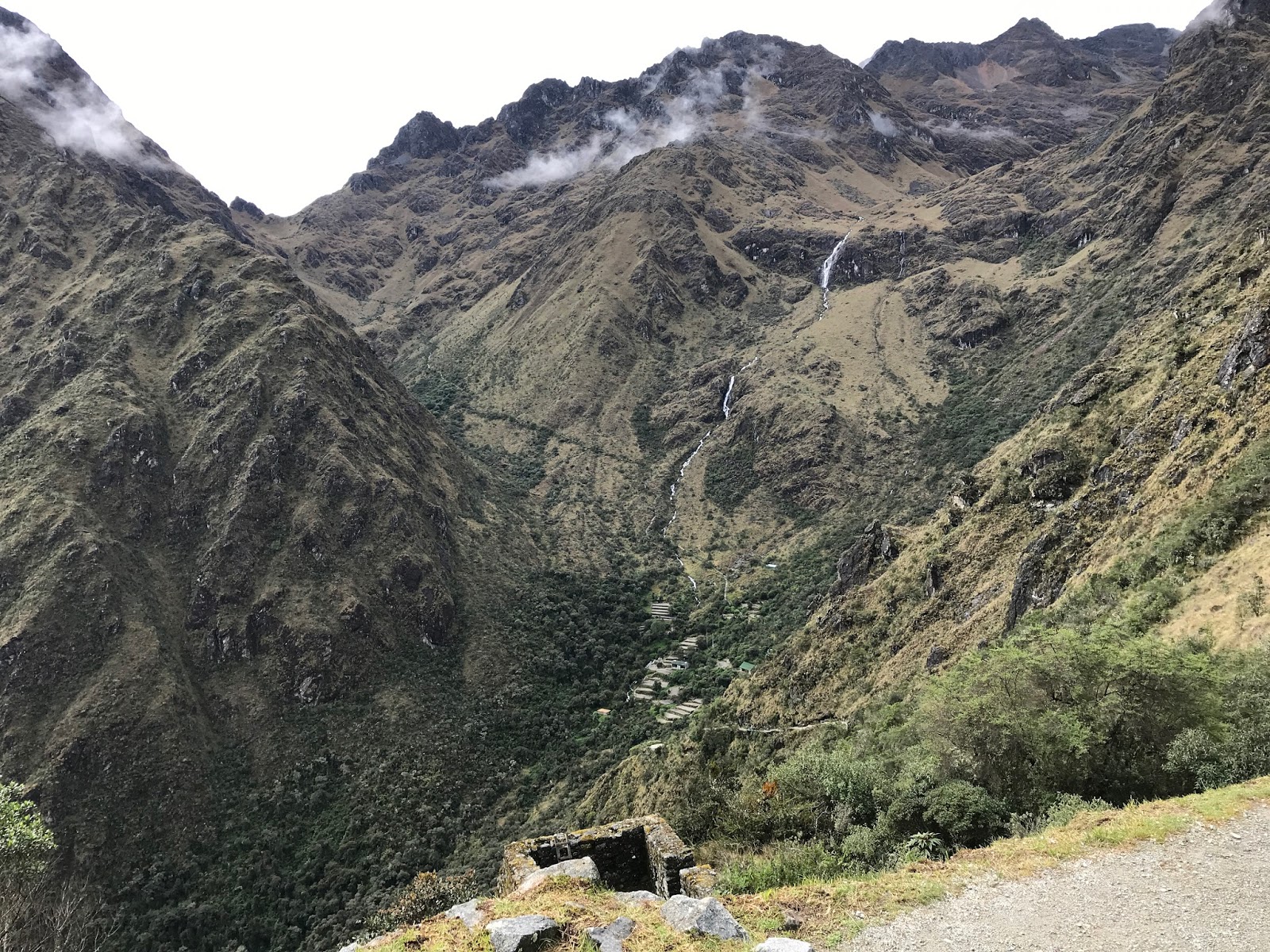
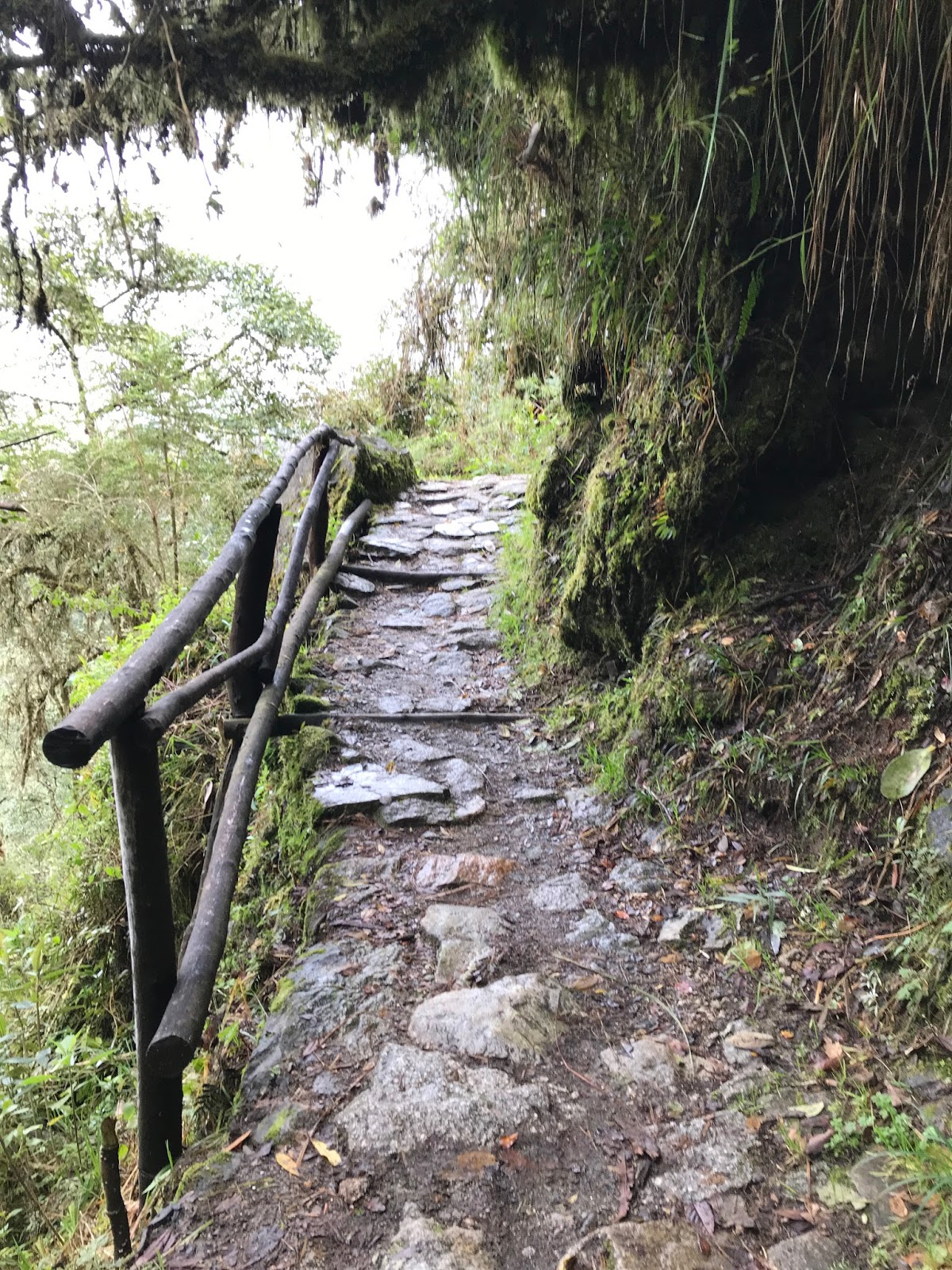
A trail amidst the rugged mountains

Small waterfalls are everywhere

Blue, Blonde, Belgium - that's Ann at the top of the trail

Christopher Lim, from Australia, lonely but determined


Hiking above the clouds

These rocks are slippery when wet

Why is this here?  The Incas never explained.  They don't have a written language

Another beautiful scenery


Another view of the ruin
We reached a designated spot for lunch.  Many other groups were there.  It is obvious that the agency that runs the Inca trail want to mitigate any damage to the land and environment.  A bathroom and sinks are provided for the hikers.  Not modern but adequate for being in such a remote area.

Why are they cheering?  Probably clean bathrooms!

Basins of water for us to wash our hands before lunch

High in the clouds and COLD!

Happy Hour Lunch!

There were 6 Australians in our group of 10.  Santiago told them that this lake looks like Australia
A well-deserved rest at Phuyupatamarka, at 3,600m high

A view of the Urubamba River

The ruins at Phuyupatamarka

There is no flush toilet in there, Ann.  It's an Inca Tunnel

Our porters with their 25kg load, and no hiking poles

The beautiful ruins at Winaywayna

The Incas cut tunnels through rocks so that they can get through

A trail with a steep drop

Llama Welcoming Party.  What is the magic word?  Reminds me of the movie "Monty Python and the Holy Grail."

Intipata Ruins
We finally reached our Day 3 camp.  Many groups are here.  It took me a while to find our camp, Number 15.  It's almost down at the bottom.  There are a few bathrooms and sinks.  There are even showers but I am not sure if anyone bothered to use them.  We have not showered for four days so what difference does another day make.

There is a reason why this camp is located here.  It's near the last checkpoint before you hike the last part of the Inca Trail to Machu Picchu.  It will take about one and a half hours to the Sun Gate, then about another 30 minutes for an overhead view of Machu Picchu.  Unlike most visitors, we'll be coming from the top, instead of the bottom.  No buses or trains for us.  It's all human power.

After our last dinner together on the trail, Santiago gathered us together for a farewell gathering and speech.  I spoke for our team and thank the porters and chef for their excellent support.  It's hard to underestimate how big a role they played in our completing the hike.  Then I handed them their tips in an envelope.  We each had contributed 150 soles, or about US$46 each, for the tips.  Our tour leader, Christian, helped us divide up the tips and put them into 4 envelopes:  Santiago, the lead guide; Guillermo, the assistant guide; the porters; and the chef.  I don't think the porters get paid a lot of money.  The tips always help.  The lead porter, Chris, thanked us for coming to Peru and hope we'll bring our friends too so that they will have more jobs.  What a gracious speech.  In return, I thanked them for sharing the beauty of their country with us.  We all shook hands and some of us hugged.  Some of us may have shed tears but it was dark and we couldn't see.  Then the rain started to fall and it's time for an early bedtime because we have to get up early at 3:30am the next morning.  Quickly, the porters started putting things away and get ready for the next morning and for the final leg of our hike.  Everyone is getting excited.

Tuesday, March 20, 2018

On the Inca Trail to Machu Picchu - Day 2

Our wake-up call in the morning is 6am.  One of the porters came to each tent and yell something and drop off a cup of hot coca tea.  Not cocoa but coca.  Coca plays an important role in the culture in this part of the world.  It is used as a stimulant, like coffee, by the locals for many years.  Cocaine is a product made from coca leaves through a complicated chemical process.  Therefore, growing and selling coca leaves is controlled by the government.

As part of the hike, we were taught how to wrap and chew coca leaves.  You put a few (maybe around 6-8 leaves) together, add a little bit of ash (from coffee, or anything else), wrap them tightly together and put them in one side of your mouth and chew.  The bundle secretes a juice that is supposed to make your cheek numb and give you an extra boost.  It is supposed to help us through the tough hike.   However, I did taste the juice but never got the stimulant effect.  I may have but I didn't actually feel it.  Maybe I was too focussed on taking 1 step at a time and making sure I don't slip and fall on the wet rocks.  All the locals, including porters and guides, chew them.  We also drink coca tea, which has a similar effect.  I thought of bringing some back to the US but I am sure I won't get past the customs at the airport.

After breakfast at 6:30am, we were ready to start hiking at 7am.  Again, our porters cleaned and packed up after us.  We are now ready for the slow, steep climb.  Day 2 is supposed to be the toughest day.

A bag of coca leaves costing 2 soles

The guide showing how to wrap coca leaves

One of the rest stops on Day 2

A trail on Day 2


Another challenging trail
The challenge for Day 2 is we have to climb a steep mountain to Warmiwanuska, commonly known as Dead Woman's Pass.  This is the highest point that we'll reach - 4,215m or about 14,000 feet.  On this day, those who are not in the best physical condition or suffering from altitude sickness, have the biggest struggle to get to the top.  Even some of the porters have to stop more frequently to catch their breadth.  To make matters worse, it was raining most of the day that day.

Locals selling drinks and snacks at one of the rest stops

The highest point of our climb, Warmiwanuska, at 4,215m
Part of the steep trail

Need to stop to admire the beautiful flowers
We crossed many beautiful waterfalls

Our camp on Day 2 among the high mountains

Day 2 Campsite.  Many other hikers camp here too.

Not only the climb was high, but climbing down was tough too because of the slippery rocks.   I don't think I ever hiked with hiking poles but on this trip I made full use of them.  Both up and down.  Having hiking poles going up means I can use my arms and shoulder to pull myself up.  Coming down is more important because it gave me two extra appendages for stability.  In spite of that I slipped a few times because when I stepped on a rock (lots of them granite) and thought it was stable.  It was not.  Fortunately, they were small falls.  Once, I slipped and fell to my side.  A bush stopped my fall before I had a chance to roll further down.  Whew!  Part of my difficulty was I was wearing running shoes, not hiking boots.  I did not expect the terrain to be so challenging.  Otherwise I would have brought or rent a pair of hiking boots.

Some of the "Speedy Gonzalez's" reached camp at about 12:40pm.  I reached camp at 1pm.  Not bad for an old fart. Just before climbing to the peak, Santiago, our guide, decided that since it was a tough hike, we were going to end our hike for the day at our Day 2 campsite.   For some of us we had the whole afternoon to rest up.  A couple of our teammates struggled and did not reach camp until 3:40pm.  Fortunately, our second guide, Guillermo, patiently stayed and encouraged them.  He provided whatever assistance that was needed and definitely, was a morale booster for them.

We are now away from civilization, hiking on trails that the ancient Incas built themselves to traverse the mountains.  Local residents are not allowed on this part of the trail to sell drinks or food.  We are on our own.  We can't buy water from the local vendors anymore.  Our porters boil water for us to fill our water bottles.  We were given snacks and anything that's needed on the trail.

Candies, cereal bars and oranges for the hike

It is easy to focus on the hike and the difficulty of the hike itself and forget about the beauty of the Peruvian mountains.  Occasionally, I will pause to catch my breath, then look around me.  What beauty, the verdant mountains and valleys, the colorful flowers, the singing birds and the fluttering butterflies.  Made me want to pull out a book, sit on a comfortable chair and just read and enjoy the beauty of God's creation.  Once in a while I will remember to pull out my iPhone and snap a few shots to time-capture what is around me.  I have my big DSLR camera in my bag-pack but it was too much trouble to pull it out.  The iPhone7 did very well.

The beauty of the rugged Peruvian mountains
Pasture where some animals are grazing

Another beautiful view

Looking at a valley

Surprised to see some llamas on this part of the trail
We had our usual dinner at about 6pm.  We were finished by 8pm and were ready for bed after that.  We filled our water bottles with boiled water.  Day 3 is going to be a long day.

Sunday, March 18, 2018

On the Inca Trail to Machu Picchu - Day 1

In the morning we drove in a van for about 45 minutes from Ollantaytambo to the start of the Inca Trail.  There we rendezvous with our porters for the first time.  There were 10 of us hikers plus two guides.  There were 14 porters, including the chef, to support us.  They have various duties: carrying our extra baggage, setting up and breaking camp, cleaning, etc, anything that makes our hike as easy and comfortable as possible.  And, of course, the most important duty of all, carrying our extra luggage.  As the hike progresses, I saw how hard they work and appreciate them even more.  I have done a lot of hiking and camping but never before had I have a team to take care of us.  What a privilege.

Map showing the route and ruins that we'll be passing through

Instructions on what to bring

Coca Leaves to give us energy on the hike

Our rendezvous spot with the porters

Our porters packing and getting our stuff ready

My Official Permit for the hike
At our rendezvous spot, we gave them our duffel bags so that they can repack them with other things they have to carry.  They carry EVERYTHING that's needed on the hike:  tables and chairs, pots and pans, tents, food, toilet paper, soap, etc.  They have done this many times so I assume they have their list of things to bring.

When everyone is ready, the porters start on their journeys first.  They have to be ahead of us to make lunch and set up camp for us.  For us hikers, we walk about 100m to the first checkpoint.  The Peru government is now controlling access to the trail because of past abuses and overuse.  I understand that only 500 hikers a day are allowed on the trail to minimize damage.  I am glad they are doing this because they need to preserve history and a national treasure.  For us, our tour company, Tucan Travel, applied the permits for us when we first signed up for the tour.  At the checkpoint our permits were checked against our passport.  Further on, there will be other checkpoints.

Getting our documents checked

A team photo before the hike

Approaching the first control station

At our first break

Starting the hike with a beautiful view of the valley

Here comes our porters with their 25kg load
On the first day of the hike we passed through areas where there are still people living there.  The locals sell drinks, food and snacks.  At about 2pm we stopped for lunch.  Our porters had already started preparing.  They set up a big tent that's to be our dining room.  They provided basins for us to wash our hands.  Not only that, the lunch was good and generous.  If that is not challenging enough, in our group of ten, there was a couple who are vegans and one who needs gluten-free meals.  Desserts and hot-drinks are also provided after the meals.  When we finished, the porters collect our dishes and wash them, just like in a restaurant.  I've never been so spoiled in any of my camping trips.


Getting ready for lunch in our "dining room."  Our 2nd guide, Guillermo is on the left

A delicious and generous lunch

One of the named areas we hike through

With this kind of food, this is not camping

Washing hands before lunch
At about 4:30pm we reached our first camp site for the day.  It is next to a couple of buildings belonging to a family.  We used their restaurant as our dining room and bought water from the owner. Fearing that I will run out of battery on my phone, I had my phone charged for 5 soles.  We also have to pay 1 sole to use their bathroom, which is really a squat toilet.  It smelled so bad that the ladies refused to use it.  Our tents were all set up for us and we found our duffel bags in our tent.  By about 8pm we were all finished with dinner and there was nothing else to do.  Some of us went to bed right away.  I tried to read in the dining room.  After a while I was politely told that the porters needed to go to sleep.  They slept on pads laid down on the floor.  I had a pad plus a thin air-mattress AND a sleeping bag.  As always, it took me a while to fall asleep but even though it was not a full day, it was a tiring day.

Our campsite for the first day
A group of happy campers