Wednesday, February 12, 2020

Sri Lanka, Part 4 - Damro Tea, Nuwara Eliya

We are now in the mountains part of SL.  Driving through the winding roads take time.  Some parts are even perilous because they are so narrow that only one vehicle can pass at a time.  To make it worse buses and trucks use this road as well.  One side has to stop to wait for the other side to pass.  But, it was beautiful country, with all the green tea plantations around.

Lush green scenery 

The shoot of the tea plant is used for making tea

Close up look at the tea plant

Tea bushes are grown on the side of the mountains
I've been looking forward to visiting a tea plantation.  Most tea estates don't give tours or demonstrations but Damro Tea does.  We were first shown how raw tea leaves are processed to be consumable tea.  All tea start from the same tea leaves.  It's the processing that makes it different - whether it's black, green, oolong, white, etc.  White tea are the most expensive because it's a delicate process to make them.  We had sample cups of tea and of course, a showroom to sell you tea.  I had orders from Doris to buy tea that is used for making milk tea, her favorite Hong Kong beverage.  I wasn't sure I'll be able to find it.  But as soon as I asked one of the ladies she knew right away what tea is best - BOPF, which stands for Black Orange Pekoe Fanning.  It's a strong black tea that when added a teaspoon (or more) of condensed milk makes it a very delicious drink.

Most tea estates sell their tea at auctions in Colombo, the capital.  The bidders represent major tea brands and they mix tea from different estates before packaging them.

Most of the tea pickers were brought to SL from India, especially the Tamil region.  Tea pickers are paid 1,000 rupees a day, about US$5.51, and they must pick 50 kilos (about 110 lbs) a day!  It's very tough work because you have to climb on the side of the mountains and balance yourself on the slopes.


Tea Leaves being dried by machine

A Cup of Milk Tea

Boxes of BOPF tea, about US$20 for 5 boxes

On the way to Nuwara Eliya we passed a small town that was having a Hindu procession.  I don't know what the festival is all about but everything about the festival was colorful, including the saris worn by the Indian women.

Indian women with their colorful saris pulling a shrine

A Hindu procession

We finally checked into the Ceybank Rest hotel, almost in the middle of Nuwara Eliya town.  It's a very old hotel that has seen better days.  Everything about the place is old.  However, the staff try their best and provide as good a service as they can.  After check-in we took a walk in the Central Market to see what they sell.  It's an interesting assortment of fruits, vegetables and fish.

At the Central Market with Mohan, my driver

Jackfruits.  These are smaller and used for cooking

Indian bitter melon, looks different from the Chinese bitter melon

Many varieties of bananas are sold here

Peas for making dahl

Banana flowers for cooking

Egg plant, called brinjal here

Okra, sometimes call Ladies Fingers

Another type of bitter melon

We also walked along the main street of town and see what kinds of things the shops sell.  There were a few bakeries, clothing stores, provision stores, etc.  We also walked through a market that sells well-known brand jackets and clothings from Patagonia, Columbia, North Face, etc.  They are all made in Sri Lanka but I don't think they are genuine.

These are called string hoppers
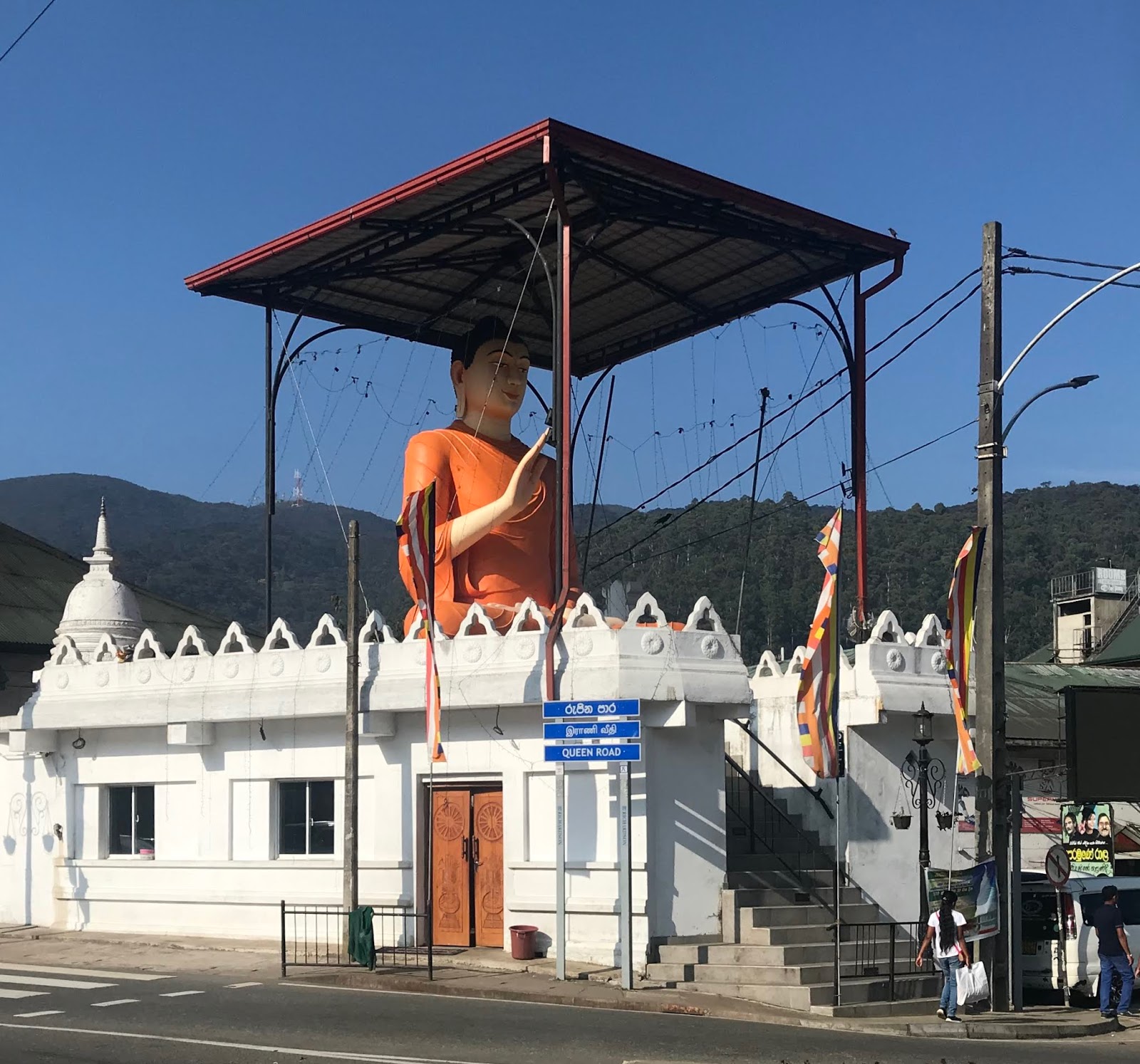
Statue of Buddha in the middle of town

Market for selling fake name-brand jackets

Sri Lanka, Part 3 - Kandy, Adam's Peak

As we leave Dambulla we are approaching the mountainous area of SL.  This is known as the Central Province.  We are heading towards the town of Kandy, where we will visit the UNESCO World Heritage Site, the Temple of the Tooth Relic.  Along the way we visited a spice garden near the town of Matale.  I wasn't sure what this meant when I saw this on the agenda but once I got there it made sense.

We were greeted by a young man when we pulled into the parking lot.  I don't remember his name and his pitch is that he is a university student studying herbal medical and working there part time to pay his fees.  He dove right away about the different popular spices:  ginger, turmeric, vanilla, cinnamon, cloves, etc.  These are the tropical spices that drove the Europeans to come to Asia in the thirteenth  century onwards.  They add flavor to the food and in this pitch, there is medicinal value in these spices.  I agree there may be some medicinal values in some of these spices but they are not scientifically proven.  You can believe what you want to believe.  My conclusion is that this is just a sales pitch and I am glad I walked away with buying only a bottle of cream for 3,000 rupees that is supposed to help me sleep.  It was educational but I won't say I am totally convinced about all the illnesses that the herbs can cure.

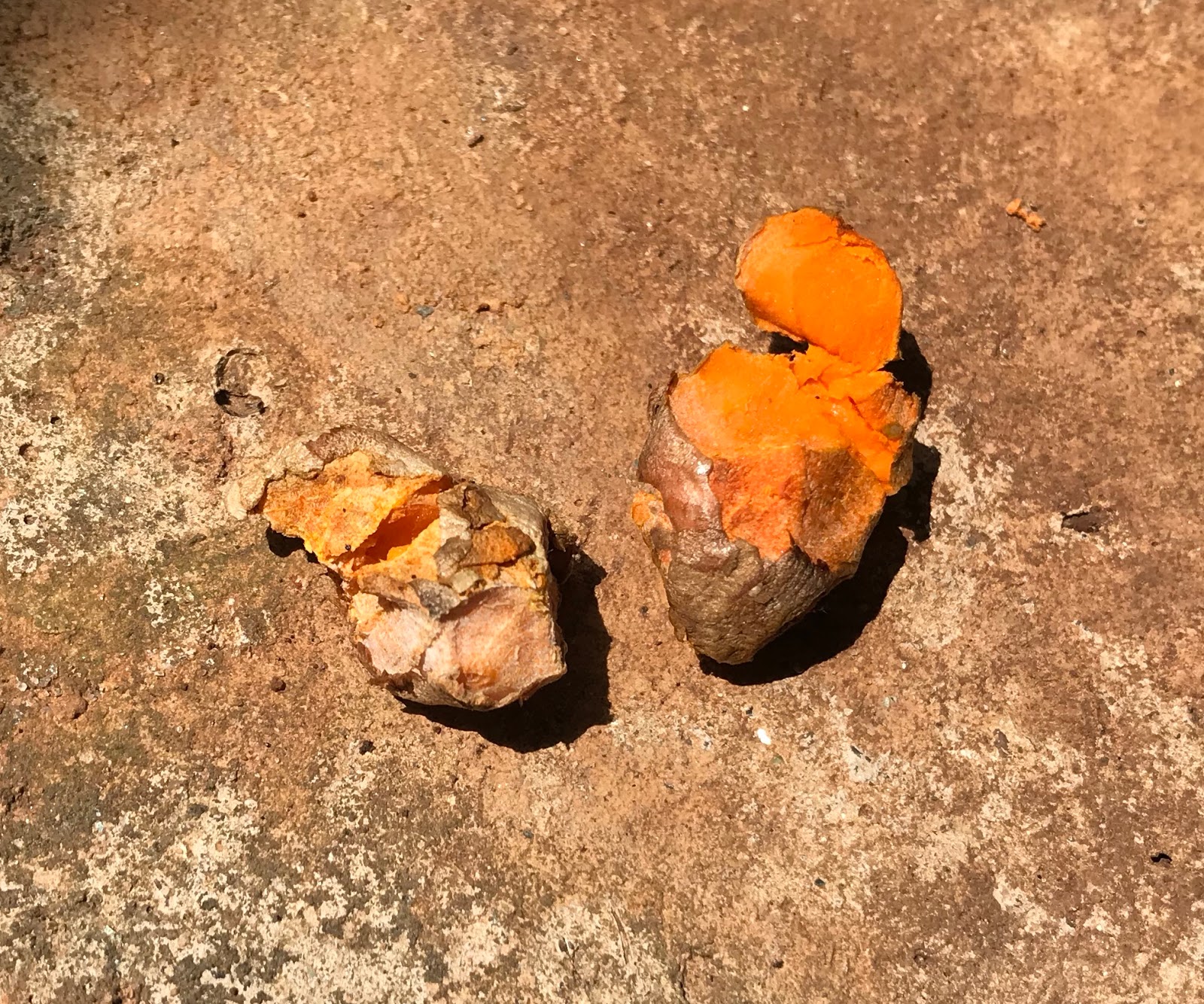
Raw Turmeric

A Ginger Plant

Vanilla Bean Pod
We drove a circuitous mountain road to almost to the top where we checked into the Skyloft Kandy Hotel.  It is a beautiful hotel and beautiful views of the mountains and the surround area.  It is modern and the service was excellent.  On the way here we stopped at a supermarket to buy a small packet of laundry detergent.  Being here for 2 days allowed me to do my laundry and get them dry.  I could've gotten it done by the hotel but it costs 150 rupees (about 85cents) to wash a T-shirt.  Maybe I am too cheap.

The next morning we drove to the Temple of the Tooth Relic in the middle of Kandy.  This is a very important shrine for the Buddhists in SL as it is supposed to hold the tooth of the Buddha.  It was bombed by the Tamil Tigers in 1998 but has been restored.  The morning we were there there were many tourists and local worshippers.

To see the Tooth Relic we had to go on a slow-moving line of worshippers and tourists to a small window where we can see the relic.  The locals stopped to offer prayers and offerings.  We have to keep moving so if you don't know what you are looking for you don't know what it looks like.  No photography or videos are allowed.

Entrance to the Temple.  US$10 per foreigner

The Temple

Inside the Temple but not where the Tooth Relic is housed

Panoramic View of the City of Kandy

One of the main streets in Kandy
After visiting the Temple we stopped at a Gem Factory and Museum.  I think it was more of a showroom to sell gems because there was only a couple of glass cases to show the gems and the "factory" has about 2 or 3 jewelers talking to each other rather than working on the stones.  But that's how tour companies earn their extra commissions.  Bring gullible tourists to such places.

Gemstones found in Sri Lanka
Late in the afternoon we attended a local cultural dance.  It is a showcase of local dances performed by several men and women.  Some of the dances seems to be more gymnastics with back flip and back somersaults.  This is followed by an outdoor performance of fire-eating and fire-walking.  That is a Hindu ritual.

A Cultural Dance

Fire-walking demonstration 

The biggest physical challenge comes on the 8th day - climbing Adam's Peak, a 7,000+ feet mountain  in Central SL.  Locals call it Sri Pada.  It is supposed to contain the "footprint" of Buddha.  We checked into the White Elephant Hotel about 1:30pm.  I rested until about 4pm and we drove to the starting point of the hike.  There were many people there and many vendors on the side of the trail selling all kinds of foodstuff and souvenirs.  It's almost a carnival atmosphere.  I was one of the few foreigners.  The locals greeted me warmly.  Some talked to me, some just said hello.  Some offered me snacks.  The steps are concrete.  I was told in the old days there were no concrete steps and older folks have to write a will before they climb because they might not make it back.  The pilgrims, if I may call them, come in all shapes and sizes, young and old.  There are some who I thought were totally unfit to climb, in my opinion.  But, this is their pilgrimage.  Some do it once a year.

However, the climb was very challenging.  I was told that it'd take about 4 hours to go up and 4 hours to come down.  I was a little skeptical.  But, with the crowd, it somehow slow you down as you get closer to the top.  It took about one and a half hours instead of 30 minutes for the last part.  It was one step at a time.  That's because at the summit the line narrows to one line and everyone stops to pray and offer offerings in front of the shrine.  Offerings of money, flowers, etc.  No photography was allowed.  I could only see a bright area through a small window.  Some people chose to stay at the summit for whatever reason.  Some also rang a big bell to indicate how many times they have been up there.  For me I took a glimpse of the shrine and start heading down.  At first I went down the wrong stairs and couldn't find my shoes.  I realized it looks different from the way I came up and went back up and came down the right stairs.  It would've been funny if I can't find my shoes because those are the only ones I brought for the trip!

Coming down was not that easy either.  My legs were tired and weak.  I had not eaten anything except a few crackers they gave the climbers on the way.  The steps are not small either.  I had to hold on to the railing in case my legs crumble.  It seems to take forever for me to get to the bottom.  When I thought I was almost 15 minutes to the bottom I texted my driver Mohan that I am almost down there.  I was wrong.  It seems to take forever to get to the bottom.

Sign at the start of the trail

Adam's Peak is in the distance in this picture

Crowd at the start

Some choose to take a detour and wash in the small stream

Statues of Praying Monks

A white Stupa on the way

Getting to the steep part
It was midnight by the time we got back to the White Elephant Hotel.  I was dead tired.  Mohan was surprised that I made it to the top.  He thought I'd give up half way.  That thought did cross my mind. It's another feather in the cap.

Monday, February 10, 2020

Sri Lanka, Part 2 - Polonnaruwa, Sigiriya, Dambulla


On the third day we headed south to the UNESCO World Heritage Site of Polonnaruwa.  This is the second most ancient kingdom in Sri Lanka (SL) after Anuradhapura.  Below are pictures from the grounds of the ancient city.  Admission is US$25 per person.  Following the tour we checked into the beautiful Giritale Hotel situated not far from the Giritale Lake.  My room overlooks the lake.  When I wanted to take a walk down the lake the hotel security guard warned me not to turn left at the main road and to return before it gets dark.  The reason?  There are wild elephants roaming in the forest nearby.

A Reclining Buddha statue

Entrance to a part of the grounds

A Sitting Buddha Statue

Entrance to a former structure

Statue guarding the entrance

Ancient upright structures

A water tank

More statues on the grounds

Another old statue

An Old Storage Tank

A Pond for Bathing

Statue of Buddha

Including the drive, the tour took about 3/4 of a day.  I am not disappointed to finish the tour early so I could enjoy the views from the hotel.

The following day we headed towards Dambulla where we will spend the night at the Nice Place Dambulla hotel.  On the way we stopped at a small village to get some demonstration of what village life is like.  First, we took a slow bullock cart to the edge of the lake.  Then we took a row boat to reach the village where our hostess met us.  She showed us first how she cuts up a coconut.  Coconuts are an important part of life in many poor countries in the tropics.  They can provide food, oil, and building material.  Then she ground and milled some millets which were then made into a flat bread.


BMW - Bullock Motor Wagon

Shaving the inside of the coconut to get flakes for cooking

Coconut sambar and millet roti

Sigiriya Rock Fortress
Walking up to the summit
Abandoned palace on top of the summit

The following day we drove to the Dambulla Cave Temple.  These caves were used only by the monarchs until the 20th century.  They are now opened to the public.  I was amazed by the conditions of a lot of the statues and the inside of the caves.  The complex has five caves.  They were built in the 1st century BC and is a World Heritage Site.  What is interesting about these caves is that they include a few statues of Hindu gods.  Both Buddhism and Hinduism originated from India and there might be some shared beliefs between the two religions.  It was definitely worth the US$10 entrance fee to the temples.

I compare these caves to the 9th century Mogao Caves in Dunhuang, China.  Although the latter is much more impressive its conditions had deteriorated to the point that the Chinese government is opening only a small section of the caves to the public.


Temple Cave in Dambulla

Reclining Buddha inside the Temple Cave


Buddhas inside the Cave
Paintings on the walls


One of the many Buddha statues inside the cave
Coming down from the caves in a different direction brings you to the Golden Temple.  This impressive Buddhas statue is part of the Dambulla Cave Temple World Heritage Site.


This area is blessed with very nice weather.  It is warm but not humid like in the tropics.  However, it has many tropical fruits like bananas, papayas, pineapples, mangos, guava, etc.  Papayas, pineapples and water melons are offered as dessert at almost every meal.  We saw many roadside fruit stands selling all types of fruits.

Red Bananas

Soursop, a delicious fruit.  A South American version is called cherimoya


A fruit stand along the road
 We passed a place where they offer elephant rides.  I was not interested because I've done this a couple of times in Thailand.  We stopped to see why a crowd is looking into the river.  Below is what we saw.

This elephant enjoyed soaking in the river that he pooped
Something that piqued my interest when I walked past some containers that looked like old British-style mailboxes.  On closer look they are recycling bins.

Recycling Dustbins or Cans