Tuesday, February 20, 2018

Iguazu Falls

We took an early morning 1-hour flight from Rio to Sao Paulo, then another hour and a half to Foz de  Iguaçu, on the Brazilian side.  Unlike in the US, security is a little looser for domestic flights.  For example, I was able to bring bottle water with me and going through security, you are not as thoroughly checked.  Definitely, no TSA-equivalent personnel yelling at you.  Our van picked us up and took us to the Hotel Taroba on the Brazilian side of the town.

I was expecting Iguaçu to be a small town,  maybe a few buildings for tourists to visit.  I was surprised while the plane was getting to land, to find that there were several tall buildings.  The Brazilian side of the town is called Foz de Iguaçu and the Argentinian side is called Puerto Iguaçu.  Our plan here is to visit Iguazu Falls, first on the Brazilian side, then on the Argentinian side.

We were picked up at the airport, then dropped off at the entrance to the park.  There is a long platform that allows you to view the falls.  As you get closer, you see more and more of the falls until you are just below the fall itself.  Here you get to see the full view of the fall.

Brazilian side of Falls

Another view of Brazilian side of Falls
It did not take long to see the Brazilian side of the falls.  We had some time so we decided to go to a nearby Bird Park.  The admission fee was not very high, maybe 50 Reals or about US$15,  It was an okay park.  I was expecting to see more with better presentation of the birds but it was not quite up to some other bird parks that I have seen.

Tucan 
Parrot
After checking into the hotel, we first went to dropped of our dirty clothes at the laundromat, located 1 block behind the hotel.  I have accumulated about 1 week of dirty clothes and couldn't be happier to get them washed.  The laundromat was going to charge 55 Reals for a minimum 5 kg of laundry.  Here I did about 2 kg of clothes for 20 Reals.  The clean clothes were cleaned and nicely folded, and was ready the next day.  Nothing makes a traveler happier than having clean clothes.  After a week of heat and humidity in Rio, the laundry bag gets full quickly.

That night we went to a churrascaria restaurant about a block from the hotel for dinner.  This is a traditional Brazilian restaurant where they serve you a never-ending variety of meat - beef (of different cuts), lamb, chicken, pork, etc.  The waiter will come to your table with a long skewer full of meat.  If you want it, he will shape off a piece on your plate.  He keeps coming back with different types of meat until you give up.  As you can imagine, you get very very full.

The next morning we drove across the border to the Argentinian side of the Falls.  Like many border crossings, the bureaucracy take some time.  Our driver and tour leader took our passports and did all the processing for us.  We just sat and waited in the van.  Overall, it took about an hour to go from our hotel to the Iguazu National Park.

Argentinian side of the Falls

A panoramic view of the Argentinian side of the Falls
Most people would agree that the Argentinian side of the Falls is more beautiful.  The part where most visitors see the falls is very dramatic and is called "The Devil's Throat."  A small platform is set up for visitors to have a good view of the fall but it's very crowded and difficult to get a good view.

We also signed up for a trip on a speedboat up river to near the falls and also to get under the fall itself.  It's a very different perspective seeing the falls at the river level.  Three times the speed boat got very near to the falls and in one last thrust, we went under the falls and were totally drenched.  It was like getting under a heavy shower for about a minute.  We were given water-proof bags to store our belongings but everyone was drenched.

We took a similar speedboat to get close to the falls

The speedboat took us under the fall itself
On our second evening in Foz de Iguazu, our tour leader insisted that we go to a Chinese restaurant for dinner.  Coincidentally, it was Chinese New Year's Eve, a traditionally evening for the family to get together.   Christian insisted that the Chinese food is very good and authentic.  I am always skeptical when a non-Asian speak highly of an Asian restaurant.  When we entered the restaurant I noticed that were other Chinese families gathering for their traditional dinners.  Then I spoke to the owner in Cantonese.  When the food came out, I could tell that they were quite good.  Not 100% authentic but good enough for a small town.  We ordered a lot of food and I thought there was no good we were going to be able to finish it.  However, we have some young and very hungry people in our group and we cleaned the dishes.  Best part was it costs us very little money, around 100 Reals or about US$30 each.  Everyone came away happy.

A Chinese New Year's Eve dinner

It was a wonderful experience visiting one of the wonders of the world.  I've now visited some of the biggest waterfalls in the world:  Niagara, Victoria and now Iguazu.

Sunday, February 18, 2018

Favela

A Favela is a slum in Brazil.  It is not the best representation of Brazil but it is what it is.  Most of the favela residents are from poor rural areas looking for economic opportunities in the big city.  They are poor and therefore cannot afford normal housing.  In spite of being close to the city, they get no essential services like water and sewer.  Shacks or shanties, whatever you call them, are built without any building code.  You find an open space and build however you want and whatever you want, based on what you can afford and not what the building code says.  It is a result of a government ignoring the plight of the poor and not doing anything about it.

Many Brazilians warned me not to visit a favela.  They are dangerous and often overrun by armed drug-traffickers.  If you get into trouble, nobody can help you.  So we went on a tour with a local company called "Be a Local."  Here is a link to their tour:  https://bealocal.com/tours/favela-tour/

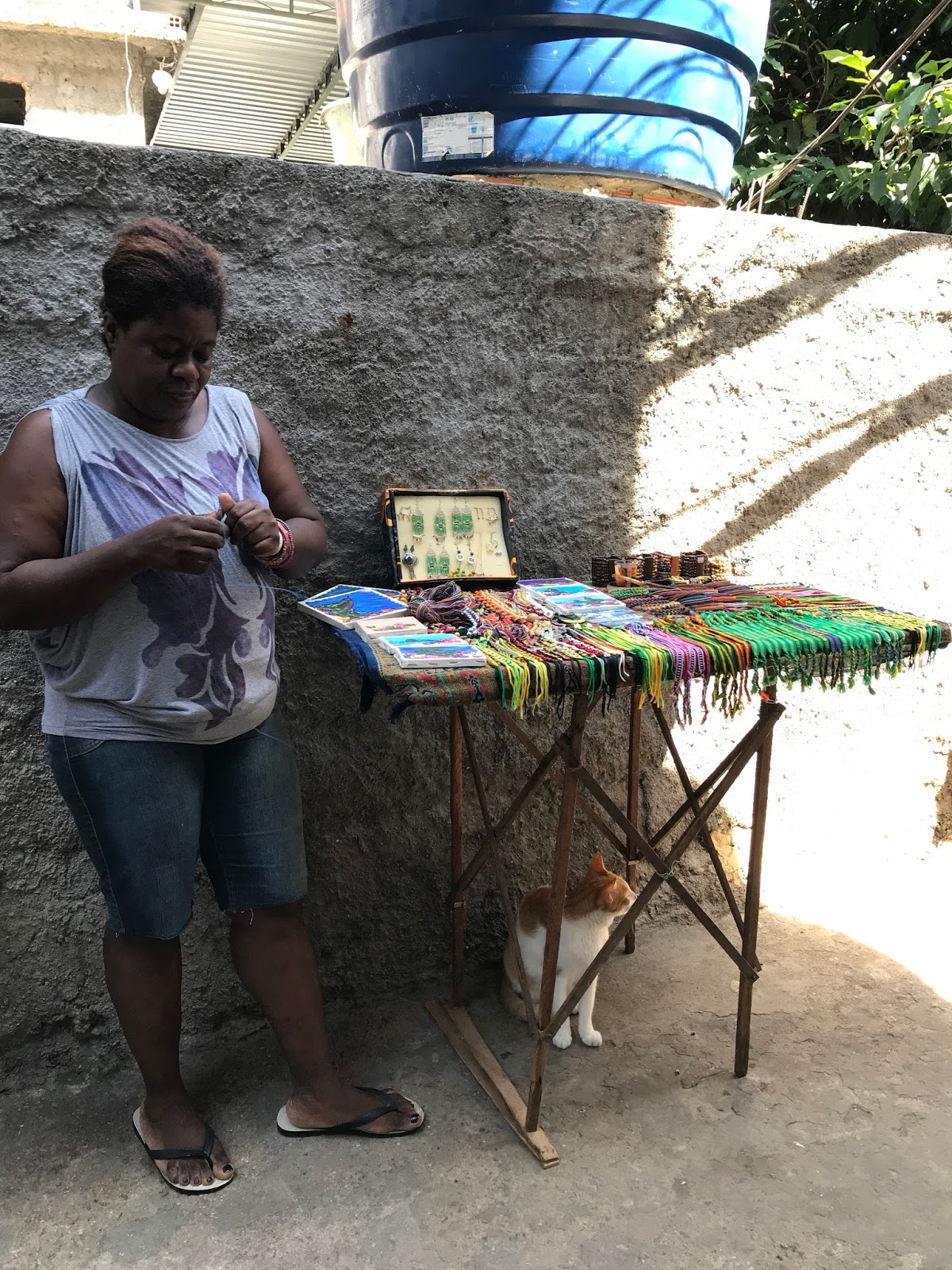
Our tour guide was "Ed", who spoke excellent English and did a very thorough job of explaining about life in a favela.  We visited the Rocinha favela, built on a hillside within the city of Rio itself.  We started on the top and walked through a very narrow "No. 1 street", stopping at various places so that Ed can explain certain things.  We also stopped at a few businesses:  an art studio, a bakery, and a woman selling souvenirs.  It's our way to support the locals.

Since the "houses", if you can call them that, are built without building codes, they are built in the most ingenious or improvisational way.  Stairs twist here and there.  Wires are all over the place.  Plastic pipes showed up and disappeared into the concrete.  It's a nightmare for any repairman, not to mention a safety hazard for the residents.  We had to be careful not to step on feces, in the middle of the "street."  I think most of us were glad we don't live there and for the tour to end.

A favela at the bottom of Corcovado, where Christ the Redeemer is located
A cute boy

Artist that we visited

Group photo

Mass of wiring

Armed guards patrolling the neighborhood

Narrow stairway

Graffiti to brighten up the area

Taken from an upper level house.  The upscale condos are in the background

Visiting a bakery.  Our guide Ed, is the one with the sling

Discarded telephone wires are used to make the crafts

Which pipe is mine?  Plumbing nightmare

Picture of Bob Marley

Saturday, February 17, 2018

Rio

Rio de Janeiro is often referred to as just Rio, which means River (of January).  It recently hosted the World Cup in 2014 and the Summer Olympics in 2016.  There were a lot of negative publicity about Rio leading to the summer Olympics but once it's over, it reverts back to its fame as a party city.  It is a big sprawling city of about 12 million people, with a big gap between the rich and the poor.

Its Christ the Redeemer statue on top of Corcovado (Camel's hump) and Sugar Loaf Mountain need no introduction, the former being named one of the New Seven Wonders of the World.  Ipanema Beach, made famous from the song "The Girl from Ipanema", and Copacabana Beach are two of the best known beaches in the world.

I spent six nights in Rio, 5 of which with Tucan Travel.  I came a day early so that I can get adjusted to the time and city.  I am glad I did, because after a 20-hour trip, I was dead tired.  After a good night's rest, I was rest to join in the carnival spirit of the city.

Hotel Regina where I stayed, is located in an old neighborhood called Flamengo.  It's about a 20 minute walk from downtown and a 15-20 minute bus ride to Ipanema and Copacabana beaches.  As I exit the hotel, 2 blocks to the right is Flamengo Beach, not very popular but still crowded towards the late afternoon or early morning.  If I turn left and walk one block, I will come to Catete Road, or Rua do Catete.  It's a very busy street with plenty of shops and restaurants.  I ate at several of these restaurants, some of food as simple as something that is similar to an empanada or as elaborate as a buffet.  Buffets are common in Rio but instead of all-you-can-eat, you pay by weight.  I went to one and paid only about $7 for a nice plate of food.  Another more upscale one that I went to, I pay about $23 for food, drinks and dessert.  The main thing is you control how much you eat and how much you want to spend.  One drink I enjoyed is called an Açai bowl.  It comes from the Açai palm.  I usually get it without the toppings.  It taste better than it looks.  A 150ml cup costs about 15 Reals, around $4.60.  It has a very sweet and fruity flavor to it, with the consistency of yogurt.

Flamengo Beach, with Sugar Loaf Mountain in the background

Escaladria Selaron in the Lapa area

An Açaí bowl

If I walk about 15 minutes on Catete Road, I come across another neighborbood called Gloria, followed by Lapa and another 10 minutes, I am in downtown Rio.  I walked this route several times and enjoyed seeing the Rio residents all dressed in costumes at all times of the day.  Whether you are young or old, fat or skinny, white or black, almost everyone dresses up for the Carnival.  It's like Halloween on steroids, for an entire week.

We went on a city tour on Sunday.  First to see Christ the Redeemer statue on top of Corcovado (camel's hump in Portuguese) mountain.  It was a long drive up the mountain.  When we get to the station, we took another van to near the summit.  You can walk up or take an elevator for the last stage and eventually, you come to the base of the statue.  The statue is almost 100 ft tall and was built between 1922 and 1931.  It is a cultural icon for both Rio de Janeiro and Brazil, instantly recognizable by anyone seeing a picture of it.  It's listed as one of the New Seven Wonders of the World.  It was restored in 2010.

I've been looking forward to visiting this statue for a long time.  From pictures in magazines or TV, it's hard to tell what it's like around the statue.  The most famous images are those taken behind the statue, with a view of the City of Rio in the background.  Here are some of my images.

Back of the statue, as seen as I climbed up the stairs

A frontal view of the statue, with beautiful clouds in the background

Station on top of the hill.  Vans take tourist up near the statue

Plaque explaining the history of the statue

A small chapel under the base of the statue

From the summit, looking down near the top of the statue
Our next stop is another Rio icon:  Sugarloaf Mountain.  It is named because the shape resembles what concentrated refined loaf sugar looks like.  The name was given by Portuguese during the days when sugar cable trade was big in Brazil.  To get to the top, you take two cable cars.  First, to the shorter Morro da  Urca mountain, then a second to the top of Sugarloaf Mountain.  On top of the mountain you have a 360 degree view of Rio.

Base of the cable car up Sugarloaf Mountain

A panoramic view from the top.  

Another view from the top.  You can see Copacabana beach on the left.
We also stopped at the Metropolitan Cathedral of Saint Sebastian, an incredible triangular Cathedral with beautiful stained glass windows.  It's in the downtown area.

Outside view of the Metropolitan Cathedral

Inside view

Panoramic inside view
It was a wonderful week in Rio, especially with the Carnival going on.  You can see and feel the vibe of the Brazilian people.  They are easygoing and friendly.  Even though I was warned many times about pickpockets or robbers, even by locals, I never personally encountered any issues.  I was always on the alert and put my money and necessary credit cards in a money belt, tucked under my shorts and shirt.  Things are relatively cheap here.  The popular Brazilian restaurant is the Churrascaria, which is basically an all-you-can-eat buffet with plenty of different types of meat.

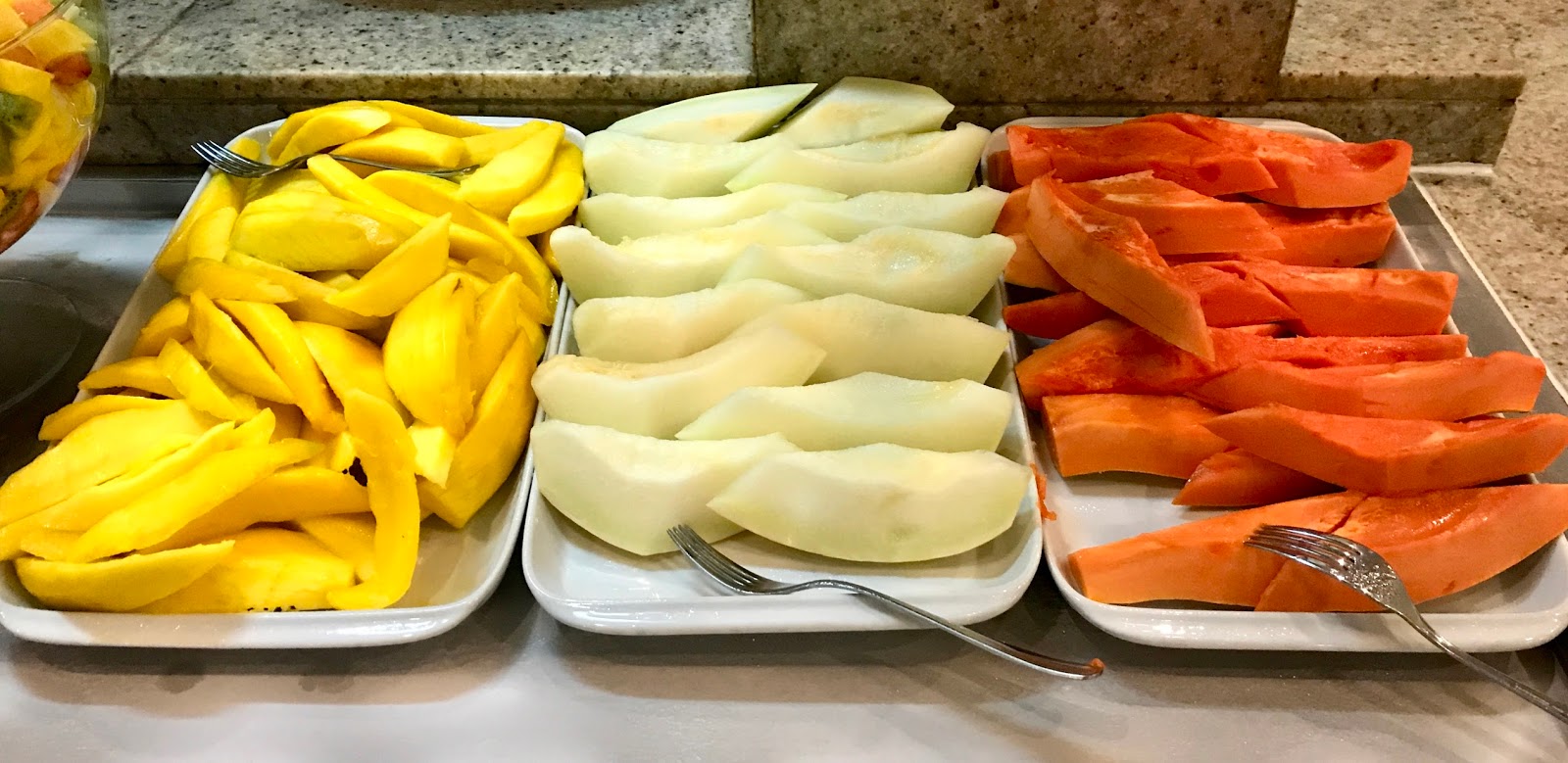
The hotel provides an excellent breakfast buffet.  My favorite part is the tropical fruits.  Every morning that's what most of my breakfast was.

Mangos, melons and papayas

Pastries for breakfast

More fruits:  grapes, guava, oranges and fruit cocktails
I will write about our visit to a favela in the next post.

Wednesday, February 14, 2018

Carnival in Rio

The biggest attraction for me coming to Rio is Carnaval.  The Rio Carnival has a reputation for its party atmosphere and fanciful parades.  I've seen short videos of the parade but friends who have been here said there's nothing like it anywhere else in the world.  I am combining this part of the tour with the South America Highlights tour, which leaves immediately after this is over.

The celebration starts the day after I arrived in Rio, on Friday, February 9th.  It goes on until Tuesday, February 12, with various block parties, called blocos, all around the city and the main event, the parade of the Samba Schools in the Sambadrome.  Tourists from all over the world come here to celebrate and participate in the biggest party event.

On the day after I arrived, Friday, I heard there'd be a bloco in the Carmelitas area.  My tour leader gave me directions on how to get there and I started out in the late morning.  After 15 minutes from the hotel, I came to a concrete arch structure.  This used to be an aqueduct but today there is a tram riding on top of the arches.  The parade is up the hill by the Santa Teresa church.  I followed some party-goers, dressed in costumes, up the steep streets towards the church.  I was early.  Luckily, I brought my Kindle and was able to past the time away.  Slowly, the crowd start to show up.  Before long I was surrounded by participants, fans, and vendors.  Apparently, anyone can sell drinks, including alcoholic drinks here.  A lot of them just push a cooler filled with water, soft drinks and beer.  By about 2 pm, I was surrounded completely.  At 3 pm, the siren went off, signaling the start of the parade.  To get a better view I ran up a balcony and squeeze myself between a crowd that was already lined up.  What a sight!  People were dressed in all kinds of costumes.  Music was blaring loudly from the truck.  Dancing.  Singing.  Posing.  Everyone was enjoying the moment.
The Arches at Lapa
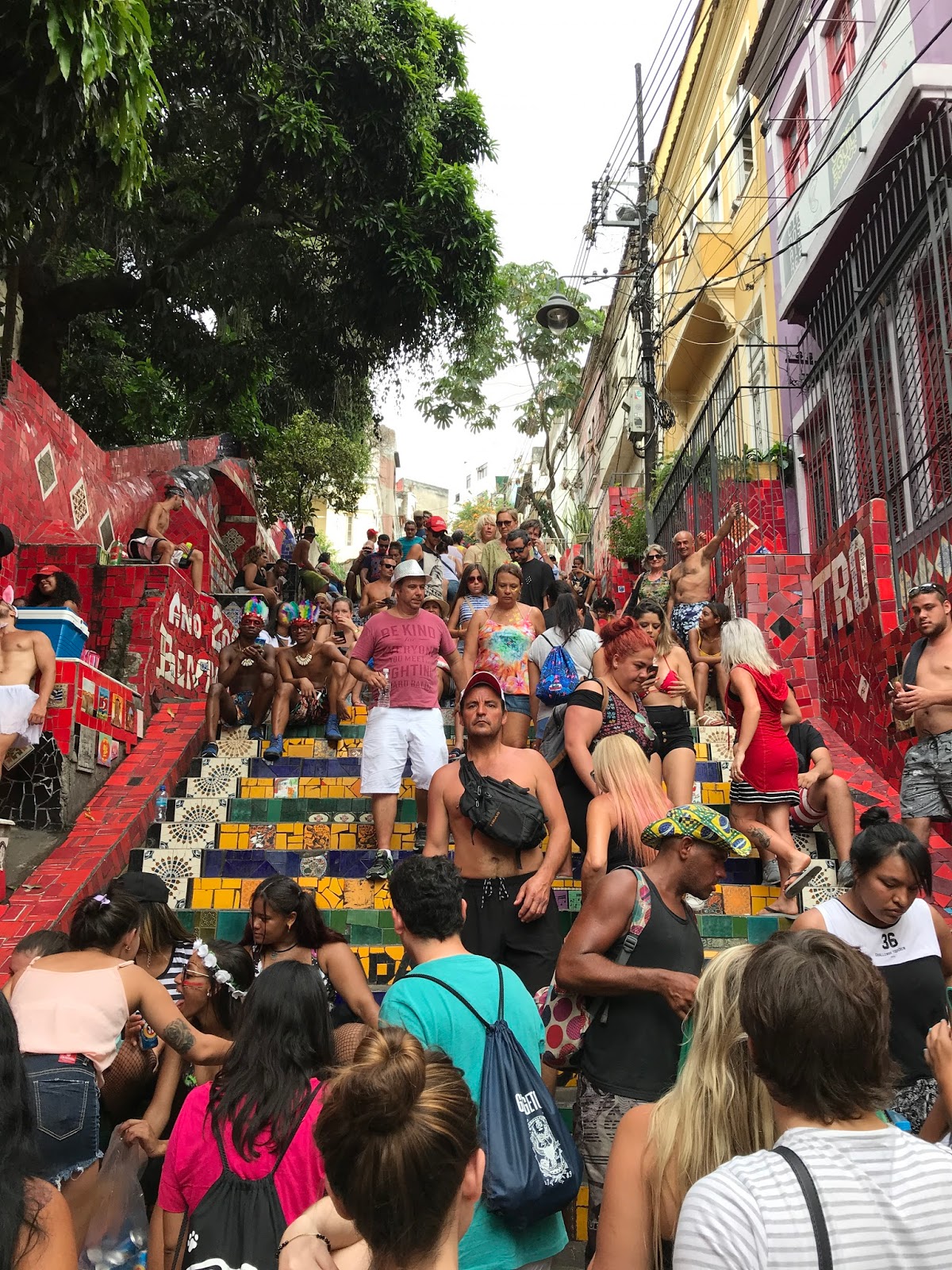
Escaladria Selaron, colorful steps leading up to Santa Teresa

Amazing Crowd
Some "tall" participants


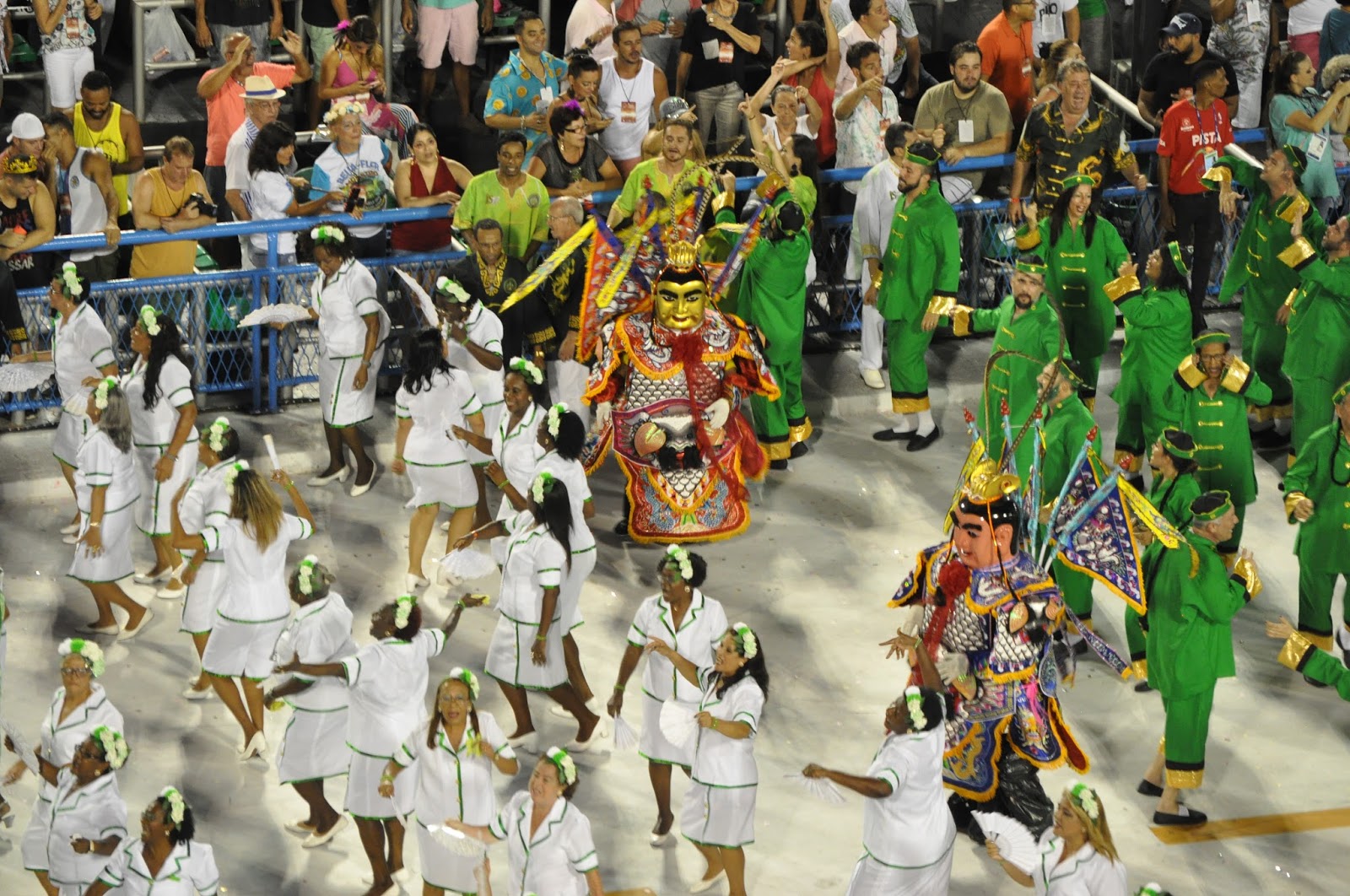
The next day, on Saturday, February 10th, after a city tour, is the day we were to attend the Carnival parade at the Sambadrome.  This is the highlight of the trip.  It's the Preliminary Schools Parade.  Although it's not as glamorous as the Main Schools Parades on Sunday and Monday evenings, it is still an amazing sight to see.  Each school takes about an hour to go through the length of the Sambadrome, which was built specifically for this purpose.  There are many sections to a schools' contingent.  The amount of effort each school put in to its choreography, costumes, floats, etc, is beyond comprehension.  The details are simply amazing.


Besides the parades, there are block parties (called blocos) everywhere in the city.  These are official block parties, where there are food vendors, portable toilets, band, security, cleaning crew, etc.  They are spread out all over the city and there are at least 5 or 6 listed in the official schedule everyday.  Some are at the beach, some are on a street, and some at a park.  I came across many as I walk around the city.  Some start as early as 8am and some start late in the afternoon.  Here are some pictures of the blocos:


Carnival in Rio is perhaps the biggest mass celebration I've seen anywhere.  It is part of Brazilian culture and everyone here embraces it.  You see residents dressed in costumes at all times of the day.  One thing that stands out is there is very little fightings, in spite of all the alcohol that is consumed.  I saw 1 or 2 but they were quickly snuffed out.  It's time of celebration before 40 days of Lent.