I had little or no expectations coming to Moscow. Many friends have been to St. Petersburg as part of a Baltic cruise and said how beautiful St. Petersburg is. Other than seeing pictures of Red Square and the St. Basil's Cathedral, I know very little of the other tourist places.
My hotel is 5 metro stops from the Red Square. Moscow has an extensive and well-built subway station. It was built in the 1930s' to serve the people because back then, no one can own cars except the government officials. So everyone has to use the metro to get around. The metro stations are huge! They look like a regular train station. Some of them have statues commemorating past heroes or famous Russians. The trains are old but they run efficiently. They come every 2-3 minutes. Once I got it figured out, it was a breeze getting to the Red Square, where everything in Moscow centers around, especially the well-known churches, museums, buildings, etc.
 |
| Inside a cavernous metro station |
 |
| Revolutionary Heroes in the station |
Muscovites told me that prior to 1991, before the fall of communism, you can get enough food but they were all from Russia or the other Soviet countries. There were not many choices. But, once Russia opened up to the world (just like China), all kinds of foreign goods appeared in the stores. Who said the Russians are starving? If you think they are, you are probably still listening to 60s' propaganda. A visit to one of the grocery stores find it just as well stocked as any American grocery store. Restaurants are everywhere too. People are well-fed and well-dressed.
 |
| Deli Section |
 |
| Smoke Fish |
 |
| Lots of vegetables from all over |
I was told that even in the 80s', if a truck selling bananas show up on the street, a line of at least 1 km long will form quickly. Even toilet papers were hard to come by then. Thanks to
Perestroika, Mikhail Gorbachev and Boris Yeltsin, things changed quickly in the late 80s' and early 90s'.
In spite of the rain I had four wonder days of wandering around Moscow, enjoying the cathedrals, museums, park, etc. Below are some of the pictures and narratives behind them.
 |
| The Iconic St. Basil's Cathedral |
St. Basil's Cathedral is the most iconic building in Red Square. Its formal name is The Cathedral of the Intercession. It was built between 1555 and 1561 by orders of the Tsar Ivan the Terrible in memory of his victory over the Kingdom of Kazan. It is believed that it was designed by a couple of Russian architects called Barca and Postnik. Legend has it that the architects were blinded by the Tsar so that they cannot build another cathedral like this.
Each dome represents a church. There are 12 domes altogether and collectively they make up the cathedral. Today the inside is a museum but it is also a living church. On the Sunday that I was there I saw a Russian Orthodox service going on in the church. The museum contains Russian Orthodox Christian relics from the 16th and 17th centuries. You see many icons, plaques and paintings adorning each church. Walking through each church is like walking through the 16th and 17th centuries. The fact that they survived wars and time is in itself a miracle. While I did not understand or read through everything, seeing all these ancient relics really touched me. It is a testimony of the faith of the early Russians. I understand from our guide that there has been a resurgence of church attendance in the last few years. Russian is building more churches and monasteries. Considering that the church was banned during the communist era, this is truly amazing.
Admission into the museum is 500 rubles or about US$8.50, a bargain compared to other museums. There is an audio guide available. I wish I knew that before I bought my admission ticket.
 |
| Kremlin, after a rain |
Politically, the Kremlin is the center of the Russian universe. It is where all the major political decisions are made and it's where President Vladimir Putin's office is. The word Kremlin in Russian means fortress. Other cities in Russia also have their own kremlins, but this is The Kremlin of Russia. You need to buy a 550-ruble ticket to get into the grounds of the Kremlin. It is more than just the government buildings, which, obviously are off-limits to the tourists. Within the grounds are five beautiful and ornate cathedrals, built between the 15th and 17th centuries. Below is a picture of one of them: The Annunciation Cathedral. They all have golden domes on them.
I was told by our tour leader that the golden domes are made of metal. The reason why they are made of metal is so that they are strong enough to support the big cross on top of the dome. Notice that each cross is also supported by wires or cables so that it can withstand strong winds and whatever natural elements that want to knock it down. The big crosses are symbols asking the faithful to come to church. Greek Orthodox churches also have domes but they are not made of metal. Instead they are usually made from masonry with tiles on the exterior. The crosses on those domes are much smaller than the Russian ones.
 |
| The Annunciation Cathedral, 1 of 5 within the Kremlin |
 |
| St. Vladimir, the patron saint of the Russian Orthodox Church, overlooking the Kremlin |
The statue in the picture above was erected in 2016 with much controversy. St. Vladimir, the patron saint of the Russian Orthodox Church, was erected by his namesake, Vladimir, the President of Russia. It is about 60 feet tall and located only about 100 yards from the Kremlin walls at a busy intersection in Moscow. Some say the statue is a thinly-disguised monument to himself. For more about this statue, read this
article in the New York Times.
 |
| Cathedral of Christ the Saviour, one of the biggest and grandest churches |
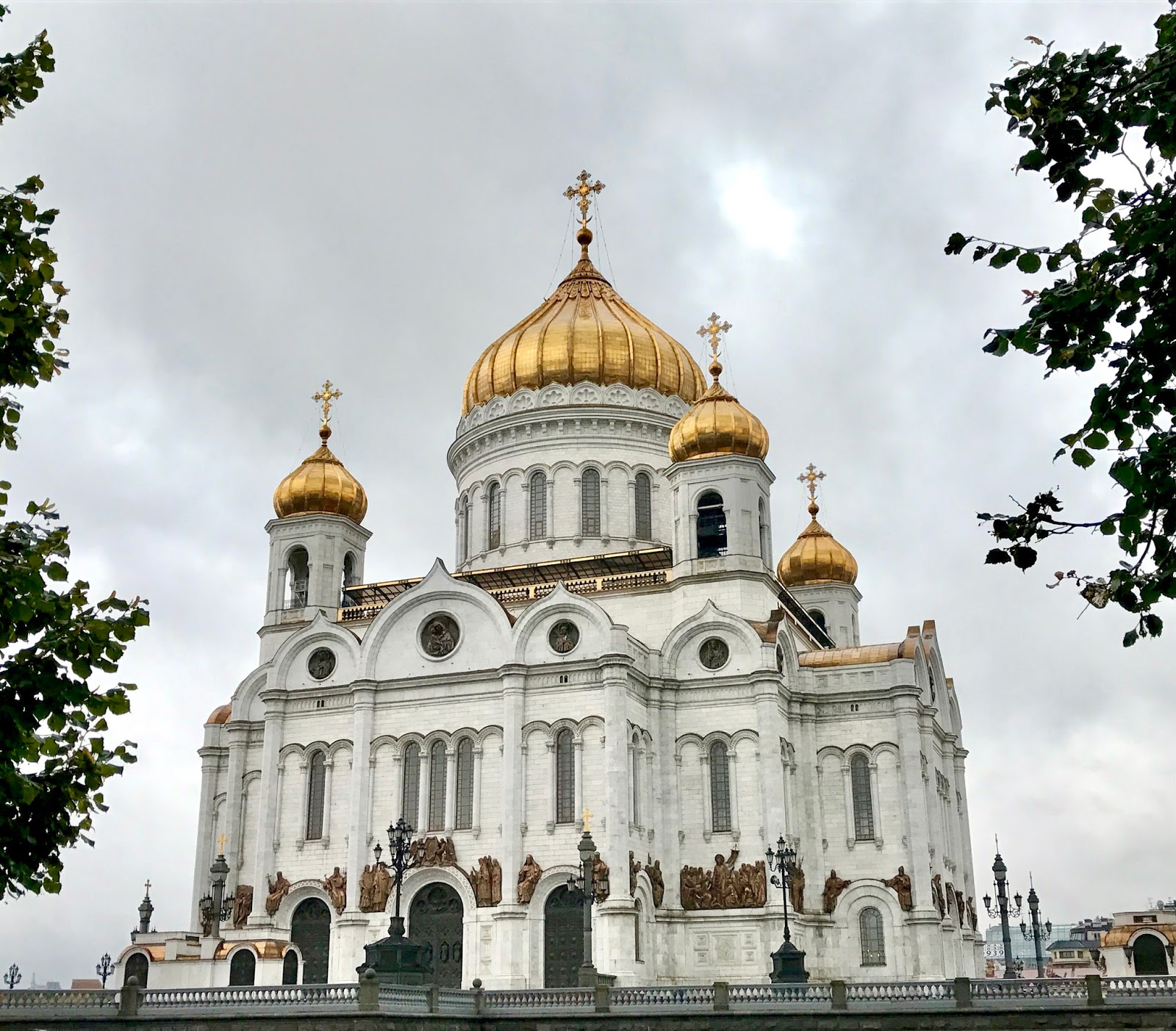
One of the biggest and grandest churches in the world is
Cathedral of Christ the Saviour. It is on par with other grand churches like St. Peter's Basilica in Rome and St. Paul's Cathedral in London. The current church is the second to be built at this location, replacing one that was built in the 19th century and ordered destroyed by Joseph Stain in 1931.
 |
| A Panoramic View of Red Square after a rain |
It is difficult to capture the size of the Red Square in one view. It is just very BIG! So standing on one end of the square, in front of the State Historical Museum, I took the above panoramic view. Looking straight ahead in the distance is St. Basil's Cathedral. You can see the a very small silhouette of the "onion domes." To the left is the big and lavish GUM Shopping Center. If there is need for evidence that communism is dead, this is it. Inside this shopping center are the major high-end retailers of the world: Tiffany, BOSS, etc, plus other Russian high-end retailers. You can even find a Beluga Caviar cafe here. I've never seen that anywhere in the world. To the right is the Kremlin wall. On the other side of the wall are the cathedrals that I mentioned above.
 |
| One end of Red Square. Security is tight on Putin's Birthday |
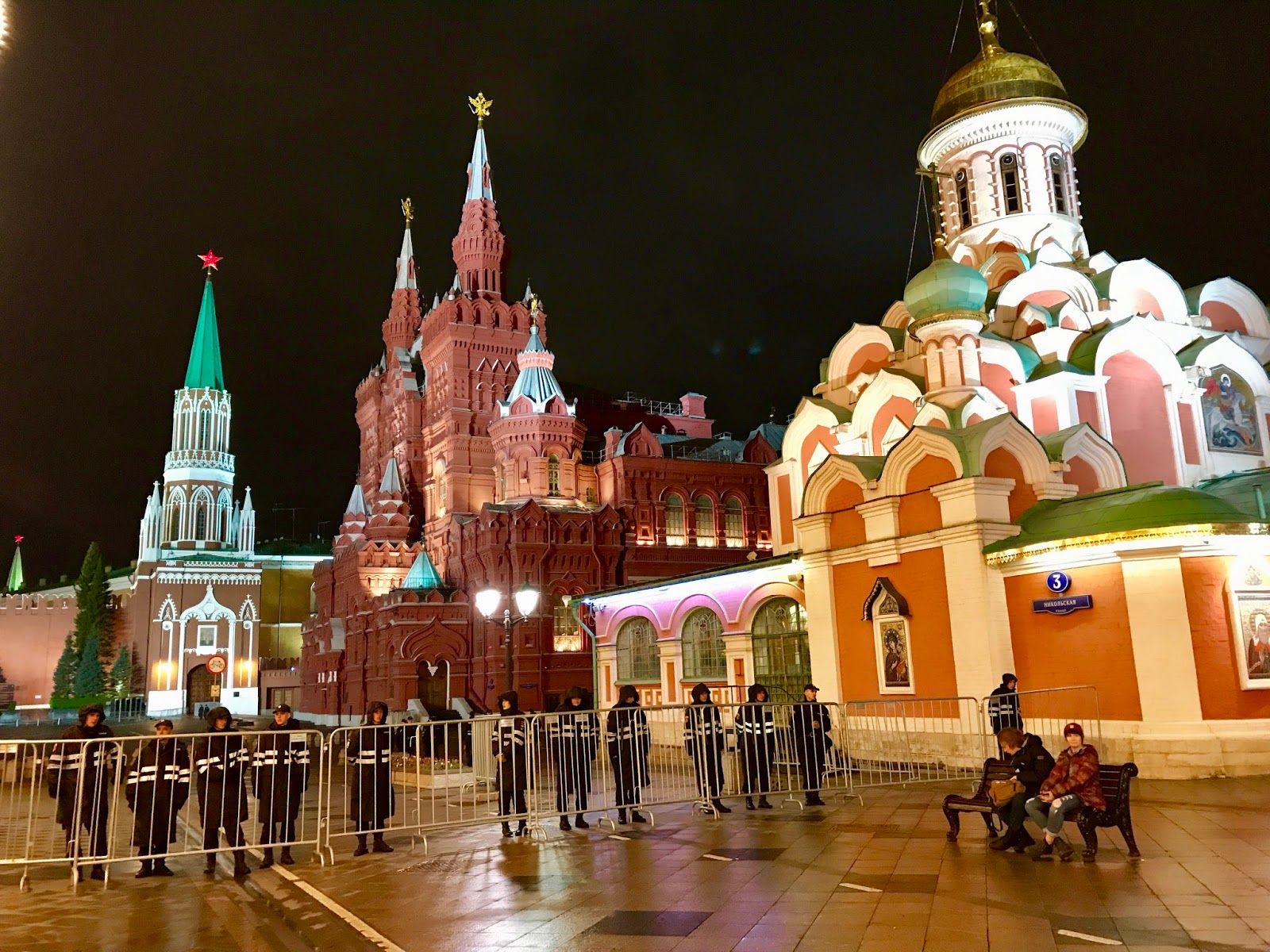
The red building in the middle is the State Historical Museum, in front of which is where I took the panoramic picture above. But this nighttime picture reminds one that Russia is still a police state. On that Saturday evening, they closed off Red Square and some of the neighboring major intersections. Not knowing what was happening, I asked someone, who asked one of the policemen guarding the barricade above. The policeman said that someone wants to harm Vladimir Putin. Later I learned that there were some anti-Putin demonstrations nearby. The hundreds of policemen and security personnel around Red Square is a show of force as to who is in charge here. You have to be extremely cautious not to mess around with these guys.
 |
| A cute bicycle on the street |
 |
| The Four Seasons Hotel near Red Square. |
If the above building looks familiar, it's because it is on the label of the
Stolichnaya vodka. This hotel was once called Hotel Moscow. Stalin was said to have tried to get Russians to come and stay at this hotel so he put a picture of the hotel on the Stolichnaya vodka label. Today it houses the Four Seasons Hotel, one of about 10 five-star hotels in Moscow.
To say that well-known American brands have infiltrated the Russian market is an understatement. McDonald's, Starbucks, Burger King, Dunkin Donuts, and the very popular KFC (which used to stand for Kentucky Fried Chicken) are everywhere. I was at a food court near the Red Square and the KFC store was the biggest and have the longest lines. While Americans are shunning junk food, Russians are welcoming them with open arms. Below is what a McDonald's menu in Russian looks like.
 |
| McDonald's Menu in Russian |
 |
| Inside GUM Shopping Center, celebrating Fall |
 |
| Cannons captured from Napoleon, when he retreated after a failed invasion in |
In 1812
Napoleon decided to invade Russia. It was a disaster and Napoleon had to flee, leaving many armaments, including cannons, behind. In the Red Square is a display of some of these cannons. Each individual cannon has an unique French name on the barrel. Below is a picture of one of the emblems on the wheel of the cannon.
 |
| Emblem on a cannon |
Above I mentioned that you don't mess around with the Russian police. After being in Russia for 4 days and doused with rain every day, I was delighted to see a beautiful sunny Sunday morning on my last day in Moscow. I planned an early morning trip to the Red Square so that I can take some photographs without tourists around. Unfortunately, I was met with the same barricades from the night before. I waited at one of the barricades and here I met the most jovial and gregarious policeman I've seen in Moscow. A couple of British tourists and I were at the front of the line and he was friendly and joking with us. When his shift was over as he was walking away from his post, he met a bunch of his fellow policemen. Everyone gave him a hug and slap on the back. Humanity does exist in some of these stone-face policemen sometimes.
 |
| A non-typical friendly Russian policeman |
Old
Arbat Street is a popular pedestrian mall in the city center of Moscow. I took a walk through the street one rainy morning. Most of the shops were closed and there were very few tourists there. In the summer, in the evenings, there'd be throngs of tourists, with street musicians and all kinds of vendors. As I was walking along I noticed a graffiti wall on one of the side streets. When I took a picture of the graffiti wall below, I did not realize the significance of it. Later I found out that it was dedicated to Korean-Russian musician Viktor Tsoi. This is called the
Tsoi Wall. More about this wall can be found
here.
 |
| Tsoi Wall Graffiti on Old Arbat Street |
I have been in Moscow for 4 1/2 days and it rained everyday except one. I could have visited more museums and other popular places but the rain slowed me down. I don't know whether I'll have another chance to come back but I've seen as much as I could and want. It changed my mind about Russians and Russia. At the end of the day, they are just like us. The difference is that they have a political system that controls their lives tightly. Hopefully, someday it will change.