Thursday, May 25, 2017

Seoul-ful of Memories

The last part of my trip is 2 weeks in Korea.  I did not spend a lot of time planning this trip.  I stopped at the Korean Tourism Center in Singapore and picked up some brochures.  The folks there were not entirely helpful.  I am not concerned.  One of my nieces lives there and I also have a friend whom I met on one of my travels.  I figured by the time I get there I will have some ideas on what to do.

Fortunately, my niece was there when I arrived in Seoul.  She arranged for me to stay at the guesthouse where she is staying.  It's in the Itaewon district, a popular area for foreigners.  It's because it's close to an US army base.  But there are foreigners from all over the world.  And all kinds of international restaurants - American, Turkish, Japanese, Indian, French, etc.  It's also a lively area in the evening, attracting even the young locals to the pubs.

A night scene at Itaewon district

International restaurants in Itaewon
Korea has a 5,000-year history.  I will write more about my tour around Korea in my next post.  In this post, I am focussing just on Seoul, a big sprawling metropolitan area of about 25 million people.  I was in Seoul for a total of 10 days.  Even then it's impossible to see all of the city.  I will just highlight the places I went to.

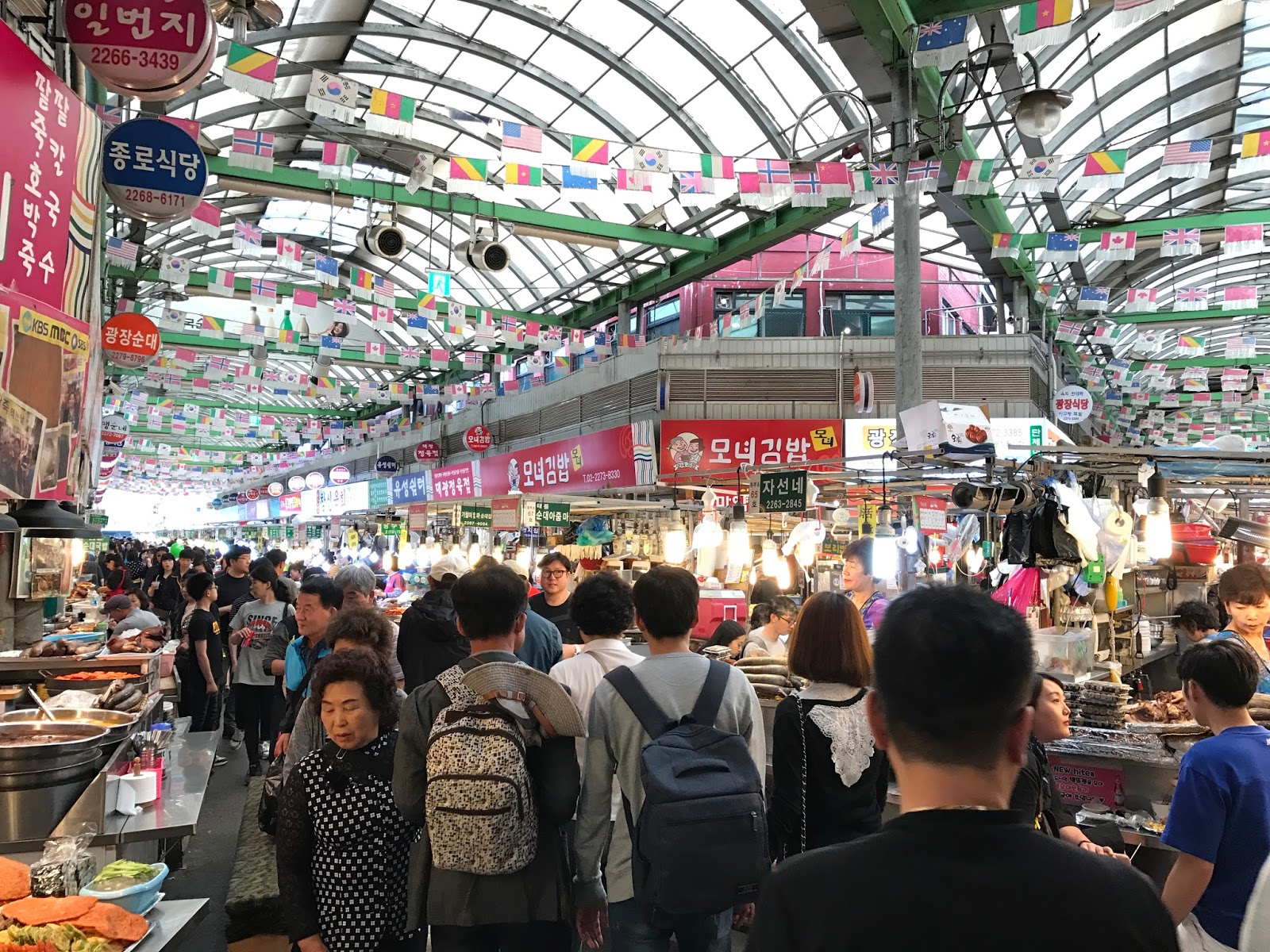
As I've said many times in this blog, I love visiting markets.  They give a good perspective of the history and culture of the local populace.  The first one I went to is the Kwanjang Market, a big market that sells fresh fish, preserved foodstuffs, food stands, restaurants, etc.  There is some, but not a lot, of similarity between Korean and Japanese and Chinese food.  The similarity is how they preserved food which goes way back before the invention of refrigeration.  A lot of salt, chili pepper powder and other spices are used.  Kimchee, the ubiquitous preserved cabbage in Korean meals, is a prime example of the use of these preservatives.  Walking through Kwanjang Market is a walk through the culinary alley of Korea.  For someone familiar only with western foods, it is a revelation of what is and can be consumed in the East.

Big and busy Kwanjang Market

Pancakes made from crushed mung-beans

Preserved crabs

All types of preserved foodstuffs

All types of chili powder, used as a preservative or cooking

All types of preserved vegetables
Another market I enjoyed is the Namdaemun market.  This is not a food market.  It is a market for clothes, jewelry, souvenirs, cosmetics, etc.  This market has been around since the 16th century.  It is next to the Namdaemun gate, built during the days when it was a wall city.  Walking through the market is like looking through the window of the lives of the Korean people - what they buy and use everyday.

Namdaemun Market

One of the few indoor shopping centers at Namdaemun Market
I also love streets that are full of shops and people.  A couple of places in Seoul that are popular walking streets are Insadong and Myeon-dong.  Both are popular with tourists and locals alike.  Insadong is full of small shops and cafes.  Myeong-dong has a lot of street food vendors and more upscale stores.  I was told that it used to be crowded with tourists from China until a recent political rift between the two countries.

Dumpling and noodle dinner in Myeong-dong

Busy street at Insadong

A lot of street food and upscale shops at Myeong-dong
Being an old country means it has a lot of historical buildings.  There are five grand palaces built during Joseon period.  The main palace is the Gyeongbokgung Palace.  Koreans girls love to dress in their traditional hanbok dresses and walk around the palace grounds.

Gyeongbokgung Palace

Beautiful Korean girls in traditional hanboks
Another popular tourist spot is the Cheonggyecheon area, a recreation area constructed around an old stream.  It's very popular for people to stroll along the banks of the river, which also has benches for people to sit and a lot of greenery.


Cheonggyecheon - a popular recreation area around an old stream
Lighted displays on the river

South Koreans were heavily impacted by the Korean War.  North Korea invaded South Korea in 1950 and many Korean families were split up.  After the war South Koreans went through a long period of hardship until the 1980s' when it started its economic climb after hosting the Seoul Olympics.  To commemorate the war and honor the countries that came to fight for them, the South Korean built the
War Memorial of Korea.  It's a beautiful, sprawling memorial to those who fought in the war.  Today the threat is just as imminent from the North.

Statues at the War Memorial of Korea
I learned a lot about Korean History at the National Museum of Korea.  It's one of the most beautiful and well-planned museums.  It took me two visits to see most of the museum.  Best of all, it's free.  They also have free guided tours in English.

National Museum of Korea

A couple of artifacts at the museum

Wednesday, May 17, 2017

Boogie Boogie Bangkok

I titled this post Boogie Boogie Bangkok because Bangkok is indeed a fun place.  Amidst all the chaos that comes with a crowded city and traffic jams, there are a lot of things to do here.  In contrast to a rigid city like Singapore, Bangkok is a carefree place.  There are few rules.  The most important thing to remember is to respect their religion.  Whether you are going to the temple or a shrine or talking to a Thai, you must be respectful of Buddhism.  I know some people feel afraid because the Thais are dark-skinned and poor, and they want to rob you.  Relax.  Because of their religion they are the most peaceful people.  Again, there are no guns here.  I have not heard from anyone who has been here many times to have been robbed.  So enjoy your time here.

This trip was initiated by a couple of friends.  My high-school friend, Eric has a serious medical issue that requires surgery with a specialized piece of equipment.  Bangkok has a hospital that has that equipment and he wants to explore treatment here.  With the help of an American friend who has lived in Bangkok for 30+ years, we were able to get an appointment with the doctor who oversees the equipment.  My other friend, Jimmy and his daughter wanted a weekend getaway so they separately asked me if I was interested in going to Bangkok.  Everything came together nicely.  I flew from Phuket to Bangkok, met Eric, Jimmy and his daughter Sharon and Walter, my friend from New Jersey.  It was one of the best weekend I ever had.

First, Eric's appointment with the specialist went very well.  Walter picked him up at the hotel, accompanied him to the hospital and sat in on the conversation.  The cost?  An incredible 300 Thai Bahts or about US$8.70.

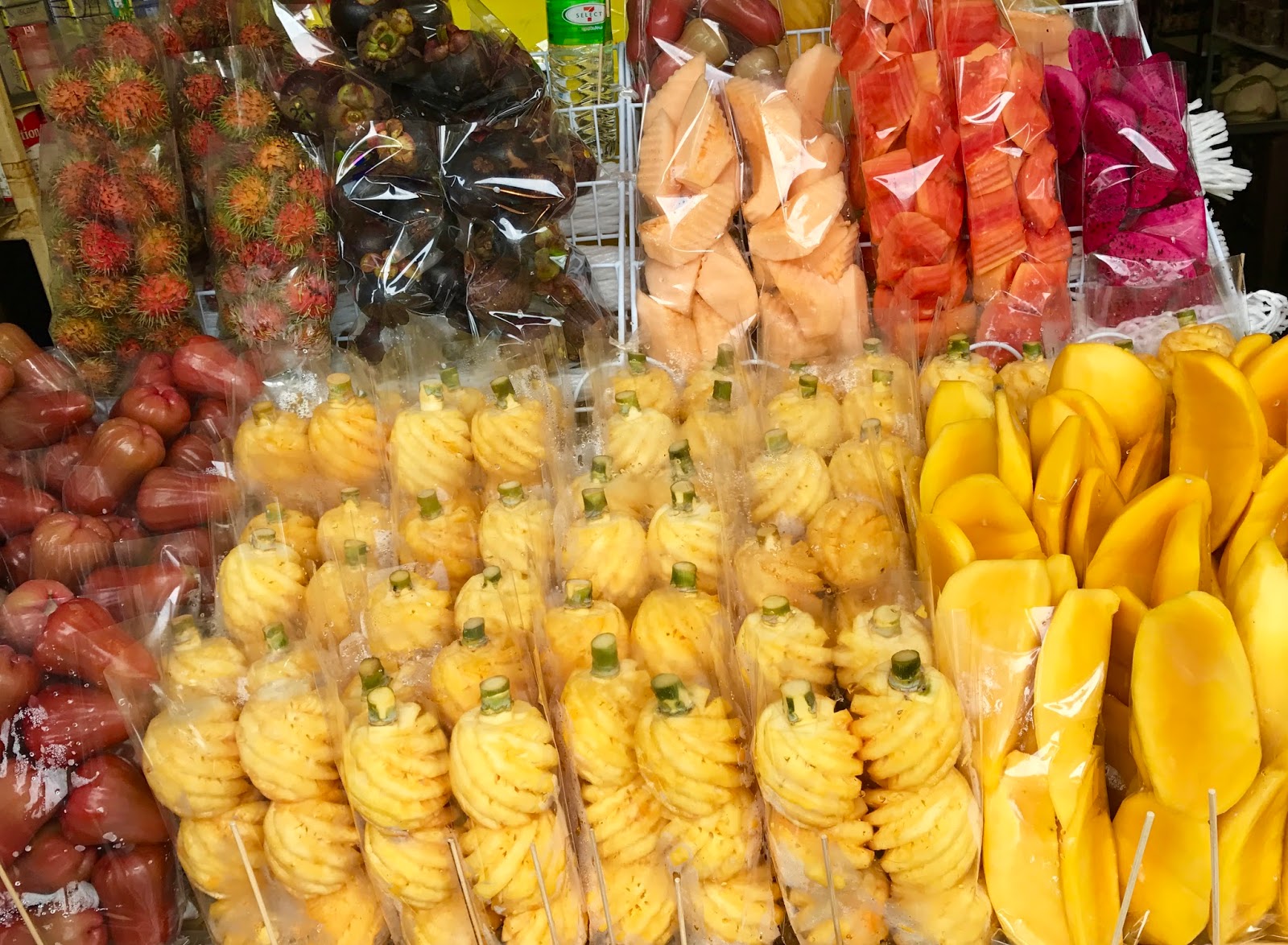
We stayed at the Novotel Hotel at Siam Square.  Eric and Sharon have stayed here and they like the location.  It's in the middle of all the shopping and activities in Bangkok.  It is closed to the Mahboonkrong (MBK) and Siam Paragon and other shopping malls nearby.  The whole area is a hive of activity.  It was a long holiday weekend (International Labor Day, May 1) and everyone and their friends were out.  Besides restaurants, there are also many, many restaurants with very good food.  I have not heard many people say they don't like Thai food.  It gives you a full spectrum of taste: from very spicy curry to very flavorful desserts made from coconut milk.  There is also an abundance of tasty tropical fruits:  pineapple, watermelon, papaya, guava, durian, coconut, mango, etc.  The hot and humid weather in Thailand is just perfect for tropical fruits.  They are picked ripe and therefore, very sweet and flavorful.  Not only that, they are very cheap.

L-R, Top: rambutan, mangosteen, cantaloupe, papaya, dragon fruit. Bottom: jambu, pineapple, mango

Chinatown
 We visited Chinatown in the evening.  If there's anything that defines Bangkok, it's street food.  The main street of Chinatown is lined on both sides with all kinds of street vendors selling local noodle soup to pomegranate juice to seafood.  Some of the restaurants also sell shark fin and bird's nest soup. Click here to read more about Bird's Nest.  It's a delicacy among Chinese and supposed to provide high nutritional value.  For whatever reason, bird's nest soup are cheaper here in Bangkok than in other places like Hong Kong.  Most of the Chinese in Chinatown come from the Shantou and surrounding areas.  My parents came from that area and I can converse easily with the Thai Chinese who still speak that dialect.  We had an excellent seafood dinner at one of the restaurants.  We ate inside but some of their tables spilled out into the streets.  It's part of the scene in Bangkok.  Tables on sidewalks and the street, next to waiting taxis.

Delicious Thai food:  Morning Glory (vegetables), Tom Yum soup, Pad Thai at Bah Khun Mae Restaurant
 In the morning we took a taxi to the Wat Rakang Kositaram.  Wat means temple in Thai.  My friends are Buddhists, although not devout.  There are many temples in Bangkok, just like there are many small churches in Europe.  This one is small and is mostly for the locals.  They made some offerings and prayed.   I waited outside in the temple grounds and took a few pictures.  After the visit, we behind the temple and took a ferry across  the Chao Praya river to the other side and took a taxi to the Erawan shrine.

Wat (Temple) Rakang Kositaram

Chao Praya River
The Erawan Shrine is located at a corner in a busy intersection in the Central Business District (CBD) area.  If the name sounds familiar, it's because in August 2015 someone left a backpack with explosives;  it killed 20 and injured 125 people.  No arrests have been made so far.  Many worshippers from all over the world come here to worship.
Thai dancers at the Erawan Shrine

Tapioca Dessert
Later we had lunch at an excellent Thai restaurant near the hotel.  Eric has patronized the Bah Khun Mae restaurant many times and highly recommended it.  We were not disappointed.  The Tom Yam soup and Pad Thai, two popular and favorite Thai dishes, were just excellent.

Walter volunteered to take us to Ayuthaya that afternoon.  I was there on my last trip to Bangkok but I don't mind going again.  It's a long day for him.  First, he lives outside of Bangkok and had to drive to the middle of town to pick us up.  Then it's about an hour and a half-drive to Ayuthaya.  Ayuthaya was the old capital of Thailand before Bangkok.  We walked among the ruins.  We saw the elephants taking riders on a ride but we did not go for a ride.  I did that on my December 2015 Trip.

Temple ruins at Ayuthaya

Dinner at riverside restaurant

In the evening Walter took us to a surprisingly good restaurant by the river.  It was a surprise because the front of the restaurant did not look anything like a restaurant but when we entered the alleyway, it opened up to a patio overlooking the river.  The food was excellent and as always in Thailand, very cheap.

Dinner at Ayuthaya
On our last day we visited the popular Chatuchak outdoor market.  Many years ago this used to be a makeshift market with tarpaulins, poles, canvas, etc.  The government must have recognized it as a fire hazard and decided to build a permanent market that is opened only on the weekends.  There are thousands and thousands of stores that selling anything from food, to pets, to furnishings, clothes, etc.   It is fun just to see the variety of things that they sell.

Slabs of Chinese BBQ pork

Coconut ice cream with sago palm fruit.
Shopping is fun in the shopping centers around the hotel.  Being a long holiday weekend, there were people everywhere.  For me, it's all window shopping.  I have enough junk.

Thursday, May 11, 2017

Scuba-Diving in Phuket

Phuket is only a 2 1/2 hour flight from Singapore.  But I've never been there until now.  I thought I'd spend 3 days in Phuket, without any plans on what to do.  Just go there and figure it out.  But then I thought I've always wanted to try scuba-diving.  Phuket is well-known for that and has very clear waters off the coast.  Also, there are many dive-shops in Phuket.

First, I have to take a Discover Scuba course, a 3-hour course, where you are shown a video and given the basics of scuba-diving.  Then you put on scuba gear in a swimming pool and do some basic maneuvers like learning how to breathe through the tube, sinking to the bottom with and floating up with a buoyant vest.  It was not hard.  Just a test whether you freak out when you are in the water with all this equipment and can handle yourself underwater.

After contacting three dive shops and exchanging emails with them, I decided to sign up with All4Diving.  Alain responded promptly to my questions and emails.  I read through their website and reviews on TripAdvisors.  They are not the most popular but they seem to have a very good track record.  They have been doing this in Phuket for 20 years.  They offer many types of diving courses plus recreational diving.  I signed up for a 3-day course and found a decently-priced hotel nearby.  Before flying to Phuket, I have to read five manuals and then take a Knowledge Quiz.  The manuals, although time-consuming, was very informational in giving a lot of theories and information about scuba-diving.  It was worth the time.

I flew from Singapore to Phuket on an early Monday morning flight.  The shuttle van from the airport to the hotel took almost an hour and a half but it costs only 180 Thai Bahts.  At this time, the conversion is about US$1 = 34.63 Bahts.  A regular tax would costs 800 Bahts.  After checking-in to the Hemingway Silk Hotel in Patong Beach, I took a walk to find the All4Diving office.  It is on Bangla Road, but further down the road from a stretch of popular bars and nightclubs for tourists. I met Alain and he told me that I can have a head-start by watching the videos that afternoon.  I spent about 3 hours watching 5 chapters of the videos.  It was similar in content to the manuals but it gave a more visual explanation of some of the subjects.

Hemingway Silk Hotel in Patong Beach

A very popular Patong Beach

All4Diving Office
Following a short nap in the afternoon, I took a stroll around the area near the hotel.  It is a bustling place.  About 100m from the hotel is the Baan Soon Night Market.  This is the kind of place I love to eat - street food.  Good and cheap.  Not everyone can handle street food.  Growing up eating this type of food and years of traveling and indulging mostly in street food whenever I can, my stomach has gotten used to it.  One thing to note about street food in Asia is that it's almost all fully-cooked.  So, whatever bacteria there is is killed.  Besides this street food market, the area is swarmed with tourist shops, selling anything imaginable.  Across the street is the big Jungceylon Shopping Center, where there are many stores and more restaurants.  If I walk farther down on Bangla Street, the nightclubs and bars will be in full swing in the evening.

All types of BBQ available

Grilled Seafood

All types of fruits for juice

Pad Thai for 50 Bahts or $1.50

Thailand has all kinds of tropical fruits

One of the nightclubs on Bangla Street

Banana Pancake for 50 Bahts
Mango Sticky Rice, one of my favorites

Next day it's time to get serious about scuba diving.  The van that was supposed to picked me up at 7:30am picked me up at 8:00am.  We headed to the pier, about 30 minutes south of Patong Beach.  The boat holds about 40-50 people, including crew plus a lot of scuba diving equipment.  Almost each student diver has his or her own instructor.  Most of the instructors are French and all the crew members are Thai.  The crew includes about 5 or 6 locals who provide assistance with diving, checking equipment, filling tanks, etc.  Two ladies on board provide the meals.  The meals on board are great.  They provide Thai breakfasts and lunch and a lot of tropical fruits - papaya, pineapple, water-melons, guava, etc.  They also provide cakes and other refreshments.  It's a very well-organized boat and everyone knows what their job is.

MV Mermaid, our dive boat

Suited up and ready for the dive

My Scuba-diving gear

My Dive Instructor, Stephane
Over two days, in four dives, I was to perform a series of drills to test that I can dive on my own in open water.  I have performed the same drills in the swimming pool on the first day.  The first day we went to Phi Phi Island, a very popular and well-known island for scuba-diving.  The water was very clear.  Fishes were swimming all around me.  There were beautiful corals at the bottom.  This is what diving is all about.  Seeing an underwater world that most people don't see.  I've snorkeled many times but scuba-diving is very different.  It opens up a new world.

I did two dives with drills on the first day, with a third dive that is just for fun.  I did not have any trouble with the drills.  The challenge I have is learning how to equalize the pressure in my ears.  Before you know it you are about 5 meters deep and your ears are hurting like crazy.  To equalize, you have to squeeze your nose and blow throw them, which will force your ear drums to open and equalize the pressure between your ears and the water.   Another difficulty is learning how to control your buoyancy.  By breathing in or out, you control whether you are going up or down.


Diving with my instructor Stephane

Fish swim around you thinking you are just another fish.  Notice the beautiful corals

Amazing view under water
On the second day, I did two dives with drills.  Drills like taking off your mask and letting the water out and putting it back on, staying buoyant above the bottom, or what happen if you run out of air and need to use your partner's secondary air?  They are meant to teach you how to be diving without an instructor.  However, in all scuba-diving, you have to dive with a partner.  I skipped the 3rd dive on the second day because I was to fly the next day.  Safety rules said that you are to fly at least 18 hours after your last dive because of nitrogen that might still be in your body.  Nitrogen in your body causes decompression sickness, also known as "bends."

After 3 days I completed my certification for Open Water Diving, the first step towards many other courses in scuba-diving.