Saturday, September 24, 2016

Kraków

Before I decided to come to Krakow, the only thing I knew about the city is that it's where Auschwitz is located.  Yes, Auschwitz gave the city its notoriety but that's not the only thing that this place is well-known for.  The city and Poland both have a long history, going back to the 9th and 10th centuries.  Pope John Paul II studied and served as the bishop and archbishop here before being elected as Pope in 1978.  The city calls him its native son because he spent most of his life here before becoming pope.

After talking to others and reading more about Krakow, I decided that I need more than 1 or 2 days here.  I booked an Airbnb apartment just outside Old Town Krakow for 4 nights.  At about US$45 a night it's much cheaper than staying at one of the hotels.  The apartment is spacious and has a kitchen.  My host arranged for someone to pick me up at the airport for 90 PLN (about US$23) since I was arriving late in the evening.  Jakub, the host, met me at the apartment and showed me where everything is.  I also asked him to book a tour to Auschwitz the following day.  It costs 155 PLN, or about US$40.  It's about 1 1/2 hours from Krakow.  I will talk more about Auschwitz in my next post.

On my second day in Krakow, I signed up for two walking tours.  One in the morning, touring the old Jewish Quarter and the second in the afternoon of the city itself, mostly Old Town.  In most European cities, there are "free" walking tours.  But, they are not really free.  After the tour, you are expected to tip the guide.  The amount you tip depends on what you think the tour was worth.  These tour groups tend to be much larger and sometimes, it's hard to follow the guide.  I paid 60 PLN for each tour; booked through the city's Tourist Information Center.  The Jewish Quarter tour started at 10 am.

Most of the Jews in Krakow used to live in the Kazimierz area.  It was named after an old Polish king in the 14th century.  They coexisted with Christians throughout history until Hitler put all the Jews into a ghetto during the war.  Today it's no longer a Jewish area, although some of the buildings are still being preserved like it was in the old days.  It's a popular area with restaurants and other businesses.

An old Jewish synagog, that is not being used today

Old Jewish shops that are being preserved to look like the old days

One of the old buildings in the Jewish Quarter

A Jewish cemetery

Restaurant tables to look like old sewing machine tables
Chairs are placed in this Square to commemorates Jews who were forced to gather there before being taken to the ghetto
On the top right-hand corner is a pharmacy.  The pharmacist risked his life helping many of the Jews.


My afternoon tour started at 2 pm with about a dozen people.  They came from all over:  England, Australia, Netherlands, Canadians, and me, the only American.  In the morning, there were quite a few Americans and Canadians.  This city tour took us mostly around Old Town, where the guide explained the history of Poland, how it evolved, the culture and language, some of the famous people, buildings, statues, etc.  You can read more about its history here:  History of Poland  One thing I did not realize is Poles are considered to be Slavic people.  Hitler said that Slavs are sub-humans.  No wonder he invaded Poland.  When I listened to Poles speak, I wonder which language is closest to it.  Our guide said none but the closest language is from Slovakia.

Vistula River

Inside St. Mary's Basilica

Old Town Square

St. Mary's Basilica

The Royal Palace
My last tour in Krakow was to the Wieliczka Salt Mine, about 30 minutes outside of Krakow.  Again, I signed up for a tour that costs 150 PLN, about US$40.  This is a very popular tour, judging from the van being packed.  The tour guide at the mine said they typically get about 9,000 visitors a day at the mine.  It is so popular that the owners decided to close the mine because they make more money for visitors than mining the salt, which now has become very inexpensive, compared to the old days.  The tour lasted about 2 hours.  The tour is more than about the workings of the mine itself.  There are many interesting stories about statues, incidents and accidents, history, etc.  Not surprising since it's been running since the 13th century until 2007.  Some parts of the mine are big, including a chapel.  It's more like some of the limestone caverns that I have visited.  At the start of the tour, we were told by the guide not to lick the walls and floors, even though they were salt.  They have to be purified before they can be consumed.

Entrance to the mine

Wood was used extensively in the mine.  They came from nearby forests

They call this "cauliflower".  A close look at the salt

In the old days, horses were used a lot in the mine.  They never see the light of the day throughout their lives.

There is even a chapel inside the mine

Close up look of a type of salt

There's even a restaurant inside

Tuesday, September 20, 2016

Oslo in 2016

I last visited Oslo in 2011.  My impression was that it was a clean and friendly city.   Back then I bought an Oslo card, which allowed me to go to all the museums and ride public transportation free.  I highly recommend this because the museums are awesome.  The two I remember are the Kon-Tiki and Viking Ship Museums.  This time I only went only to the National Gallery, where I saw Edvard Munch's famous "Scream" painting.

On my way to Bergen to Krakow, I decided to stop again in Oslo for a couple of nights.  I booked a hotel room that is very close to The Royal Palace and Karl Johans Gate, which is a popular pedestrian mall from the Oslo Central Train station to the Royal Palace.  Many tourists and locals come here but there are also a lot of shops and activities along the side streets.

On my first day here, I took a walk down the Karl Johans Gate and just enjoyed the beautiful weather and the park near the palace.  It's a Sunday and there were a lot of people here.


Park along Karl Johans Gate


The Norwegian National Opera and Ballet Hall.  You can walk on the roof.


Norwegians love statues and they are everywhere


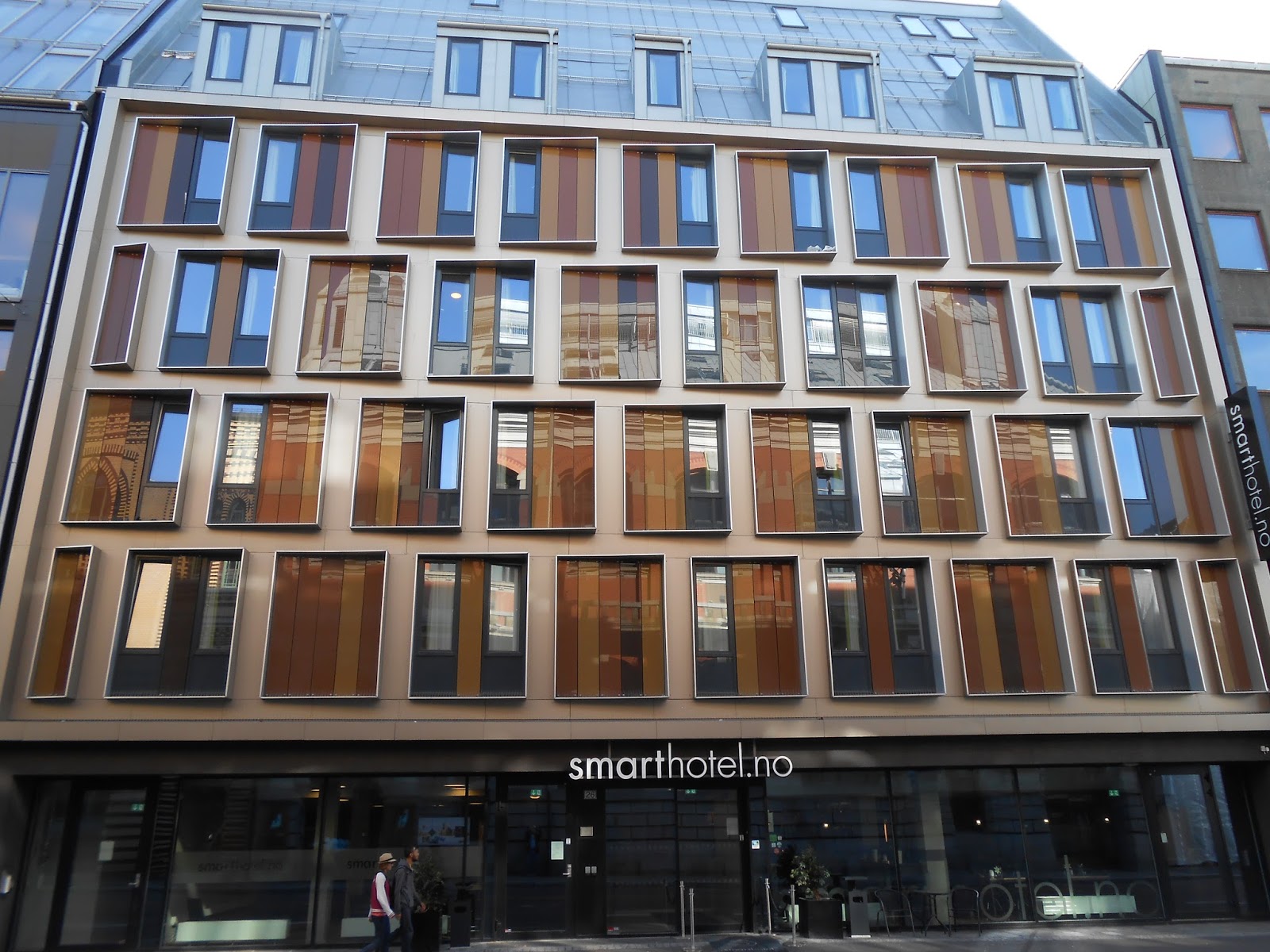
Smarthotel, where I stayed for 2 nights

The King's Palace, at one end of Karl Johans Gate
I tried to look for the Nobel Peace Center but was unsuccessful.  I finally walked to Greenland, an area just behind the Central Railway Station.  This is where a lot of the immigrants from Asian, Middle East, and Africa reside.  It's kind of a ghetto but lately has seen a lot of interest from younger Norwegians because it's so close to the city and real-estate there is probably much cheaper than other parts of the city.  I found a restaurant to my liking.  It was a Pakistani restaurant, serving dishes that are quite similar to Indian food.  I had Tikka Masala chicken with rice and nan.  It was good.

The next day I realized that the Nobel Peace Center is actually quite close to the hotel.  I found it and memories started to come back of the harbor area.  It's where I took the ferry to the museums five years ago.  Unfortunately, the Center is closed on Mondays.

I walked around the city for a few more hours because taking the NSB local train to the airport for my flight to Krakow.  The fare was 92 Norwegian Kroners.  The weather was nice that day and I walked behind the Karl Johans Gate area and found some interesting looking shops.

A grocery store popular with immigrants in the Greenland area

Nobel Peace Center

Statue in the Harbor Area

Yachts in the Harbor Area

Trams or Light-rail is a popular mode of transportation around the city

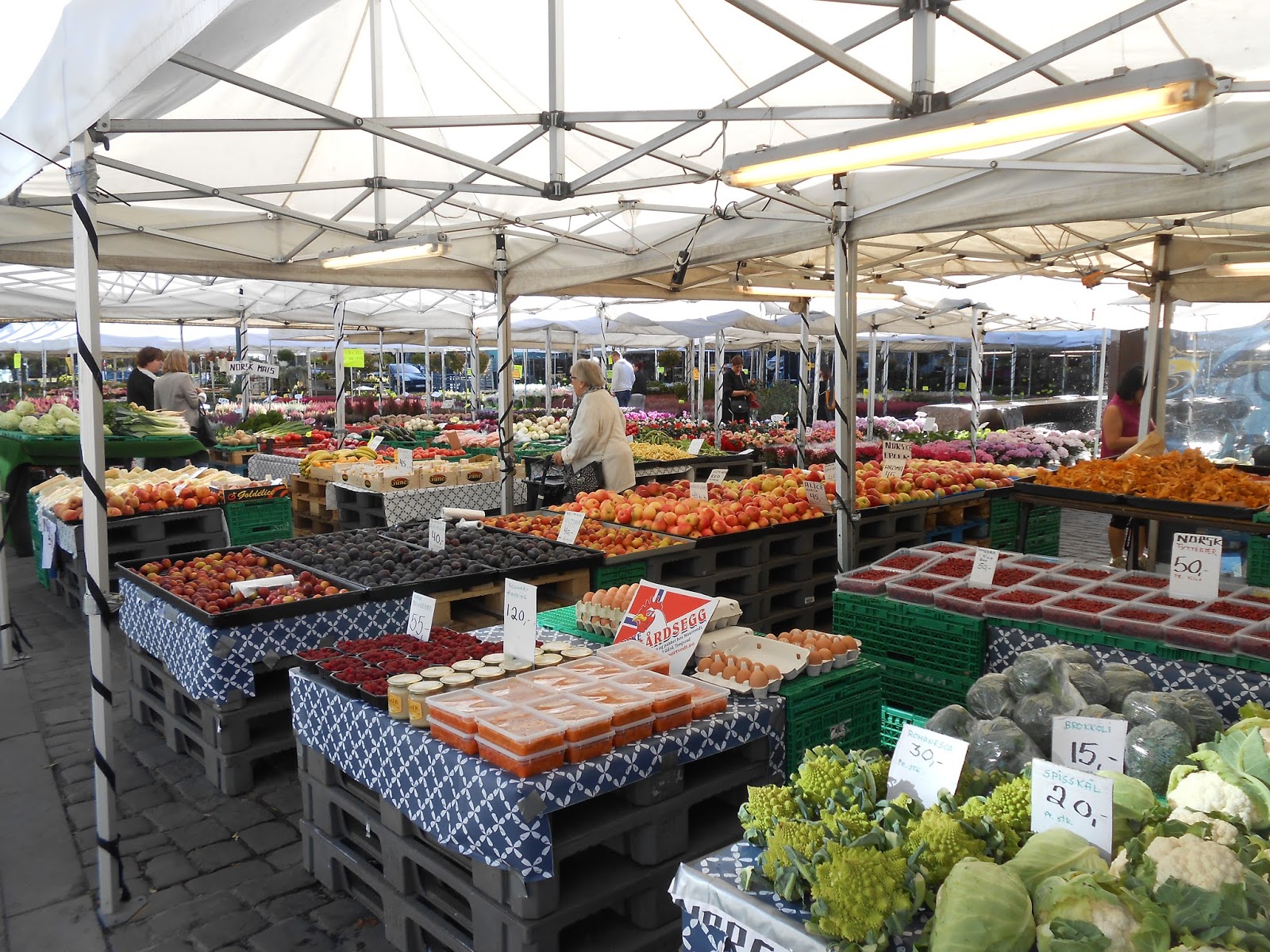
A Farmers' Market right in the middle of the city

Surprisingly, there are quite a lot of beggars in the city.

Friday, September 16, 2016

Cruising through Norway on the M/S Lofoten

I first heard about Hurtigruten in an article called Day For Night in Norway in the New York Times on September 19, 2014.  It impressed me.  I thought, what a way to take a slow trip through beautiful Norway.  I first visited Norway in 2011, as part of the Europe by Rail trip.  Back then, I only visited Oslo and Trondheim.  You can read about those posts by clicking on the links.  I've read about Bergen and the Bergen Railway.  It was described as one of the most beautiful train journeys in Europe.  Regardless, I wanted to visit Bergen and see the fjords.  The article stoked my interest again.

I logged into Hurtigruten's website and checked their prices.  The trip that I am interested in is called the Classic Roundtrip Voyage, from Bergen to Kirkenes to Bergen in 12 days.  The prices vary quite a bit by date and ship.  It drops sharply after August and gets cheaper as it gets closer to the winter months.  The cheapest price is on the M/S Lofoten, the oldest and smallest ship.  That doesn't bother me.  I picked the September 6, 2016 sailing date with a price of about US$2,400.  Since I am saving money on the cruise itself, I signed up for several excursions.  I figured since I am going to be there, I might as well go to some of these places on shore to get the full experience.  I never know when I'll have a chance, if ever, to go back to these places again.  Eventually, I paid about US$3,600 for the cruise and about 10 excursions.  Yes, the excursion are expensive but I thought well, I saved a lot of money by booking a smaller ship so I can afford it.

After checking out of my Bergen hotel, I walked 10 minutes downhill towards the Hurtigruten terminal.  The check-in was quick, about 5 minutes.  I listened to a safety talk for about 15 minutes, and then I am on the ship.  I found Cabin 250 on the B deck.  It was a very small cabin, with 1 single bed, a sink, and a porthole window.  The toilet and shower is down the hallway, shared by a few cabins.  The restaurant and cafeteria are 2 decks above.

M/S Lofoten


Cabin 250

Dining Room
Lonely Planet called this "The World's Most Beautiful Voyage."  As I am writing this part of the post. I am on my 10th day, heading south towards Trondheim in the morning.  From Day 1, it's been beautiful scenery all the way.  Altogether, the ship would've stopped in 34 ports, 22 of them north of the Arctic Circle.  At some ports we stopped for only 15 minutes, enough to load/unload some cargo or take on a new passenger.  At many ports, there is enough time to do a shore excursion.  Some of the excursions are one-hour long, some may be 4 hours, enough time for the ship to do its business.

Hurtigruten makes a big deal about crossing the Arctic Circle.  When we were going north, we had a ceremony in which someone dressed as Neptune, the Sea God, appeared.  Volunteers who have ice water poured down their backs get a shot of Norwegian spirit (I don't know what it was).  Going south, those who ate a spoonful of cod-liver oil gets to keep a souvenir spoon.  Corny, but it gets everyone's attention.

The excursions range from a City Walk to Mountain Hiking to Horseback Riding to a King Crab Feast.  I signed up for several - including an Art Nouveau walk in Alesund, a trip to the North Cape, and a visit to the Russian border.  They are not cheap, ranging from 359 (US$44) to 1799 (US$220) Norwegian Kroners.  But, they are informative.  I signed up because I wanted to experience as much as I could.  Some of the excursion were cancelled for lack of participants.

Hike to farmers' huts up in the hills in Hjorundfjord

Art Nouveau Walk in Alesund

Munkholmen (Monk's Island) near Trondheim

A Sami farmer and his reindeer, near the North Cape

Looking at the border with Russia, near Kirkenes

An underground cave in Kirkenes, where some Norwegians hid during WWII

18th Century Fort in Vardo

Vardohus Festning, UNESCO World Heritage Site, in Hammerfest

Arctic Cathedral in Tromoso

North Cape in foggy weather

Sami Woman near Kjollefjord

Arctic Sunset in Solvaer
 What is not mentioned in any of Hurtigruten's website or marketing information is their meals.  All of us on the trip have Full Board, meaning we get three meals a day.  Every meal was outstanding.  There is such a variety of food that it's difficult even to choose what to eat. They were all cooked fresh every day.  Fresh seafood is delivered to the ship every 2 or 3 days and every meal has some kind of seafood, whether it's the entree or appetizers like smoked salmon, pickled herring, sardines, cod, or fish soup.  Being a major fish exporting country, there is no lack of seafood and the variety.  One night we even had a seafood buffet - king crab, mussels, shrimp, crab claws, fish, etc.  All you can eat.  There is usually at least 3 kinds of desserts.  My dinner seating is at 6 pm and sometimes I wish they give me another hour before I eat dinner because I had eaten so much at lunch.  I can't help it.  The food was that good.

Salad bar, with smoked meat in foreground

Fish, potatoes, and stew

Seafood Buffet

Smoked Salmon

Smoked Halibut and Salmon
 Today is the last full day on the ship.  It's September 16, 2016.  The ship will arrive in Bergen tomorrow afternoon at about 2 pm and everyone will get off the ship.  I will take the airport bus to Bergen Airport and fly to Oslo, where I will stay for 2 nights.  From Oslo, I will fly to Krakow (4 days), then take the train to Warsaw and stay for 4 days.  After Warsaw, I fly to Munich for the last part of the trip.  There I will meet some friends and have fun at Oktoberfest.  I return to Phoenix on October 3rd.

I've talked about the trip and the food.  What about the passengers on the ship?  The majority of the passengers are Germans.  I think it's because Norway is only about 1 1/2 hours flight from most parts of Germany and Huitigruten advertises heavily in Germany.  It's also very affordable for them.  There were also a group of French tourists who came on board during the middle of the cruise and disembark after a few stops.  Surprisingly, there are very few Americans, less than 10 of us.  It's nice to be able to converse easily with fellow Americans, or other English-speaking passengers for that matter, because not all the German passengers are comfortable speaking English.  The Americans try not to stick too close together.  We usually go our separate ways when we go to shore.  Other countries represented are Australia, England, New Zealand and Canada.  There are very few Norwegians on board.  Most of them take short trips, like you would on a ferry.

My dinner table-mates from Australia, Sissy and Eddy
This has been a wonderful experience.  Who knows, I may come back for another trip or go on another Hurtigruten cruise, perhaps to Antartica.