Monday, September 4, 2023

Chilli Crab at De Golden Spoon

The feature of this post is chilli crab.  It is one of the most popular and best known dishes in Singapore.  You will find out later why this post features chilli crab.

Cynthia and Steven went for another run along the Singapore River again.  I woke up early and decided to take a walk and ran into them.  I walked as far as the former General Post Office building.  It has now been converted into the Fullerton Hotel.  For a change in scenery some of us went to the Zion Food Center for breakfast.  It's slightly further than TB but not many stalls are opened so early in the morning.  My friend, Jimmy, met us there.

The plan today is for some to go to the Botanical Garden, then meet the rest at the Adam Road Hawker Center for lunch, specifically nasi lemak.  I went to visit my bedridden sister, who is being taken care of by her daughter.  They don't live very far from the Furama hotel.  After having breakfast with my good friend, Jimmy, he dropped us off at my niece's flat.  Sadly, my sister is unaware of anything that is going on around her.  She is being take care of by a maid.  

Nasi lemak is a very popular local dish, sold usually by Malays.  The rice is cooked with coconut milk and pandan leaves, which gives it a fragrance flavor.  For sides, it is usually served with a small fried fish or anchovies.  Sellers will also add cucumber, eggs or fried chicken.  You can expand your dish to include as much side dishes as possible.  What makes a nasi lemak dish stands out is the rice and the sambal, a chili paste made from various ingredients.  Sambal has different levels of spiciness.  Mixing it with rice is the right way to eat mask lemak.

Nasi Lemak with fried fish, anchovies and egg

The rest of the group went to the Botanical Garden.  It was a very hot morning.  They spent some time visiting the Orchid Gardens, which the Botanical Garden is well-known for.  The heat started getting to the kids.  Instead of meeting me at the nearby Adam Road Hawker Center, they came back to the hotel.  It ended up with my niece taking Doris and I there and bought takeout lunches for everyone.

A stroll through the Garden

Three little fans

The VIP Section

A Group Photo

The Wongs


One of the beautiful orchids

The highlight of the day is a dinner hosted by Eddy and Mai-lon at De Golden Spoon restaurant.  It's about a 10-minute walk from the hotel.  I've hosted many dinners there. It has good quality food, excellent service and the price is very reasonable.  We had 3 tables to accommodate about 26 guests.

Table 1 - Eddy with Joel and Audrey's family

Table 2 - Winnie and Wai Heng's family and Doris

Table 3 - Tobias' family, Shawn, Cynthia, Teresa and Brett


Eddy and Mai-lon closely guarding their chili crab dish

The dinner at De Golden Spoon was wonderful.  Two popular dishes stood out - coffee ribs and 
Chilli crab.  Mud crabs, weighing 1-2 kg, are usually used to cook chilli crab.  The sauce is what makes it special.  It is tomato-based and has a sweet and sour taste.  Deep-fried bread (called man-tou) are dipped in the sauce as a side dish.  This dish is very popular in Singapore and Malaysia.  Everyone loved the food and the restaurant.  Best of all, everyone had a chance to socialize and get to know each other.

Roti Prata at Tiong Bahru Hawker Center

Around the area where the Furama is located are several hotels.  This is called the Havelock Road area, within walking distance from Great World, a big shopping center.  My high-school was about a mile away but has since been torn down to make way for beautiful private condominiums.  The Singapore River flows through this area.  In the last couple of decades the Singapore government has made the banks of the river into a touristy area, with pubs, restaurants, souvenir shops, etc.  In the early days warehouses dominated the banks of the river.  It was an important part of Singapore as an Entrepôt.

Singapore River, with Marina Bay Sands Hotel in the distance

Skyscraper Office Buildings

The old General Post Office, now the Fullerton Hotel

Hotels and Condos, with sidewalk

Cynthia and Steven went for an early morning run along the river, towards the city.  

Cynthia and Steven, with MBS and Singapore Eye in the background

We started the day again at the TB hawker center.  Ella, who had not felt well on the first day, joined us.  We now have a full house.

Roti Prata

Roti Prata is a popular breakfast dish in Singapore's hawker centers.  In Malaysia it's called Roti Canai (pronounced Chanai).  It was brought to Southeast Asia by South Indian immigrants.  It is made from fluor and water with a lot of fat, usually ghee.  It is cooked on a flat griddle and served usually with some kind of curry.  It can also be made into a sweet dish, using condensed milk or sugar.  

Sharing local breakfast with grandchildren

Kids enjoy the drinks

Delivering Kopi

Eddy and Mai-lon, smiling after a delicious breakfast

Shawn and Ezra eating noodles

Taylor eating porridge


Following breakfast we took the MRT to Chinatown.  I wanted to give everyone a flavor of what it looks like.  Years ago it was an enclave for new immigrants from China, especially those from Guangdong (Canton) Province.  Sadly, most of those old buildings have been demolished to make way for shops catering to tourists.  There are still areas that cater to locals, like the People's Park Complex.  

The People's Park Complex has more of a local flavor to it.  Over the years many Chinese from northern part of China set up shops here selling northern Chinese cuisine.  Examples are the mala hot-pot, all kinds of bread and meat, etc.  There are also many money-changers.  This is where we change from US dollars to Taiwanese currency, the New Taiwan dollar (NT).  The money changers are mostly Indians.  There are also a few remittance centers because Singapore has many foreign workers who send money back home.

Esme with fresh coconut

At the MRT station.  Notice the cleanliness

Overhead Bridge at Pagoda Street in Chinatown

Durians Anyone?

Drinking fresh-squeezed Juice

Taylor enjoying a watermelon

Having a little fun

The kids were tired after touring Chinatown so they the MRT back to the hotel to swim and rest.  Some of the adults continued to the Maxwell Road Food Center.  This hawker center is made popular by many Instagram posts by travelers from all over the world.  One stall stands out - Tian Tian Chicken Rice, a Michelin-star restaurant. However, there are many other excellent food stalls here too. 

That evening I hosted a family dinner, inviting close family members and friends.  There were about 60 of us at the Swallow City Restaurant.  It was an opportunity for the Tay family to meet our extended family and close friends.   It was sort of a reunion without having to meet each and everyone individually.

A Family Dinner

Tobias and family came straight from the airport

Appetizer Dish

Preparing Peking Duck

Nephews and Nieces

Another long day for us.  We are ready to go back to the hotel to rest.  


A Family Trip - Arriving in Singapore

The pandemic has kept me from traveling to Singapore, my home country for the last 3 years.  Determined that I will go in 2023, I was on the lookout for a sale by Singapore Airlines.  I know it always happens around Thanksgiving, with the so-called Black Friday sale.  I told my family and everyone wanted to go.  We decided on August for a couple of reasons:  it's during my granddaughter's school holiday and my niece's flat's (apartment) renovation would be done by then.  It's not the ideal time to go to Taiwan because it's hot and may have some remnants of the typhoon season, which occurs usually in July.  Be it as it may, we decided to meet in Singapore at the beginning of August.  The plan is to spend 1 week each in Singapore and Taiwan.

Doris and I arrived first in Singapore in the early morning of August 3rd.  My niece's husband, Wai Heng, picked us up at the Changi Airport, even though it's 1am.  He dropped us off at the Furama Riverfront Hotel on Havelock Road.  We are staying here because my German friend, Tobias, will also be staying here with his family.  Months earlier I booked four rooms for the group, pre-paid and with 7-night stay. This gave us the best room rates, as low as US$110 a night.  The Furama is not the nicest hotel, probably a 3-4 star hotel but it is conveniently located to many places we want to go.

First, it is a 10-minute walk to the Tiong Bahru Hawker Center, where we will be eating many local meals.  Second, it is less than 10 minutes away from the MRT (Singapore's subway system) station.  You can just about go anywhere in Singapore using the MRT,  It is one of the best in the world, and the cleanest.  Third, it is close to the city and if you don't mind the heat, you can walk to Chinatown or even to the city center.  Fourth, it has a large pool for the kids; a big treat for them in this heat and humidity.

There were 11 of us in the group:  8 adults and 3 kids.  We came in 3 groups from different airports.  Doris and I flew from the west coast, starting the Singapore Airlines flight from Los Angeles (LAX), stopping at Tokyo's Narita Airport on the way.  Shawn and Ella's family (plus Esme and Ezra) flew from JFK airport in New York City on the longest flight in the world, 19 1/2 hours, direct to Singapore.  Cynthia, Taylor, and Steven, with Steven's parents Eddy and Mai-lon, flew on the second longest flight, 19 hours, from Newark, NJ, also direct to Singapore.  We all lost one day crossing over to Asia so we all arrived on August 3rd and 4th.

Having arrived first, I have the local SIM cards, MRT cards, local electrical plugs and Singapore currency ready for everyone.  We used WhatsApp to communicate with each other and to our family and friends.  Regular messaging or SMS will costs us each 50 cents per message, charged by our US cell phone company.  We purchased local M1 SIM cards for about US$10 that comes with 100GB of data and good for 30 days.

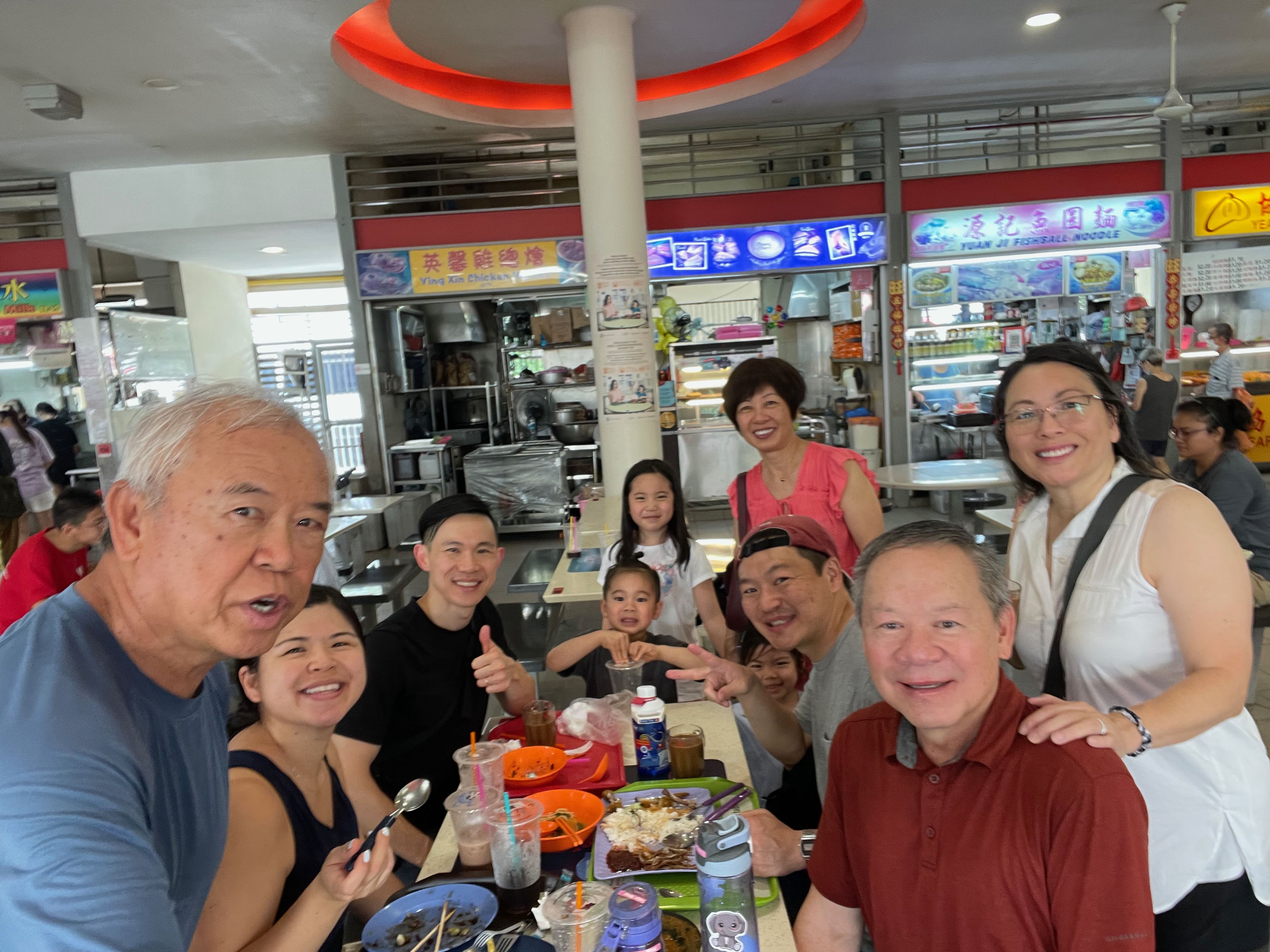
Our first order of business on the first morning after everyone has arrived is go to the Tiong Bahru (TB) Hawker Center for breakfast.  It is a popular local hawker center with many food stalls selling a variety of dishes.

Walking from the hotel to TB market

Kids enjoying themselves

A Group Picture

Mai-lon ordering prawn noodles

Inside the huge TB market

I ordered Shawn a nasi lemak and Cynthia a roti prata - their all-time favorites. The kids had fishball noodle soup and the little ones discovered iced Milo. We also found a delicious soy milk and grass jelly spot with a long line that did not disappoint.  The kids swam after breakfast and zonked out for long naps after.

At the Furama Pool

Ezra

Esme and Taylor

In the evening Winnie invited us to a Peranakan dinner at a restaurant called Ivin's.  Peranakans are ethnic Chinese who have settled in the Malay Peninsula for many generations and have adopted many of the local culture and cuisine.  They are sometimes also called Baba or Nonya.  Their cuisine is fundamentally Chinese but with strong Malay flavors.  They tend to be a little spicier than traditional Chinese food.  Lately, it has gotten very popular in Singapore.


Peranakan Dinner at Ivin's

Needless to say, everyone was tired and jet-lagged and went to bed early.


Saturday, September 2, 2023

Crossing the Panama Canal

Two months after our first cruise we saw a deal that we couldn't pass up - a 14-day cruise through the Panama Canal.  The timing and itinerary were perfect - starting the cruise in San Diego and ending in fort Lauderdale in April.  It was a smaller Holland America Line (HAL) ship - the Zaandam, a 2,000 passenger ship.  

I have been wanting to see the Panama Canal since I read the book,  "The Path Between The Seas - The Creation of the Panama Canal, 1870-1914" by David McCullough.  I am a big fan of David McCullough.  He has written some of the best books I have read:  The Great Bridge (about building of The Brooklyn Bridge), Truman (about President Harry Truman), 1776 (the United States Independence story), etc.  His books are detailed, and contains a lot of historical facts.  His writing style makes it easy to read a history book.

The Panama Canal is a waterway connecting the Atlantic and Pacific Oceans.  It reduces the time it takes for a ship to go from one to the other ocean without going all the way south to Cape Horn.  It is one of the most difficult engineering projects ever undertaken in history.  The French started building it in 1881 but ran out of money while many workers died working on the project.  The Americans took over in 1904 and opened it in 1914.  The Americans control the Panama Canal Zone until it handed over to Panama in 1977.

We took an early morning flight from Phoenix to San Diego.  I debated on taking a taxi, Uber or public bus to the cruise terminal.  I know where the cruise terminal is; it's not far from the airport. At the airport the HAL representative offered a ride on their bus to the cruise terminal for $36, a ridiculous amount.  I decided to ask an elderly representative at the Information Desk.  He said he you can take bus 992 to the cruise terminal.  It costs $2.50 in quarters.  Half price for seniors. In less than 20 minutes the bus driver dropped us right in front of the terminal.  A HAL representative met us and took our luggage.  If we had taken a taxi or shuttle van it would have costs us at least $20.

Just a few days before the cruise, HAL offered us an upgrade to a balcony room for $500 extra per person.  We took the upgrade.  A balcony allows us to sit outside the room and enjoy the views.  The cabin itself is slightly bigger than the one on an earlier cruise but it's still spacious.  It's almost the size of a 2 twin-bed hotel room.

Looking out from the balcony

A View of Downtown San Diego

Our first stop is Puerto Vallarta, a popular Mexican resort town on the Pacific Coast.  Many Americans like going there because it's next to the ocean and has cheap food and drinks.  We took a taxi with my friend Bill and his wife, Diana, to town.  It costs $5 per person.  We walked along the beach, where there are many shops and restaurants catering to tourists.  After a couple of hours we took a taxi back to the ship.

Next, we stop at another Mexican port town called Huatulco.  It's not popular among Americans but apparently, it is popular among Canadians.  I met a group of Canadians waiting to board a ferry to an island for snorkeling.  You have to take a taxi to go to town, which we didn't think it was worth it.  Again, we went back to the ship early.

Now comes the highlight of the cruise - the Panama Canal.  This is a special experience, from waiting your turn to entering the canal, being guided by the pilots, then being pulled by machines through the locks.  The Panama Canal Locks is a complex system of locks that lift and lower the ships so that it can traverse the canal.  Watching it happen is on a lot of people's bucket list.
Entering the Canal

The Centennial Bridge

Gatun Lake Locks

Passing through one of the locks

Passing another ship on the other side of the Gatun Locks

It took about 10 hours to go through the Canal.  We started very early in the morning, so much so that we ordered room service for breakfast.  HAL was very generous in baking special delicious Panama rolls for the passengers.  They were served on the 3rd level deck as well as other locations around the ship that have a nice view of the canal.  By the time we get to the Atlantic Ocean side it was already getting dark.

Our last stop after passing through the Panama Canal is Cartagena in Colombia.  I visited Cartagena in July 2022, after my trip to the Galapagos Islands.  This is a beautiful city by the Caribbean sea.  Here is my blog post on Cartagena and its colorful neighborhood of Getsamani.

The last leg of the cruise took us back to Fort Lauderdale.  We disembark on our own after breakfast.  Many passengers need help or help with transportation.  We called an Uber and in about 15 minutes we were at the Fort Lauderdale Airport.  We were able to get on an earlier flight to Atlanta, which means we have more time at the Delta SkyClub, before finishing the trip back to Phoenix.