Monday, February 10, 2020

Sri Lanka, Part 2 - Polonnaruwa, Sigiriya, Dambulla


On the third day we headed south to the UNESCO World Heritage Site of Polonnaruwa.  This is the second most ancient kingdom in Sri Lanka (SL) after Anuradhapura.  Below are pictures from the grounds of the ancient city.  Admission is US$25 per person.  Following the tour we checked into the beautiful Giritale Hotel situated not far from the Giritale Lake.  My room overlooks the lake.  When I wanted to take a walk down the lake the hotel security guard warned me not to turn left at the main road and to return before it gets dark.  The reason?  There are wild elephants roaming in the forest nearby.

A Reclining Buddha statue

Entrance to a part of the grounds

A Sitting Buddha Statue

Entrance to a former structure

Statue guarding the entrance

Ancient upright structures

A water tank

More statues on the grounds

Another old statue

An Old Storage Tank

A Pond for Bathing

Statue of Buddha

Including the drive, the tour took about 3/4 of a day.  I am not disappointed to finish the tour early so I could enjoy the views from the hotel.

The following day we headed towards Dambulla where we will spend the night at the Nice Place Dambulla hotel.  On the way we stopped at a small village to get some demonstration of what village life is like.  First, we took a slow bullock cart to the edge of the lake.  Then we took a row boat to reach the village where our hostess met us.  She showed us first how she cuts up a coconut.  Coconuts are an important part of life in many poor countries in the tropics.  They can provide food, oil, and building material.  Then she ground and milled some millets which were then made into a flat bread.


BMW - Bullock Motor Wagon

Shaving the inside of the coconut to get flakes for cooking

Coconut sambar and millet roti

Sigiriya Rock Fortress
Walking up to the summit
Abandoned palace on top of the summit

The following day we drove to the Dambulla Cave Temple.  These caves were used only by the monarchs until the 20th century.  They are now opened to the public.  I was amazed by the conditions of a lot of the statues and the inside of the caves.  The complex has five caves.  They were built in the 1st century BC and is a World Heritage Site.  What is interesting about these caves is that they include a few statues of Hindu gods.  Both Buddhism and Hinduism originated from India and there might be some shared beliefs between the two religions.  It was definitely worth the US$10 entrance fee to the temples.

I compare these caves to the 9th century Mogao Caves in Dunhuang, China.  Although the latter is much more impressive its conditions had deteriorated to the point that the Chinese government is opening only a small section of the caves to the public.


Temple Cave in Dambulla

Reclining Buddha inside the Temple Cave


Buddhas inside the Cave
Paintings on the walls


One of the many Buddha statues inside the cave
Coming down from the caves in a different direction brings you to the Golden Temple.  This impressive Buddhas statue is part of the Dambulla Cave Temple World Heritage Site.


This area is blessed with very nice weather.  It is warm but not humid like in the tropics.  However, it has many tropical fruits like bananas, papayas, pineapples, mangos, guava, etc.  Papayas, pineapples and water melons are offered as dessert at almost every meal.  We saw many roadside fruit stands selling all types of fruits.

Red Bananas

Soursop, a delicious fruit.  A South American version is called cherimoya


A fruit stand along the road
 We passed a place where they offer elephant rides.  I was not interested because I've done this a couple of times in Thailand.  We stopped to see why a crowd is looking into the river.  Below is what we saw.

This elephant enjoyed soaking in the river that he pooped
Something that piqued my interest when I walked past some containers that looked like old British-style mailboxes.  On closer look they are recycling bins.

Recycling Dustbins or Cans


Friday, February 7, 2020

Sri Lanka, Part 1 - Negombo, Wilpattu, Anuradhapura

On February 1, 2020, I flew on Singapore Airlines from Singapore to Colombo, the capital of Sri Lanka(SL).  It's a three and a half hour flight and I arrived there late in the evening.  My driver, Mohan, picked me up at the airport and drove about 30 minutes to the Rani Beach Resort in Negombo.  Looking out the window I could see people hanging out on the beach even this late at night.  At breakfast the next morning I could see that the hotel was filled with Buddhist pilgrims dressed in white.  Many were Vietnamese, as I could recognize the language.  Sri Lanka is about 70% Buddhists so this is not surprising that Buddhists from around the world came for this purpose.

At the hotel I realized that wifi is going to be very spotty.  I decided to buy a SIM card from a small store across the street called Kingfisher.  In order for a foreign SIM to work on your American phone you have to make sure that it is unlocked.  Not passcode unlock but network unlock.  Many Americans don't understand that their phones are network locked to one of the cell phone provider networks, be it AT&T, Verizon, Sprint, etc.  You have to fully own your phone or paid off the installments for the cell phone provider to unlock your phone.  Recently they have made it easier but you still have to contact the provider to make sure your phone is unlocked to use a foreign SIM card.

I paid 700 SL rupees, or about US$4, for almost 4GB of data.  That should last me about 2 weeks although you still have to budget yourself especially uploading or downloading pictures and videos.  Sunbird also provided a pocket wifi in the car, which is a router using cell phone signal.

Negombo is a suburb just north of Colombo.  You see a lot of Dutch colonial presence here - fort, canal, schools, and churches.  It is common to past a Catholic Church and further down the street a mosque or Buddhist temple.  Buddhism has been on this island for over 2,000 years and about 70% of Sri Lankans are Buddhists.  I assume the Portuguese, followed by the Dutch, converted many of the locals to Catholicism.  The Hindus and Muslims are mostly Indian immigrants from India who were brought to SL to work in the tea plantations.  Whatever religion a person is you can't tell by looking at them.  Sri Lankans are mostly dark-skinned, whether they are Sinhalese or Tamils.  Including English these are the three national languages.

Being next to the ocean makes Negombo an ideal place to be a fishing village.  We were there on a Sunday so the big fish market was closed but you can see evidence of the main livelihood of this town by the number of fishing boats along its shore.  Some of the big fishing vessels are intended to be out at sea for about 3 weeks, obviously catching the bigger fish like tuna.  Others fish closer to shore for fish like sardines.  Fish are laid out to dry on some of the beaches as a way to preserving them.

A Dutch Fort

A Catholic Church

Fish drying in the sun

Vendor selling fresh coconut, about 40cents each

After touring around Negombo we started heading north to our next destination - the ancient city of Anuradhpura.  It was a long drive through the countryside, first along the coast, then heading inland towards Wilpattu National Park.  I was surprised to learn that there are 26 National Parks in SL, being a relatively small island.  Wildlife is abundant here, especially elephants, to the surprise of many people.  There are also leopards, bears, deer, and all types of birds.  On this trip I will be visiting three National Parks - Wilpattu, Horton Plains and Yala.

Mohan drove to the home of the safari jeep driver.  Since I am the only one, I had to pay for the entire jeep, about US$55.  Mohan drove shot-gun with the driver and I was alone in the back on a high bench.  On a jeep safari the driver drives to locations where he thinks we'll be able to spot wild animals.  The animal we'd most like to see is the elusive leopard.  We passed other jeeps, either going in the same or opposite direction.  The drivers sometimes have a short conversation, presumably to let each other know where they have spotted certain animals.  Mostly it's a random drive.  There is no guarantee that you will see any animal.  If you want guarantees, go to the zoo.  We saw a herd of deer grazing, a black bear from a distance and a leopard before it went into the bush.  I regret not bringing my binoculars.  Not a very successful safari.  I hope to see more at the next two National Parks.

Entrance to Wilpattu National Park

Deer at the Park
It's about an hour drive from Wilpattu to Anuradhapura.  I checked into the Ceylan Lodge and was ready for a buffet dinner.  It was a very generous buffet with about 7 or 8 different dishes, ranging from rice to curry dishes to dhal to vegetables to side dishes.  Dessert is mostly fruits - pineapples, papayas, water melons, and bananas.   There was a group of cyclists also staying at the hotel.  They are probably in their 50s' and 60s' and mostly Europeans.  It's a tough way to travel around Sri Lanka but as long as you are having fun, why not?

The breakfast buffet was just as generous.  Following breakfast we drove to the grounds where the ancient Kingdom of Anuradhapura was situated.  A 4th century BC kingdom that ruled Sri Lanka in its early days and was instrumental in establishing Buddhism as its religion, culture and form of government.  It was during this period that the sacred Tooth Relic of the Buddha was brought to Sri Lanka.  There is a temple in Kandy that houses this sacred Tooth Relic.  More about this temple will be discussed in a later post.  Admission to the kingdom grounds is US$25 or about 4,500 SLR (Sri Lankan Rupees).  Both currencies are accepted.  You have to take off your shoes to visit the grounds. Here is where you also find the 2,500 year-old Bodhi tree.  Not the original tree but its descendants.  The tree is so precious that its trunks are supported by golden poles.

Tanks for storing water in the early days

Guarding the entrance

A modern day statue of Buddha

Entrance to the Kingdom grounds

One of the stupas

Statues around the stupa

A more modern stupa

2,500 year-old Bodhi tree, branches supported by golden poles

A graphical representation of the religion
A street cobbler

Street of the town of Anuradhapura

Shoes are to be removed before entering the palace grounds

Tuk tuk - cheap taxi on 3 wheels
The small town of Anuradhapura consists of a few streets.  In the late afternoon when it's cooler, we strolled along the main street to look for a pair of thongs.  I had forgotten mine and did not realize that hotels here don't provide room slippers like in most Asian hotels.  I also bought a couple of bags that monks used for someone.  It's like a backpack except that instead of hanging around your bag it hangs over your shoulder.  If you've seen a Buddhist monk you will see him carrying one of these bags, usually saffron color but they come in other colors too.


Tuesday, February 4, 2020

Why am I going to Sri Lanka?

When picking my places to visit I always try to go where I don't run into large crowds.  Nobody likes to spend time and money visiting places where you are competing with thousands of people for a seat on the train or enter into a museum.  A case in point is our trip last year to Italy.  Cinque Terre and Venice especially.  My previous trip to Cinque Terre in November 2011 was a beautiful awakening - a place so beautiful and unique that I vowed to visit there again and spend a few days.  When we last visited in September 2019 the place was overrun with tourists, even as soon as you got onto the train in La Spezia.  It was madness; everyone fighting to squeeze into a local train to take you to one of the five towns.  Venice was no better.  The water taxis that ply the Grand Canal was packed with people.  You can see the disgust in the locals.  They don't want you there!

Sri Lanka started showing up on the tourism map after the defeat of the Tamil Tigers, a militant organization that wants its independence in this island nation.  It fought a violent civil war for about 26 years before being defeated militarily by the government in 2009.  With peace comes tourism.  The country starts promoting itself.  Travel writers started writing about the beauty and unspoiled island with its cultural heritage and miles and miles of warm water beaches.  Lonely Planet named Sri Lanka as the top country to travel to in 2019.

I have known Sri Lanka as Ceylon in my days growing up in Singapore.  It's less than a 4-hour flight away and many Sri Lankans, or Ceylonese, called Singapore home.  How can you not know that the best tea are from Ceylon?  It felt like a distant cousin, Singapore and Ceylon being former colonies under Mother Great Britain.

One problem with traveling to Sri Lanka is that it is far from most popular travel routes.   From the United States, you can travel there from the Pacific or Atlantic way.  Either direction you are looking at at least 24 hours of travel.  For me, I planned my travel by stopping in Singapore to visit family and friends and squeeze in a two-week trip to Sri Lanka.

Not wanting to fumble my way around the island I decided to sign up with a British tour company called Tucan Travel.  I have traveled with them a few times - South America, Mexico and Russia.  Travelers who travel with Tucan tend to be younger and more adventurous, unlike a lot of the American companies who tend to pamper their guests.  Unfortunately, after I signed up with Tucan they decided to cancel my trip because I was the only one who signed up.  I turned next to the Sri Lanka Tourism website and see if I could find any officially registered local tour companies there.  Somewhere on this website is information that if you submit your travel requirements (length, dates, budget, itinerary, etc) they will send your request to six companies which will send you their proposals.  I received six very well thought-out proposals and the prices were very close.  I finally picked the one that has excellent reviews on the internet and provided the best "bang for the buck."  It's called Sunbird Lanka Tours.

Map of Sri Lanka - from lonelyplanet.com

I signed up for a two-week tour.  Here is the itinerary:

01-Feb    Airport –Negombo

02-Feb    Negombo- Anuradhapura
- Negombo City Tour (Fish Market, Dutch Fort & Canal)
- Wilpattu National Park Safari (Evening)

03-Feb    Anuradhapura
- Anuradhapura City tour (Archaeological Ruins of the First Ancient capital from 3rd century BC to 10th century AD)

04-Feb    Anuradhapura-Polonnaruwa
- Visit to Second Ancient Capital (Polonnaruwa) of the Country and see the ancient Buddhist monuments and ancient irrigation tanks made by ancient kings

05-Feb    Polonnaruwa-Dambulla
- Village Tour - Visit of a traditional rural village by a bullock cart/canoe ride in a natural lake in the village and experience the way of living of village farmers (model village)
- Sigiriya Rock Fortress (Lion’s Rock)

06-Feb    Dambulla- Kandy
- Dambulla Cave Temple
- Ayurveda & Spice Garden

07-Feb    Kandy
Kandy City tour -
- Temple of the Tooth Relic of Buddha
- Upper Lake view point
- Gem factory & museum
- Cultural dance Show

08-Feb     Kandy - Nallathanniya
Adam’s Peak

09-Feb     Nallathanniya-Nuwara Eliya
- Tea factory & Tea Plantation
- Nuwara Eliya city tour
- Lake Gregory
- Victoria Park

10-Feb    Nuwara Eliya
- Horton Plains National Park Safari
- Ambewela farm

11-Feb     Nuwara Eliya – Ella
- Train Ride from Nuwara Eliya to Ella
- Ella Rawana Waterfalls
- Ella Gap View Point
- Nine Arch Bridge

12-Feb     Ella - Yala
- Buduruvagala Buddhist temple (The rock with the statue of Buddha)

13-Feb     Yala - Unawatuna
- Yala National Park Safari
- Galle City Tour
- Leisure at the beach

14-Feb     Unawatuna-Colombo
- Colombo city Tour & Shopping
- Gangarama Buddhist Temple
- Independent Memorial Hall
- Old Parliament
- Galle Face Green
- BMICH

15-Feb     Colombo-Airport
- Departure (Flight at 10:50am)

The itinerary provides a mix of interests:  local culture, history, wildlife, beaches, train ride, tea plantations, etc.


Saturday, January 4, 2020

Oktoberfest in Munich 2019

Munich is the final destination for this European trip.  It's October and why would you be in Munich except for Octoberfest.  We decided to take the train instead of fly from Venice to Munich.  One reason for taking the train is because we'll be going through some beautiful country in northern Italy and Austria.  The first part of the train journey took us from Venice Maestre station to Verona.  Then we changed to a Deutsche Bahn train that goes straight to Munich.  The train passes through the Dolomites in northern Italy.  This is an area of great beauty.  It's also a popular hiking area.  The train then passes through beautiful Austria before crossing over to Germany.

We arrived at the Munich Hauptbahnhof or Central Station at about 6pm.  Our friend's son, Yannick, met us and helped us take the S8 train to Daglfing.  It was about a 10-minute walk from the Daglfing train station to their house.

Prior to leaving the US I tried to book a tour of the BMW factory in Munich.  I had to wait until registration is opened before I can formally book a tour.  When it finally did we were hiking on the TMB.  Fortunately, I was able to call through to their reception and booked a tour.  It was a wonderful tour of the factory and the museum.  It took about 3 hours.  The factory tour was most impressive with its level of automation.


An early BMW car

A new-generation BMW

BMW Head Office
Unfortunately, it rained almost every day that we were in Munich.  We went to Marienplatz a few times because that's the only place I know where we can stroll around.  Not only are there many shops, restaurants and church, there is also a market and a beer house next to to it.  The market sells many fresh vegetables and meat.  It also has many restaurants around the market, selling anything from traditional German sausages to seafood to other traditional Germany food.

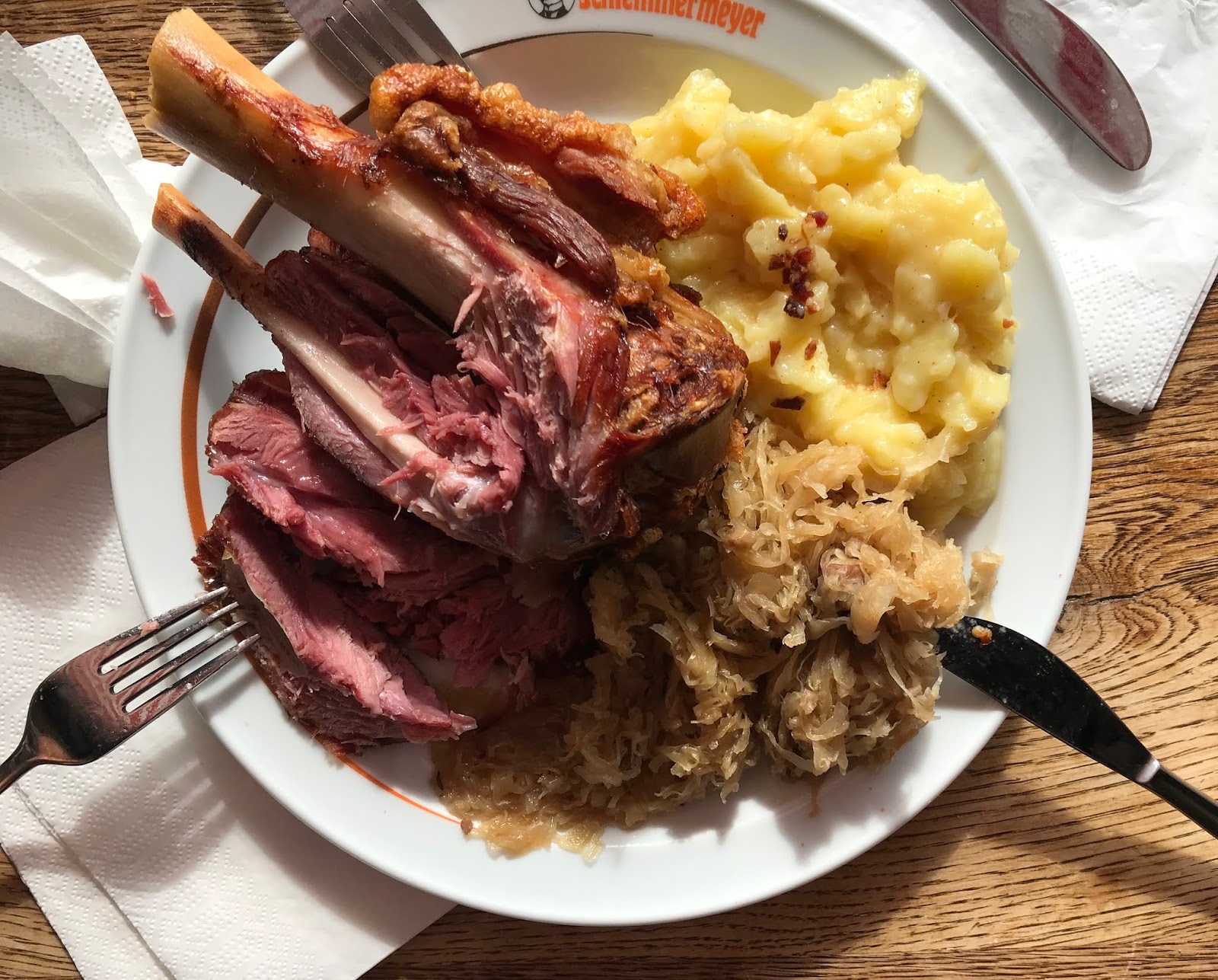
A dish of pork knuckles and potatoes
There is also the famous beer hall Hofbräuhaus München near Marienplatz.  This is a very popular beer hall, especially during Oktoberfest.  Some tourists think that they have come to Oktoberfest but it's not the official Oktoberfest, which is celebrated in Theresienwiese, a few miles away.


Large groups of Patrons in the busy Hofbräuhaus

Doris in the beer hall

Rathaus Glockenspiel in Marienplatz
One day we met my friend Paul for breakfast.  I met Paul and his girlfriend Alina while traveling in South Africa.  We were staying at a hostel in Coffee Bay, one of the most memorable places I visited there.  Read my blog here on Coffee Bay.

Meeting my friend Paul for Breakfast

Tasty German donuts
Tobias and his family one day took us to a nearby famous castle called Neuschwanstein Castle.  Unfortunately it was so popular and crowded that we couldn't get into the castle.  We walked around the grounds but it was also very crowded.

Neuschwanstein Castle
Visiting the castle with Tobias' family
One of the nicest things about visiting a local friend in a foreign country is eating what the locals eat. Tobias' and his family always take us to authentic German restaurants, sometimes quite far out of the away but they are always good.  The myth that Germany food is all potatoes and sauerkraut is not true.  There are a lot of great German dishes.

At a German Restaurant in Munich

The Menu

Name of the restaurant
Finally the day came that we are going to the Oktoberfest.  Wolfe, Sandra and their 3 sons drove in from near Heidelberg.  We had lunch together then get ready to head out.  Our table reservation is at 5pm so we took the train to near Theresienwiese and walked the few blocks to the grounds.  Security was very tight after a bombing few years ago.  The grounds are now surrounded by chain-linked fence so that security can screen everyone coming in.

Yes, we are at Oktoberfest but it is not a true experience unless you get into one of the beer tents.  The tents are owned by one of the few big Bavarian beer companies.  You can get in only if you have a ticket or wait in line early enough to get in before it's full.  I've been lucky.  My friend has a connection that he gets us table reservations every year.  This year he reserved two tables - one for the adults and another for their grown children.  These families knew each other when they were working in Singapore.  That is why I feel a closeness to them even though I did not know them in Singapore.

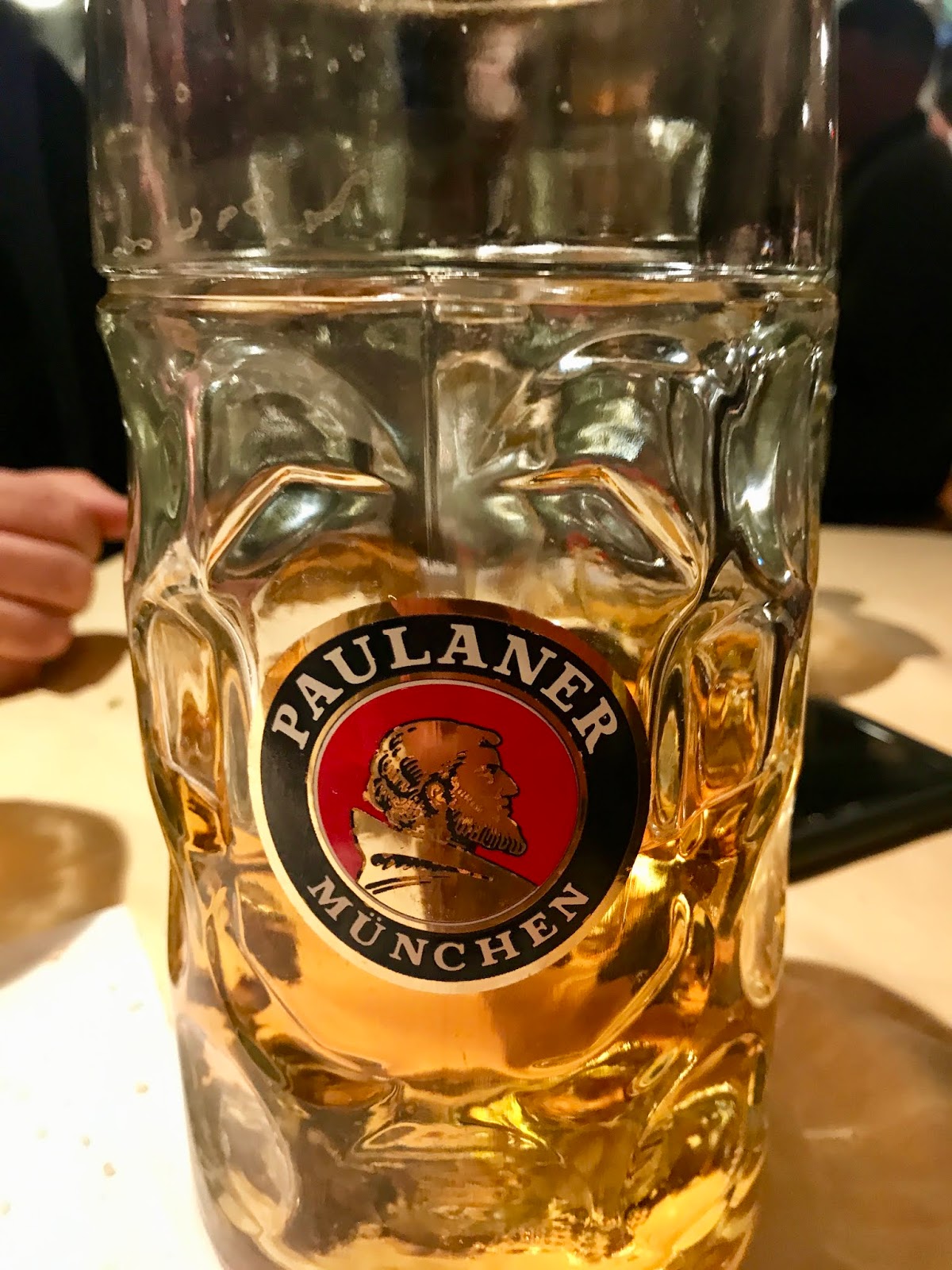
Coming here is not only about drinking beer.  It's about celebrating a festival, getting together with friends and having a good time.  The beer are brewed specially for Oktoberfest and have a slightly higher alcohol content.  They come in 1-liter jugs.  Not only are the beer great but the food is great too.  Here are some pictures of the good time that we had.

Dressed up and getting ready to go to Oktoberfest

Entrance

Doris and I outside the Paulaner beer tent
Besides beer there is tasty food too

Having a good time with friends

A 1-liter jug of beer

Beer Hall with a live band in the middle.  They play a lot of American music besides German polka music


Soft tasty pretzels

The kids are also having a wonderful time
It was a wonderful week in Munich, seeing old friends.  This is my 3rd trip to Oktoberfest and every year I look forward to going back.  One note about the German kids.  They are so nice and polite and friendly.  I felt like I have just spent a special and fun week with my extended family.