Saturday, March 17, 2018

On the Inca Trail to Machu Picchu - Day 0

On our first night in Cusco, we were given a briefing by our local guides, Santiago and Guillermo.  They both went through different parts of the hike, what to expect, what to bring, etc.  Santiago has been a guide for 23 years and has done this hike 732 times!  I am so glad he was our guide.

First, we were to leave most of our luggage at the hotel in Cusco.  We were told to bring only essential things for the 4 days on the hike.  We were each given a duffel bag to put some of our stuff; together with a sleeping bag, not to exceed 5 kg.  The porters will carry this duffel bag.  Each porter carries about 25 kg each.  On top of that we are to bring a day pack that we will carry ourselves; things we need while on the trail.

On this day we were to spend the night in the town of Ollantaytambo.  On the way there from Cusco, we stopped at various places in the Sacred Valley of the Incas.  First, we visited an animal farm where we were shown the difference between llamas and alpaca.  Then to a tourist shop that sells all kinds of touristic souvenirs.  We also saw some amazing sceneries.  Santiago also explained some of the crops that were grown by the Incas and present-day residents of the valley.

An Alpaca

Santiago explaining the crops that are grown in the area

A view of the valley from up high

Another view of the beautiful valley

Locals selling all kinds of souvenirs

More Souvenirs
We also climbed up to some of the Inca ruins in the Ollantaytambo Archaeological National Park, with a beautiful view of the valley.

Entrance to the park

A view of the ruins

A view of town through one of the doors

Above the ruin looking down at the valley
We stayed at a hotel called Tika Wagi Ollanta in town.  It is a nice, small clean hotel, about a 5-minute walk from the town square.  We had a little time to explore the town but it was very small.  Most tourists take the train from Ollantaytambo to Aqua Caliente, the town at the bottom of Machu Picchu.  From there, they take a bus up to Machu Picchu.

Another view of the ruin

The Incas were very skilled in irrigation

Two sisters posing in town

A statue in the town square

One of the streets in Ollantaytambo
Tomorrow we begin our real hike on the Inca Trail.

Friday, March 16, 2018

Cusco - Gateway to Machu Picchu

I finally have good WiFi in Peru.  I just checked into the Doubletree Hotel in Lima because I was so tired of staying at "half-assed" hotels that have WiFi that barely works and bathrooms that don't have hot-water.  I decided to splurge on my last 3 days in Peru and South America and booked a room at the centrally-located Doubletree Hilton Hotel in Lima.

Ok.  Enough griping.  You may be surprised to be reading about Cusco rather than 2 other stops that I made before coming here.  I am skipping over La Paz, Bolivia, and Puno, Peru, for now because I want to write about the hike on the Inca Trail before I forget a lot of the details.  The hike itself took four days, ending with the well-known Machu Picchu site.  However, most hikes or visit to Machu Picchu start in Cusco.

Cusco is a UNESCO World Heritage Site located in the southeastern part of Peru.  We took a 7-8 hour bus journey from Puno to Cusco and checked into the Hotel Cahuide.  Like most of the Tucan hotels where we've stayed, this is a modest 2-3 star hotel.  It is located about a 5-minute walk from the main square, Plaza de Armas.  Around the plaza are all the tourist shops and restaurants, catering to tourists that are using Cusco as a jumping-off point to Machu Picchu.  Cusco was the historic capital of the Incas before the Spanish conquest.

Plaza de Armas (Plaza of Arms), the main square

A cup of cafe con leche and pan y huevo.  Coffee w/ cream and bread with egg for 5 soles.


Peru-themed fabric

Mercado San Pedro, where you find all kinds of businesses

A mix of shops in the market

Selling grains, including quinoa, which sells for 8 soles (about US$2.50) per kilo

Even a Chinese restaurant

This one specializes in breakfast but it's more like a coffee shop
The food section of the market

A man using a manual sewing machine

Selling churros outside the market
A church outside San Pedro Market

One of the busy pedestrian streets
Hotel Cahuide
In Cusco you find many businesses catering to the tourists - from booking tours to different parts of Peru, to outdoor equipment and clothing, restaurants, money changers, etc.  You find tourists from all over the world - lots of them at the Plaza de Armas, the main square, museums, and restaurants.  They are either getting ready to visit Machu Picchu or just returned from there.

A lot of the locals conduct their businesses at the Mercado San Pedro, a local market.  It is a big market that has just about everything.  You can buy souvenirs of all types here, fruit juices, meat market, food court, spices, etc.  It's an interesting mix of businesses under one roof.  I visited this market on our second trip to Cusco, after hiking the Inca Trail.  I am glad I visited the market because I was so tired after the hike and I had to flip-flopped around town because my shoes were being washed.  I enjoy checking out the businesses - what they sell and how much they sell them for. I bought a few wooden spatulas that I am planning to give away.  You see pictures of some of the businesses above.  They have a food court here that caters mostly to the locals, at local prices.  You can get most of the meals for under 10 soles, or about US$3.  However, their hygiene is suspect because I don't see anyone using hot-water to sanitize the dirty dishes.  I was tempted to eat some of the food but my stomach wasn't feeling good that afternoon.  I settled for a cafe con leche and a pan y huevo, or coffee with milk and bread with egg.  It's interesting how the lady served me the cafe con leche.  She gave me a glass of milk and pointed to a small jug with black liquid.  It turns out that the small jug contains coffee syrup, so essentially, you add the syrup to the milk to make coffee with milk.  The whole shebang costs 5 soles or about $1.70.

Cusco has some very nice restaurants.  The first night we were there we went to a Cafe Morena, a contemporary restaurant serving excellent Peruvian food.  The price of an entree was about 40 soles or about US$12, not expensive but expensive by Peruvian standards.  The next evening we went to a restaurant/hotel called Fallen Angel, a contemporary restaurant and a boutique hotel.  The prices here are slightly higher.  We were there to celebrate the birthday of one of our fellow travelers, Nick.

Celebrating a birthday at Fallen Angel
On our second trip back to Cusco, after hiking the Inca Trail, we stayed 2 nights.  When we arrived we found that the hotel has no water.  Why?  Because somehow electricity was cut-off to the pump that pumps water to the hotel.  We were told there would be water in an hour.  So we went to dinner.  After that, there was still no water.  We were told again there'd be water in an hour.  We had not showered for four days on the Inca Trail.  Some of us decided that we could not wait anymore.  We were given the option to go to a sister hotel to shower.  I did.  I felt clean and fresh after that.  It turned out to be a good decision because when we returned to the hotel, we were told that there'd not be water until the morning.  I am glad I decided to take a shower at the other hotel.  Now I can go to sleep feeling clean.

Tuesday, March 6, 2018

Salar de Uyuni

After loading up, our caravan of 3 Toyota Land Cruisers (TLC) drove straight to the town of Uyuni to drop off our luggage at the Tonito Hotel.  Following that we drove to another part of Uyuni to visit some souvenir stalls and visit a salt factory.  There are many small salt factories in the area.  The sale is manually dug up from the salt flats, heated up to kill the bacteria, then put into small bags for sale.
We are now ready to visit the salt flats.

Salar de Uyuni  or commonly known as the Salt Flats of Bolivia is the largest salt flat in the world.  It covers an area of about 11,000 sq km or about 4,000 square miles.  When we visited in March, it was just after the rainy season.   The salt flats are flooded, which is a blessing because it allows some creative photography.  Because of the water you cannot tell where the sky begins and where the land ends.  It creates a mirror effect.

Souvenir

Picture from the salt flat

An Illusion created by the water in the salt flat

Man selling bags of salt
PS:  I've been having unreliable wifi since crossing over to Peru.  We are now in Cusco.  Day after tomorrow we'll start our Inca Trail hike to Machu Picchu.  Obviously, I won't have wifi on the trail.  I will have to update this post and add more posts when I get reliable wifi, perhaps in Lima.


Saturday, March 3, 2018

The Altiplano of Bolivia

We are to spend the next 3 days in the Altiplano of Bolivia.  The Altiplano is a high-plateau area covering parts of Argentina, Chile, Bolivia and Peru.  We were picked up at the Chilean-Bolivian border by 3 Toyota Land Cruisers (TLC) from the Andes Salt Expeditions Tour Company.  These TLCs' are all four-wheel drives which are necessary for the terrain that we will be driving through the next 3 days.  Our drivers are all native Bolivians, led by the leader Wahberto.  He is the only one who speaks English and knows the area very well.  I was in his vehicle and really enjoyed his knowledge of the area and Bolivia itself.

These area is well-known for its dormant volcanos and lakes.  Most of the lakes are toxic because of chemicals from the volcanoes.  Some have flocks of flamingoes in them.  The combination of volcanos and lakes is breathtaking.  On our first day we visited Laguna Blanca, Laguna Verde, deserts of Sabador Dali (spelling?), hot springs where some in our group too a dip, geysers and finally, Laguna Colorada.  We were at elevations of mostly above 4,000 meters (13,000 feet) so some in the group have symptoms of high-altitude sickness like headaches, nose-bleed, nausea, etc.  It was bad enough that some of them couldn't participate in any of the activities.  Where the geysers were, we were at 5,000 meters or about 16,000 feet elevation.  These landmarks are all in the Eduardo Avaroa National Reserve.  That first night we stayed at a very basic hostel within the National Park.  We had to share rooms and toilets.  There are no showers at this hostel.  There were five of us in my room.  Many of us couldn't sleep because it was cold at night.

Laguna Blanca, with volcanos in the background

Geysers

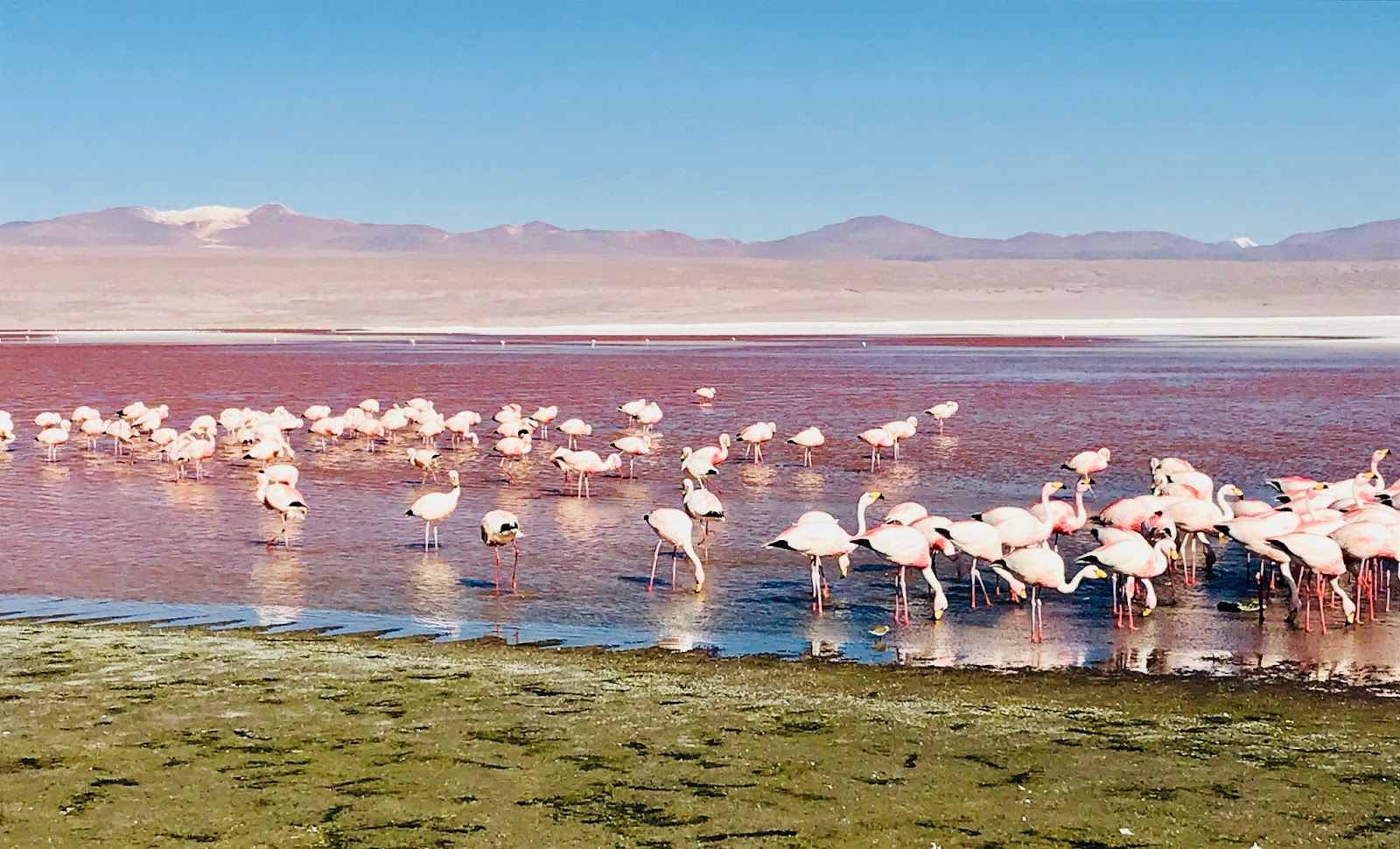
Flamingos in the lagoon

Water in the lake is toxic

Hot Springs for swimming

Arbol de Piedra, the famous Stone Tree

The Eduardo Avaroa National Reserve

Coca leaves, a drink that will alleviate altitude sickness

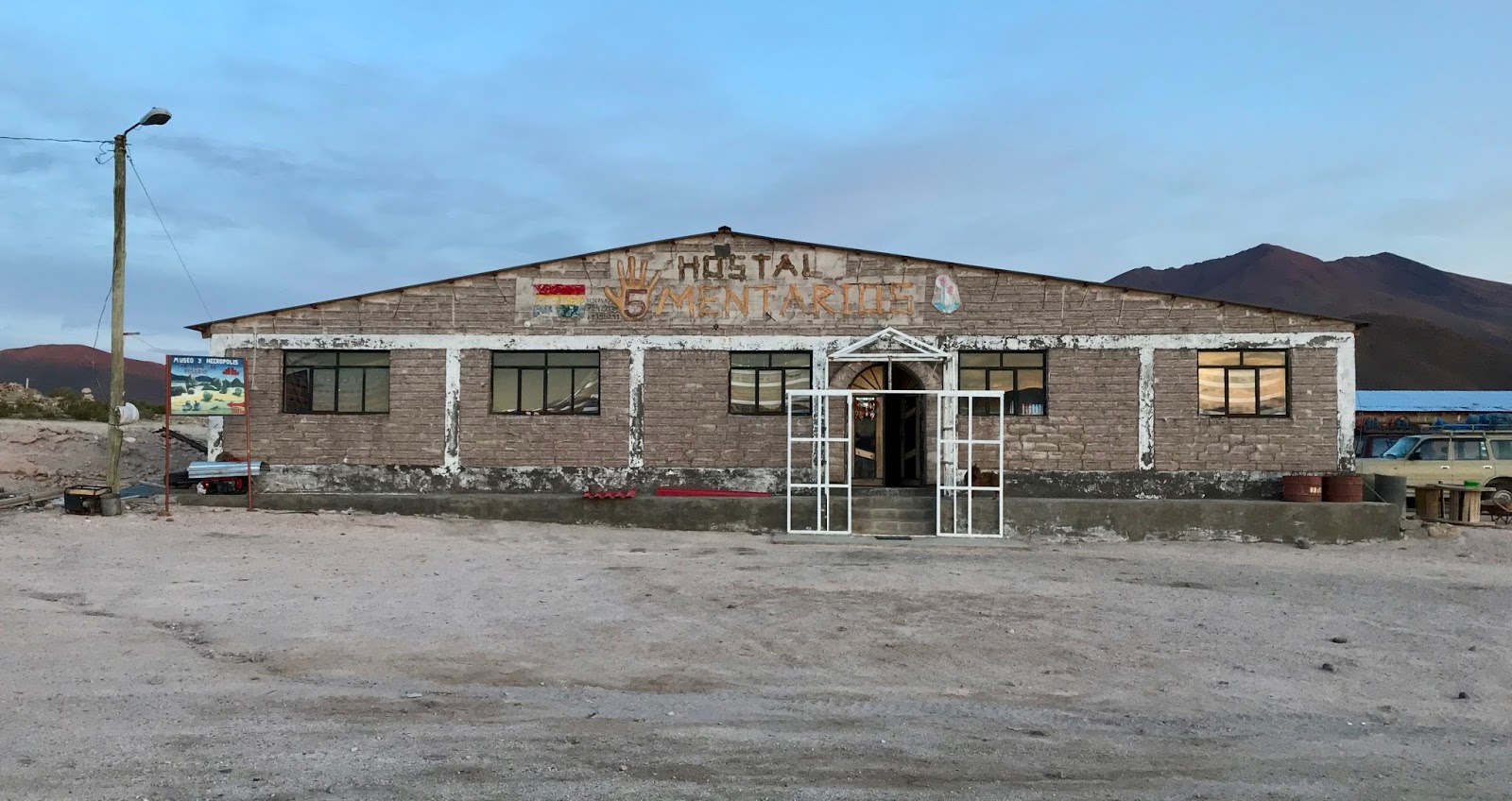
Hostel at Laguna Colorada
On the second day we drove through the Salar de Uyuni and stop at the train cemetery.  Old trains are deposited here.  Some are over 100 years old.  From there we stopped at the Seven-color volcano and Laguna Honda, Smelly Lake, Canapa, and finally, Laguna Colorada.  That night we stayed at another hostel at San Juan.  This hostel has more than basic facilities.  Although we have to share rooms, this hostel has hot-water showers.

Hostel in San Juan

Flamingos in Laguna Colorada

Quinoa plants being cultivated

Baby Llamas
On the third day we finally come to the famous salt flats of Bolivia.  I will write more about that in the next post.

Friday, March 2, 2018

Crossing The Border From Chile to Bolivia

Crossing an international border is a simple affair:  you go through Immigration, they check your passport and visa, if needed; then you go through Customs.  Our next destination after San Pedro de Atacama is Bolivia.  Two vans took us to the border, one for luggage, the other for passengers.  Normally when you exit a country, Immigration gives you cursory look at your passport, check your vehicle to make sure you are not smuggling anything out of the country, and then wave you on.  However, the morning we left for Bolivia, it was not easy.
We arrived at the Chilean border just before 9 am.  There was already a line of vehicles formed and we were probably number 6 or 7.  The border office was not yet opened.  By then some of us have to relieve ourselves and looking around the area, there were no facilities.  You can't stop Mother Nature so you find whatever concealment that works.  A mound of dirt, a bush, a building, etc.  Two cars enter the building at a time and went through a fairly thorough check.  Probably takes about 15 minutes per vehicle so that by the time we pass through we've already spent over an hour at this checkpoint.

Our vans drive us to a "no-man's land" between the two checkpoints and meet our next host and guide, The Andes Salt Expedition.  They came in three robust Toyota Land Cruisers (TLC).  Our group of 16 was split up into the 3 vehicles.  Our luggage was strapped to the roof of the TLCs'.  We then drove to the Bolivian border.  Here it looks like every backpacker in Bolivia has congregated there.  It took some time before our passports were checked and we were allowed to move on to our next destination:  the Altiplano in Bolivia.

It took us at least about 3 hours before we were finally on our way.  Well, it's not that simple after all.

At the border checkpoint

Lining up to go through Bolivian Immigration

A beautiful morning mist at the border from Chile to Bolivia

San Pedro de Atacama

After spending 3 beautiful days in Santiago, we took a 2-hour early morning flight to the high plateau in northeastern Chile, to the town of Calama.  In Santiago, 5 new travelers joined us - a couple from Sweden, 1 each from Spain, South Africa and Belgium.  We now have 16, the maximum, in our group.  This is why I like traveling with Tucan.  They limit the group to 16, which is big but not too big.  When I traveled in Russia, there were only 2 of us.  Sixteen allows you to get to know each other.

Two vans picked us up at the Calama airport.  One from luggage, the other for the passengers.  It is a 1 1/2 hour drive to the town of San Pedro, through landscape that looks somewhat like Arizona.  We checked in to the Ron Paul Hotel and took a quick orientation tour of the town.  I've never heard of San Pedro before but I was surprised how busy the town is.  It's mostly a one unpaved street town but the street was busy.  You can tell many tourists come here because you see all the shops are here to cater to the tourists.  Apparently, the world knows about this town except Americans.  Nearby are many recreational and sight-seeing places.

The most famous of these places is the Valle de la Luna, or Valley of the Moon.  A popular area for hiking and mountain-biking is the Catarpe Park.  After a hearty lunch we went to the bike shop to pick up our rental bikes.  Our tour leader told us it will be an easy bike ride.  After about 1 km we realized that this was not going to be easy.  Soon we came to a stream that we have to cross.  Though not deep, it was partly filled with small rocks, which can easily tip your balance.  Then we were riding through all kinds of terrain - sand, slopes, narrow passages, etc.  Many of us started feeling uncomfortable and stressed.  However, we continued, though many of us fell at least once.  Fortunately, no one got seriously hurt.  We all came back very tired.


Church in the Catarpe Park

Mountain Biking through the "Devil's Throat"


A delicious empanada

Store selling tours around the area

Main street in San Pedro

Crossing a stream

Welcome to Catarpe Park

A happy group of hikers

The next day was an easy day.  Some in the group went on a "Free" Walking Tour of the town.  Most of us just rested, waiting for the visit to the Valle de la Luna to start at 4pm.  A van picked us up and 
to the park.  We first did a few hikes through the area, admiring the beautiful landscape.  Just before sunset we were driven to an area where we could see some dramatic scenery while watching the sunset.

Tres Marias or Three Marias

A group picture in the Valley of the Moon

Climbing through a narrow area

A Welcome sign at the Visitors' Center

A rough terrain

One of the hikes