Tuesday, October 3, 2017

Oktoberfest II

This is the second year in a  row that I've come to Munich for Oktoberfest.  How can I resist the invitation from my friend Tobias.  He texted me back in May that they might have a table reservation again this year.  When I was able to snatched an airfare deal for Phoenix to London round-trip for $546, it was a done deal.  I started to build a multi-country trip around Oktoberfest.

First, I'd stop in England for two days:  1 day in Stratford-upon-Avon and another day in Oxford.  The two previous posts are on those two beautifully charming cities.  I arrived in Munich on a Friday evening, bought my week-long train pass (cost US$41) and ready to take the S-Bahn to Daglfing station.  This would take about 30 minutes but something happened on the tracks between the airport and Daglfing station.  Someone decided to be on the track and the train can only go up to 2 stations before Daglfing.  If I take the train going the other direction it'd take about 1 1/2 hours.  So, I called my friend to pick me up.  Still feeling fatigued from jet-lag, I had no trouble falling asleep.

The S-Bahn is the regional train.  Around the city you take the U-Bahn.  The train system, as in most European cities, works very nicely, moving a lot of people on tracks instead of cars on the highway.

The big day arrives the next morning.  We had a nice big typically German breakfast.  Lots of bread, cheese and cold cuts.  Later, friends Wolfgang, Sandra and their son Daniel, arrive from near Frankfurt.  We had a light snack at about 2 and at about 3pm, we were ready to go.  We took the S8 train to Hacker-brücke station.  It was packed with people, mostly coming but a few leaving.

Everyone is all dressed up (except me) and ready to go to Wiesn


Huge crowd getting off the train
Security is tight.  All bags and backpacks are checked.
Most people who have never been to Oktoberfest (or properly called Wiesn by the Germans) have no concept of how it works.  First, you enter a big fairground area.  Security is tight, after a bombing incident about 10 years ago.  Bags and backpacks are checked.  This open area has souvenir stands, rides, food, etc, and mostly importantly big beer tents.  The actual drinking and celebration are in these big beer tents.  They have names of the sponsoring breweries but nowadays they are owned by individuals or companies.  The best way to get into a beer tent is having a table reservation.  You are given a wrist band for your reservation and your table is ready for you and your guests.  If you don't have a reservation, then you get into the tent on your own.  If you come early or during the week, it may not be difficult.  But, if you come on the weekend, then it becomes a challenge.  You may not get  in at all.  In the event that you are able to get in, you will be in an open area.  You need to be near a table to order a beer.  Otherwise, no beer.

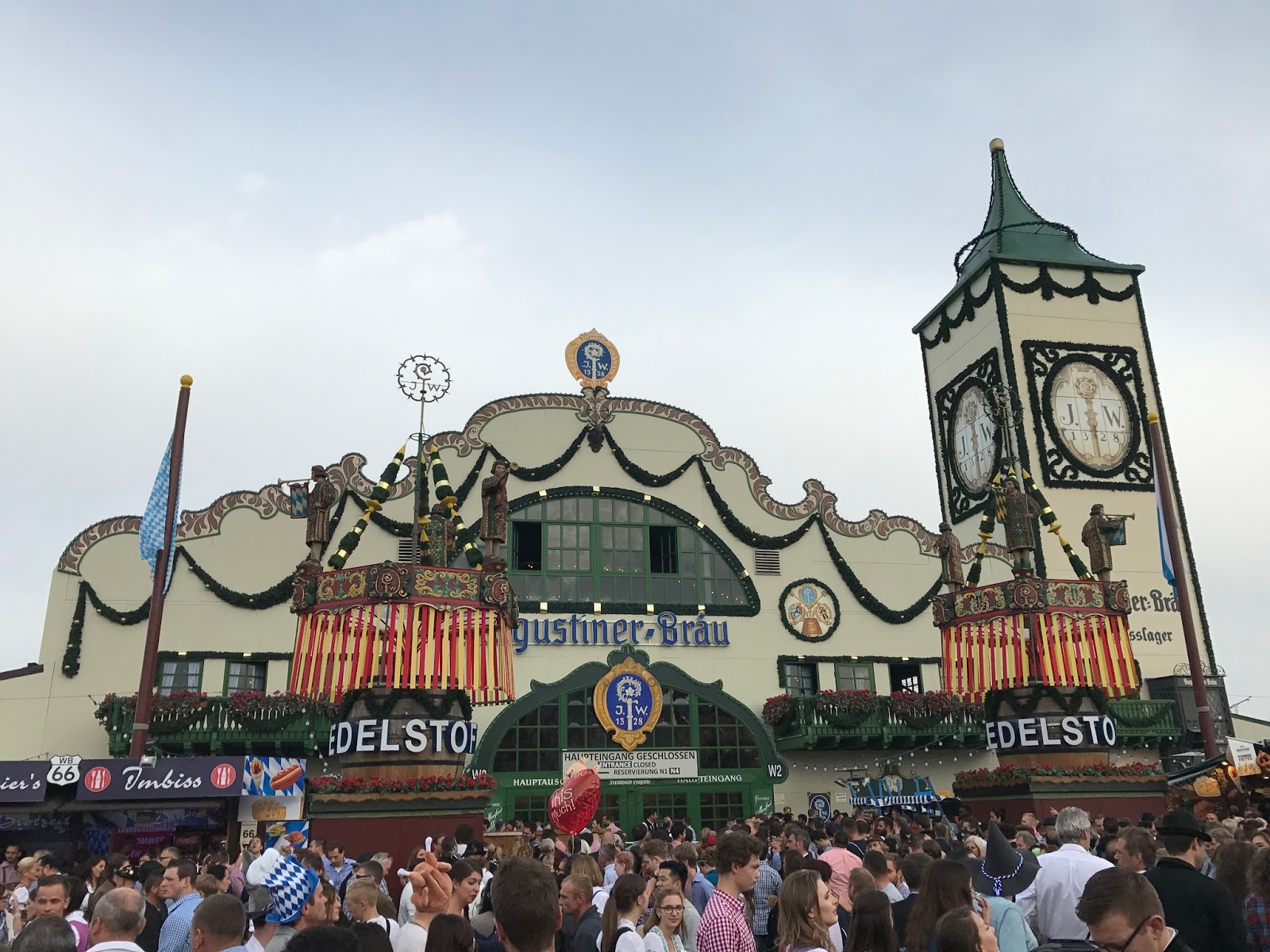
One of the beer tents

Another beer tent
Waitresses carrying as many as 10 1-liter mugs of beer.
Inside the big beer hall, including the band stand
The band plays some popular favorite music, like Sweet Caroline, Sweet Home Alabama, etc.  Music that you can sing and dance to.

You don't buy beer.  You rent it.  Here's where you return it.

You need food so that you can drink more
Pretzels here are so good.  They are soft, not hard like a rock

This couple enjoys more than drinking beer

Partying Italian women from Venice

Italians are the ones who want to hug and kiss you
Souvenirs for sale

Security is tight inside as well.
Our table with friends from all over Germany

Monday, October 2, 2017

Oxford

I had a good sleep and woke up at 5:30am.  Jet-lag is a problem flying east sometimes.  After updating my blog, I was ready for breakfast and be on the road to Oxford.  But nearby, about 15 minutes away, is the Warwick Castle.  I heard this one may be worth a visit.  I've been to several castles on previous trips to Ireland and Scotland but I am curious about Warwick Castle.  Using my GPS I followed directions to the castle.  When it announces that I've reached my destination, I look around and see a tall wall next to a residential neighborhood but no castle.  I stopped and asked a local resident and he gave me some general directions.  When I parked my car I looked for a sign that points to the castle but there wasn't one conspicuous.  I walked in the wrong direction and wasted at least 30 minutes before asking a contractor.

I had a 1/2 off coupon given to me by Pascal, the owner of the B&B.  that helps because the entrance fee is £26, a very steep price just to see how the rich used to live.  Besides, I have to pay £6 for parking.  The castle is very well done and maintained.  The grounds and surrounding areas are also beautifully manicured.  The exhibits were mostly about the lives of Lord Warwick and his family.  I have never heard of him but he was likely a very important and powerful person in his days.  In those days the feudal lords and the church own all the land.  The peasants had to work very hard to pay rent and are at the mercy of the aristocracy.  With the rise of unions and industrialization, these aristocrats start to lose their hold over the people.  Many had to give up their castles because they don't have the income to maintain them anymore.  Although a nice castle, I'd not have gone out of my way to visit, if I were not so close.

Warwick Castle, from the outside

Armor Exhibits

Inside the Castle grounds

After Warwick, I programmed the GPS for the Sportsview B&B in Oxford.  Again, I just entered the postal code and it knew where the destination is.  It took me a little over an hour to drive from Warwick to Oxford.  Some of it was on highways, some through small towns.  I did not have any problem with the manual stick, nor did I have any problems driving on the left-side of the road.   The challenge for most Americans may be the roundabouts, which are at almost every intersection.  This may have been thought of as a dumb idea but more and more American cities are adopting them.  They keep traffic moving.

The GPS announced that I have arrived at my destination but it was a narrow road and there were cars behind me.  Fortunately, I spotted a small side street and turned in.  Viola!  The Sportsview B&B was just right there and I backed into the car park (as the British would call it).  Kevin, the host welcomed me and showed me my room.  The B&B is three adjoining row-houses (or townhouses, as Americans would call it).  They are connected in the basement together.  I have an ensuite single-room, which means I have my own bathroom.  The cost?  £55, about US$75.  Like the previous B&B, it an old clean room.  Nothing fancy.   When traveling, I just have 3 simple requirements - a place to sleep, shower, and leave my stuff securely.  A hostel with multiple beds in a room would've been cheaper but I find that my snoring doesn't make me a good roommate.  I've been kicked and threatened before.  Besides, I carry quite a bit of expensive electronic equipment nowadays and want to make sure that they are secured.

Kevin gave me a map and showed me how to get to the city center of Oxford.  It's a 15-minute walk.  I found out that there is an official walking tour at 2pm so I walked hurriedly to the Visitor Center.  The walk was about Oxford University and the City.  There were about a dozen people on the tour.  Our guide, Bella, obviously has lived in the city for a long time and knows a lot about the university and the city.

Walking through Oxford University is like traveling through medieval times.  It was said to have been founded in the 11th or 12th century.  It is the oldest university in the English-speaking world.  38 colleges make up Oxford University.  Each college is autonomous and has its own buildings and facilities.  It does not have a main campus.  Some of the better known colleges are Christchurch, Corpus Christi, Trinity, etc.  Below are some pictures of the town and university.

Cornmarket Street, a pedestrian mall

Part of the Bodlein Library

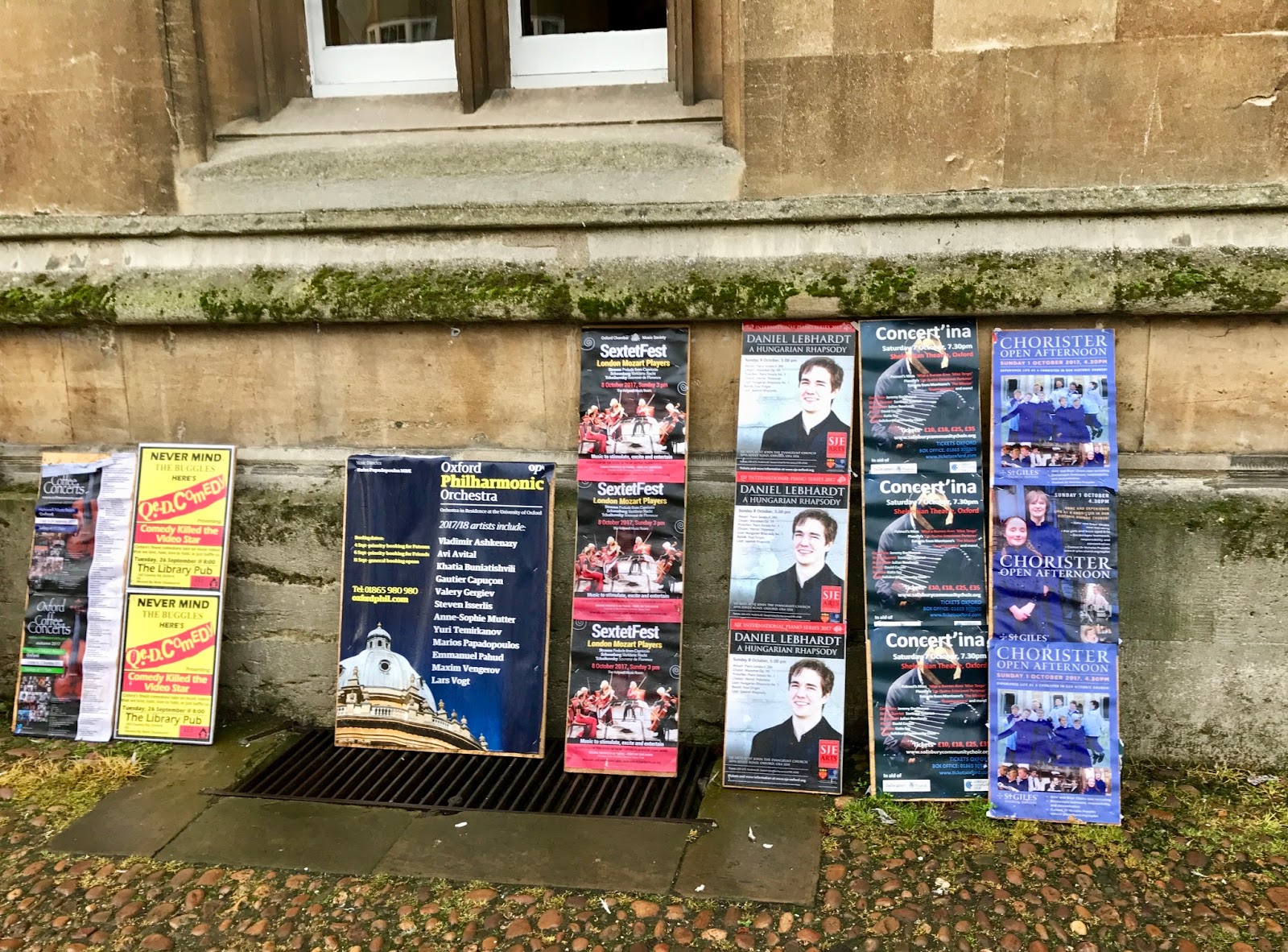
Promotional Displays on the street

Radcliffe Camera, actually a library.  The iconic building of Oxford

Meadows at Christ Church College

Bodlein Library

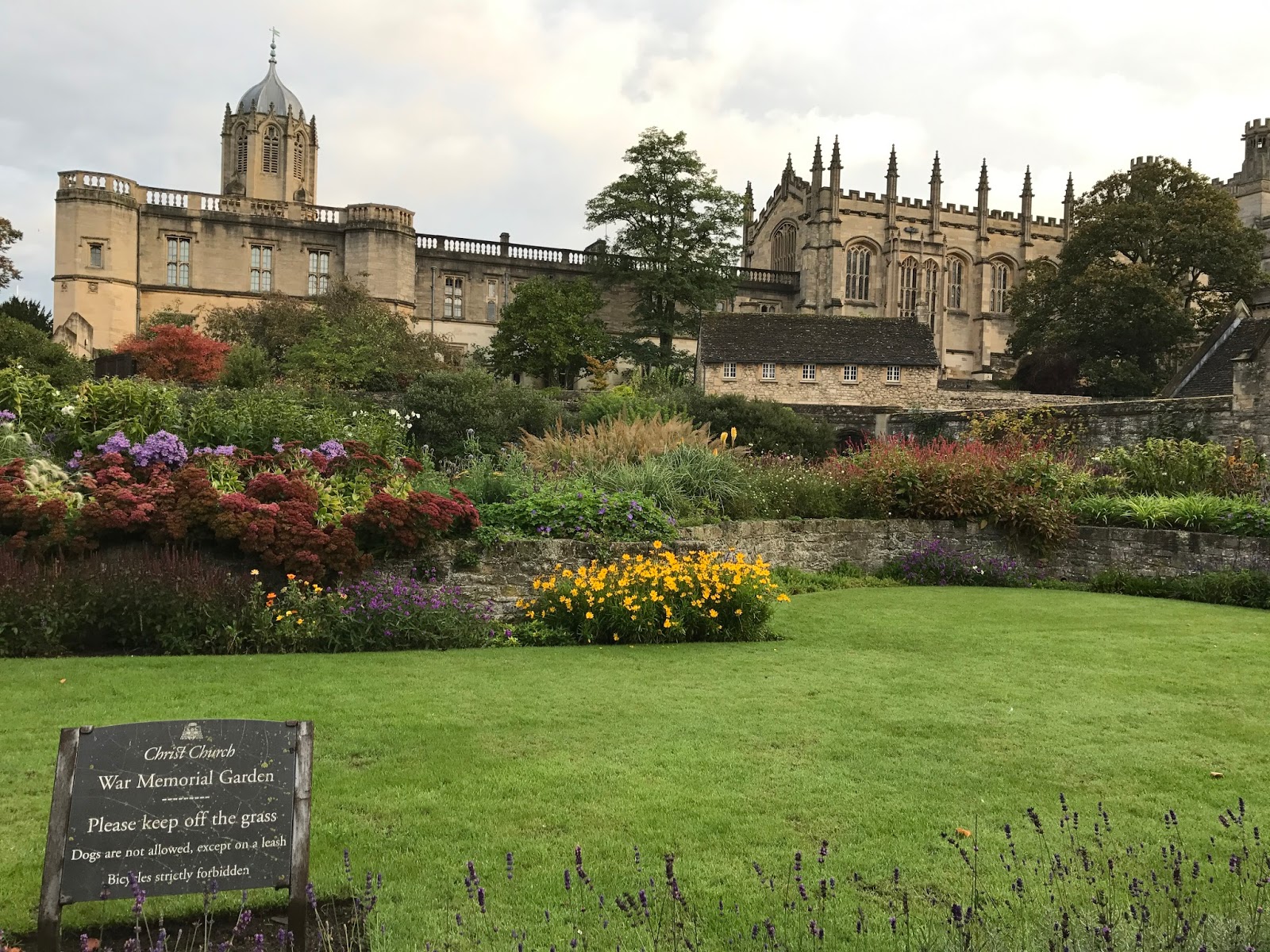
Christ Church College, from the War Memorial Garden
I'm glad I decided to come to Oxford.  It's a beautiful city.  Walking around town and the university is walking like through history.  Its alumni are the Who's Who of the famous people in the world:  J.R.R. Tolkien, C.S. Lewis, T.E. Lawrence (of Lawrence of Arabia), Walter Raleigh, Bill Clinton, Stephen Hawking, etc, and 27 British Prime Ministers.

The rental car was expensive - about £180 or US$250, for two days.  But it was worth it.  Taking public transportation to Stratford-upon-Avona and Oxford would have mean a lot of juggling with train and bus schedules and I would not have seen as much as I did.  I could've saved some money by filling up the gas tank but I didn't know where the gas station (or petrol station as they called it here) was.  I may get lost and return the car late.  Then I'll be charged an extra day of rental.

Saturday, September 30, 2017

To Be or Not To Be?

The first leg of this European trip takes me from Phoenix to London.  I planned to spend two days in England before flying to Munich, my targeted destination for this entire trip.  I debated on what to day in two days around London.  Should I just stay in London or should I go somewhere nearby.  I've always wanted to go to places near London, maybe 1 to 2 hours away, like Cambridge, Oxford, Stratford-upon-Avon, York, etc.  After many considerations and research, I decided to go to Stratford (short for Stratford-upon-Avon) and Oxford during these 2 days.  The reason is because they are both in the same general direction from London.

My preferred option when I travel is to take public transportation - bus or train.  After looking at the bus and train options, I realized that it is not an easy option going to both of those places.  I'd have to change trains several times and the walk from the train or bus station to where I will be staying is too far.  So, I decided to rent a car.  The first question friends asked me when I tell them I am renting a car in London are:  do you know how to drive stick-shift and do you know how to drive on the "wrong" (i.e left-side) of the road?  The answer is Yes and Yes.  I grew up in Singapore learning how to drive a manual transmission and sitting on the right side of the car.  It may take me a few minutes to get oriented but once I start driving, it comes naturally.

I've been spoiled by a low rental-car rate in the US using my former employer's corporate discount.  I was surprised when I reserved the car how much it costs to rent a car for just two days.  Throwing a GPS and insurance, it came up to about US$200 for two days!  First, I need to get oriented with the car.  How to use the built-in GPS?  I found out that instead of entering the full address, you can just enter the postal car and it will know where the destination is.  For example, the post code for the Salamander B&B where I was staying in Stratford is CV37 6PB.  That's all I need to enter and it did get me to my destination.  The second thing I need to learn about the car is putting it in reverse gear.   Most of the manual transmission cars that I've driven, you push down on the stick and shift the stick either up or down.  I couldn't figure this new car out!  Finally, someone showed me that there is a ring below the stick that you pull up, which engages the reverse gear.  Now I need to figure out how to open the door to the gas tank.

As anyone using a GPS can tell you, sometimes you blindly follow the directions, which seems to take you round and round in circles.  It took me about 30 minutes before I realized I was finally on the M40 highway out of London towards Stratford.  It took about 2 hours to drive from London to Stratford.  The GPS finally located my B&B.  Here comes another challenge:  a very narrow alley, just wide enough for my small car.  I managed to slowly squeeze through and park in the very limited space that the B&B has for guests.

Salamander B&B

If you've never stayed in a B&B, especially in Europe, you should.  B&Bs' preceded AirBnB.  The difference?  These people have been doing this for a very long time.  They pride themselves in providing a homely atmosphere for their guests.  AirBnBs', especially those who are new, are just there to make money and have little hospitality experience.  I was greeted by Vivian, the housekeeper at Salamander, and shown my room. Pascal, the owner was out shopping.  Why did I pick Salamander?  I read about the B&B in an old Rick Steve's book on England and I read the reviews.  For £40.50 or about US$55, I was given a single room with its own bathroom (down the hallway) and a full English breakfast.  The building and furnishings are a little old but they are all in good condition, clean and comfortable.  I don't need to spend $200 on a hotel where I don't care about all the amenities.  The English breakfast was excellent.  What's different about an English breakfast?  It usually includes baked beans and fried tomatoes, besides the bacon, ham, potatoes and fried eggs.  You sit in a dining room and share tables with other guests.  There were probably about 20 guests altogether, from different countries - New Zealand, India, US, etc.

An English Breakfast

Stratford is a small old English town by the river Avon, hence the name Stratford-upon-Avon.  It is about a beautiful 10-minute walk from the B&B to the Royal Shakespeare Theatre.  I walked past row houses that are probably more than 100 years old.  The theatre is modern and sits by the river.  The river is charming, reminding me of many pictures of the English countryside that I've seen.  There were ducks and swans, barges and row boats for rent.  A dirt path goes along the side of the river goes from the theatre to the Holy Trinity Church, where Shakespeare was buried.  I spent about a couple of hours in this area, because it was so beautiful and green.  Times seems to slow down; watching the ducks and swans, the boats and the river flowing gently through the lushly green river banks.  The oak trees are starting to shed some of their multi-hued leaves.

The charming Avon River, with white swans, ducks and boats (named after Shakespeare plays) for rent.


Another perspective of the Avon River, looking towards the bridge

Royal Shakespeare Theatre

Holy Trinity Church, where Shakespeare was buried

Inside the church, where Shakespeare was buried
This area has been settled since the 7th century.  It became a town in the 12th century.  Shakespeare was born here in the 16th century.   He died in 1616 and was buried at the Holy Trinity Church.  The entire town is mostly dependent on tourism because of Shakespeare.  Some friends who have been here told me that there is not much to see here but I disagree.  I think the town is charming and quaint.  I know some people called small towns in the US or Canada that are over a hundred years old quaint.  Stratford is more than 500 years old.  If there is a word for quaint, this is it.  Just walking around town, admire the old architecture, shops, and the river, is just plain beautiful.  Click here to read more about Stratford.

Another thing I discovered while walking around town are the Narrowboats.  In the old days, towns are connected by rivers or canals.  England has an extensive network of narrow canals that are navigable only by these narrowboats.  Today these boats are used mostly for tourism.  I was told by one of the boat owners that you can rent (or hire, as the British would say) one of these boats for 2 weeks for about US$2,000.  The boat can sleep up to four guests, plus the two boat operators.  There are cooking amenities on the boat - stove, refrigerator, microwave, etc.  But some people prefer to eat at the pubs at the town where they stop.  It is a beautiful, slow, leisure way to enjoy your holiday.  For example, you can take one of these boats to Cambridge.  It will go through canals, passing through locks, and stopping at small English towns.


Narrowboats anchored at the canal

Here are more pictures of Stratford:


A series of Shakespeare plays

Beautiful walkway outside Holy Trinity Church

Two institutions that are getting obsolete:  Royal Mail and the Public Telephone

Lucky to be able to get a ticket to the Royal Shakespeare Theatre.  But I was too tired to stay awake

A statue in honor of the Bard

Thursday, September 28, 2017

Slot Canyons

In late September, I took a group of 4 participants to a photography workshop in the Page, AZ, area.  The name of the workshop is called Slots Canyon because the highlight of this trip are the slot canyons in Antelope Canyon.  There is a Lower and Upper Antelope Canyon. One is on the north side, the other on the south side of Highway 98, about 15 minutes outside of Page.  The iconic sandstone sculpture is unique and unforgettable.  Once you see it, you will always relate them to the canyons in this area.  They are extremely popular with foreign tourists.  Ironically, many Americans have seen pictures of it but have never been there, including Arizonans who have lived in the state all their lives.

We visited Lower Antelope Canyon twice, each lasting about 2 hours.  Photographing the canyon is a challenge because of the the number of tourists passing through.  Our young guide, Brendon, has some photography background and knows where the good spots are.  He was able to gain cooperation from his fellow guides by stopping the tourists at times to allow us time to take some excellent shots. All of us in the group came away with some beautiful photographs.  Here are some that I captured.

With that many foreign tourists everyday, the Navajo guides have been able to pick up some foreign languages.  Probably the biggest group of tourists are the ones from China.  I heard "kwai tien!" (meaning hurry) and "cho la" (meaning let's go) many times.  The tourists are not supposed to stay and take pictures but if you've come this far and see something so amazing, how can you resist?


Taken with my Nikon camera with some post-processing.  One of my best
Face of an Eagle

A narrow canyon

Beautiful colors in the canyon
A group picture in the canyon

Have to be extra careful climbing down

We had a sunrise shoot at another iconic tourist spot, about 10 minutes outside of Page - the Horseshoe Bend.  Here the Colorado River takes a 270 degree turn around a gigantic rock.  Even though we were there at 5:30am, there were many tourists there already.  It gets more and more crowded as the morning goes on.  Later in the day when we drove by the parking lot, it was entirely full.  Many tourists buses make this one of their key stops.  You will see why by looking at its unique geography below.

Horseshoe Bend
My iPhone camera did not do the picture justice.  You need a wide-angle lens to capture the majesty of the area, including the horizon above this picture.  Unfortunately, I broke my wide-angle lens for my Nikon DSLR camera a couple of days before this at another sunset shoot nearby.  This is the hazard of photography.  You are so engrossed with taking a shot that sometimes you get careless with your equipment.  Most photographers can tell you stories of equipment that they lost or broke.

German girl doing a yoga pose above Horseshoe Dam
We struck up a conversation with a couple of German girls who were there to admire the scenery.  As we were leaving, one of them struck a beautiful yoga pose.  We were all amused.  It was a conversation topic the next couple of days.

We also went to many other places besides the 2 that I mentioned above.  This area, including southern Utah, has very unique geologic formations.  Here are some of them.

Toadstool


Wavy formation at Water Holes

Another Toadstool
One morning we took a river tour down the Colorado River from the Glen Canyon dam to Horse Shoe Bend.  It's a different perspective, seeing the canyon from below.  The rafts are similar to the ones they use for the Grand Canyon River trip that I took several years ago.  They sit above 30 people.

Bridge across Colorado River and Glen Canyon Dam

Another boat on the river

The boats are similar to what are used for the Grand Canyon River rafting trips.

A group picture
Five days went by very quickly.  Perhaps because we were constantly on the go and because we all got along.  There are always different personalities in a group like this but being a small group, there is less friction.  The two older folks did slow us down sometimes but nothing that kept us from taking some excellent photographs.

Thursday, August 3, 2017

Traveling in Mexico - is it safe?

I want to circle back to the beginning of this Mexico trip, when friends asked me whether it's safe to travel there.  After traveling for 2 weeks in Mexico, the answer is YES.  However, it's no more safer or dangerous than many of the places I travel to.  There are bad people everywhere.  As I've said many times, sometimes I feel less safe in the United States than in other countries.  Why?  The answer is the easy availability of guns in America.  Just because the Second Amendment said that you are allowed to carry guns, doesn't mean you should.  I think a person carrying a gun feels more powerful, stronger, dominant, and therefore, can challenge anybody.  It's a "Frontier Days" mindset that is clearly obsolete.

Mexico, like most countries in the world, do not allow any private citizens to carry guns.  Yes, the drug cartels have guns (mostly smuggled in from the US) but they are not going to go after a small fry like me.  Most crimes that you come across in Mexico are petty crimes;  like pickpocketing, purse snatching, robbery, sexual assault, etc, that are by means life threatening.  So, what then are my recommendations for avoiding such incidents when traveling in countries like Mexico, or anywhere else?

  1. Don't wear expensive clothes and jewelry.  Unless you are going to a very expensive restaurant or official function, you can be grubby when you travel.  Just wear something decent and you will be staying inconspicuous.  That's the trick - to blend in with the crowd.  If you stand out, you are asking to be robbed.
  2. Leave your passport in the hotel safe or the hotel receptionist.  Make a few copies of your passport and put one in your pocket.  Hide the others in different places in your luggage, valuables, make-up bag, etc.  Write your address, phone and email address on the other side of the copy.  This serves two purposes:  One, if your luggage or valuable is lost, they can track you down and return it.  Two, passports are very hard to replace when you are overseas.  US Passports, especially, are very sought-after items.  If someone ask for evidence of your citizenship, a copy of your passport will usually suffice.  Even money-changers or hotel registration will accept copies of your passport.
  3. Don't walk alone at night, especially women.  There are all kinds of crazy people out there and they see someone alone as an easy target.  If you must walk alone at night, walk in a busy area where there are lots of other people.  Walk in the middle of the street where you are not easily surprised by someone hiding behind something or in the shadows.  Wear light color clothes so that drivers can easily see you when you are crossing the street.
  4. Most of the time I go to an ATM to get a country's currency when I land at the airport.  Find an ATM that you see someone withdrawing money from it.  That is evidence that it is working.  If not, wait until someone withdraws money from it before you withdraw yours.  When entering your PIN, hide your hand or use your body to hide your PIN.  Make sure no one is behind you and looking over your shoulder.  If the ATM looks strange, walk away from it.  Someone may have installed a skimming device on it.  If you are in the city, withdraw from an ATM at a bank when it's open.  I've seen many ATM cards being "swallowed" by ATMs' and the customers almost in tears. If you are in a bank, you can get someone in the bank to help you.
  5. Don't buy a bus or train or any ticket from someone other than the official counter or ticketing machine.  I once bought a ticket from someone at a train station in Berlin.  I thought I would save 3 euros.  On the train the ticket inspector checked my ticket and told me it was a counterfeit ticket.  I ended paying a 40 euro fine.  Not worth trying to save a few dollars or euros.
  6. Make copies of the front and back of your credit cards and hide them in different places in your backpack or suitcase.  In case your wallet is stolen, you can quickly go back to the hotel, use Skype or any other means to call your credit card company to cancel your credit card.  The customer service number to call should be on the back of the credit card.  The toll-free call is usually free.  But, first you should open a Skype account.  Put some money in there in case you need to call home.
  7. If you don't feel good about an area, it's best to wear a money belt.  The money belt is tucked into your pants and it's near impossible to take anything from it without alerting you.  Bring as few credit or debit cards as you need whenever you are walking around in public.
  8. If you are an American, don't be loud or let everyone know you are an American.  In today's political climate there are people who just don't like Americans.  Likewise, don't wear clothes or any indication that you are an American.  You will notice Canadians always put a Canadian flag on their suitcase or backpack to let people know that they are NOT Americans.  They don't want to be mistaken.
  9. Don't always be ready to help.  Sometimes it's a distraction so that this person's partner can pick-pocket you when you are helping the first person.  This is especially true in popular tourist cities in Europe.  Also, don't let any gypsies get close to you.  A group will swarm around you and before you know it, your wallet is gone.
I will update this list as I think of more advice for my friends who are reading this blog.