Monday, July 24, 2017

Chichen Itza

Chichen Itza is the face of Mexican tourism.  It is one of the most visited archaeological sites in Mexico with over a million visitors every year.  Because it's such an important site I thought it'd be good to to focus on it alone instead of mixing with my last post for this Mexico trip, which is on Cancun.

El Castillo, the Temple of Kukulkan
We left Merida early at 5 am so that we can be one of the first in line to get into Chichen Itza (CI).  This is not only a smart move but weather-wise it makes a lot of sense.  Keep in mind that this is July and we are in a tropical region by the ocean.  The temperature will probably reach about 90F and the humidity will be about 80%.  It's relatively cooler in the morning and the smaller crowd makes it easier to take pictures.  We arrived at the entrance just before 8 am and were the one of the first 5 in line.  Our guide, Diego, met us at the entrance.  He explained later that most Mexicans from the area have Mayan blood in them.  He has been a guide for about 10 years and speaks fluent English.

It is impossible for me to repeat what Diego explained in two hours.  There are too many details and sometimes I stole away to take pictures.  If you are interested to learn more about the Mayan history and CI, you should get a book on it or for a summary, click on the Wikipedia link at the beginning of this post.  One thing I remember Diego saying is that a lot of what he said are hypotheses because there were no records of who lived at CI and what happened there.  It was said that there were 24 books on Mayan history written by the Mayans but they were burned by a Spanish missionary, except for 4 that are now in various museums in the world.  (I know I am not factually correct here but I hope to find more details later.)


Skull Platform

Venus Platform in the Great Plaza

One of the small statues

More excavation found a different level

El Caracol, Observatory

Temple of the Warriors

The Sacred Cenote (a sinkhole with fresh water)

More engravings from the Skull Platform

Grand Ball Court, with the stone ring at left of center


More engravings

Temple of Warriors
After an hour at the site you start to see a constant flow of tourists.  By the time we left at about 11 am, the entrance to the site was like a zoo.  Tourists come from all over the world and you can hear different languages spoken.  Those who did not hire a guide have to guess what each structure mean.  Each guide costs about 1,000 pesos or about US$55.  If you are in a group, I think it's worth it.  As we leave, big tourist buses from Cancun, about 2-3 hours away, start arriving.

Until 10 years ago, tourists were allowed to climb El Castillo, the main temple.  For safety reasons and fear of vandalism, visitors are not allowed to climb the steps anymore.  Again, I suggest you click on the Wikipedia link above to read more about the history of Chichen Itza and the Mayans.  If you have a chance to go to Yucatan, I strong suggest you visit the site in person.


Saturday, July 22, 2017

Mérida

In the morning we checked out of our hotel in Palengue and walked about 5 minutes to the bus terminal.  We were to take the 8:30am bus to Mérida, our next destination in the state of Yucatan.  We'll be traveling from Chiapas, through the state of Campeche, then Yucatan.  It's a 8-9 hour bus ride, but at least the bus stopped for lunch and we were able to get out and stretch.  Although the bus is fairly comfortable, being stuck in one is not my idea of fun.  I was able to pass the time listening to music on my iPhone with my noise-canceling headset.  I could've read my Kindle but the uneven road and the bumpiness of the ride would've given me a headache.

We arrived at Mérida at about 5pm and checked into the Hotel Colonial, about 3 blocks from the zocalo.  Mérida is the capital of Yucatan.  An old colonial city with beautiful buildings and churches around the central square.  Signs of tourism are everywhere around the square: foreign tourists, souvenir shops, nice restaurants, shopkeepers speaking better English, tourists buses, etc.  However, the locals also congregate around the square, especially in the evenings.  A restaurant specializing in ice-cream, smoothies, Mexican desserts, seem to be a very popular meeting spot for locals and tourists alike.

Zocalo in Merida

A monument at a nearby square

Cathedral next to the zocalo

Government building on another side of the zocalo
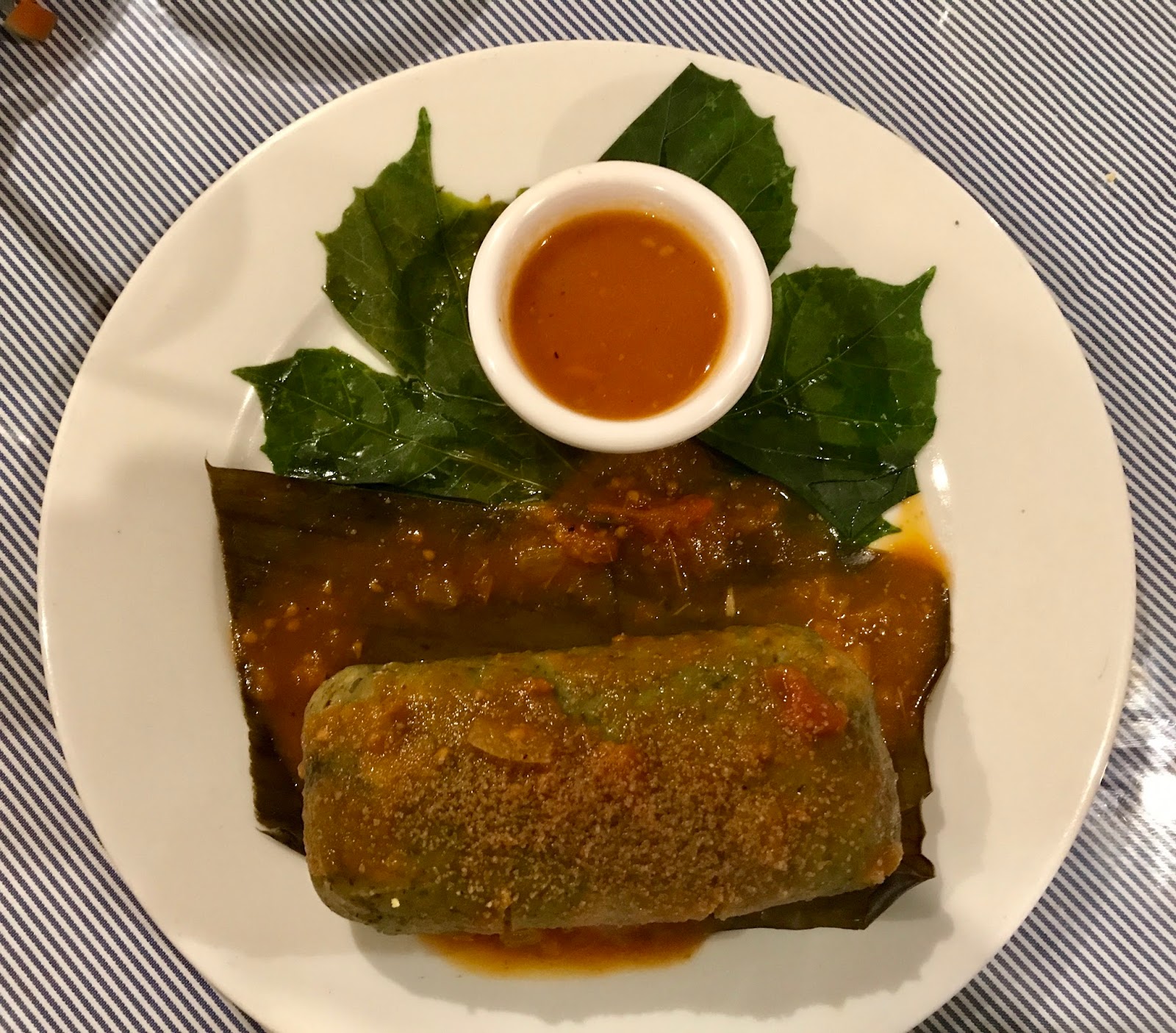
We spent little time exploring the city.  By the time we arrived there, it was dusk and as we started walking around, there was a sudden tropical downpour.  We met for dinner at an excellent and busy restaurant across the street from the hotel at 7pm.  I'm glad I've fully recovered from my stomach episode a few days earlier and was able to enjoy a nice local version of tamale, wrapped in banana leaves.  Tamales are popular all over Mexico but each region has its own version.  The concept is the same:  some filling (usually meat) wrapped in ground corn (called masa) then wrapped in corn husk or banana leaves.  They are usually cooked in water or some flavored liquid.  In Arizona where I live, tamales are very popular near the Christmas season.  Click on the link here to read more about Tamales

Tamale wrapped in banana leaves

Making fresh tortillas in the restaurant
The next day we were off to our respective tours.  Interestingly, the 3 Australians (2 girls and 1 guy) chose to go and swim in Cenotes.  Click on the link to learn more about cenotes.  They are basically sink-holes caused by the collapsed of limestone, filled with water.  They are connected to an underground ground water systems.  They are very common in the Yucatan peninsula.  The Mayans used them for their water supply system.  Today many tourists visit cenotes to swim in them.

A cenote in the Chichen Itza area
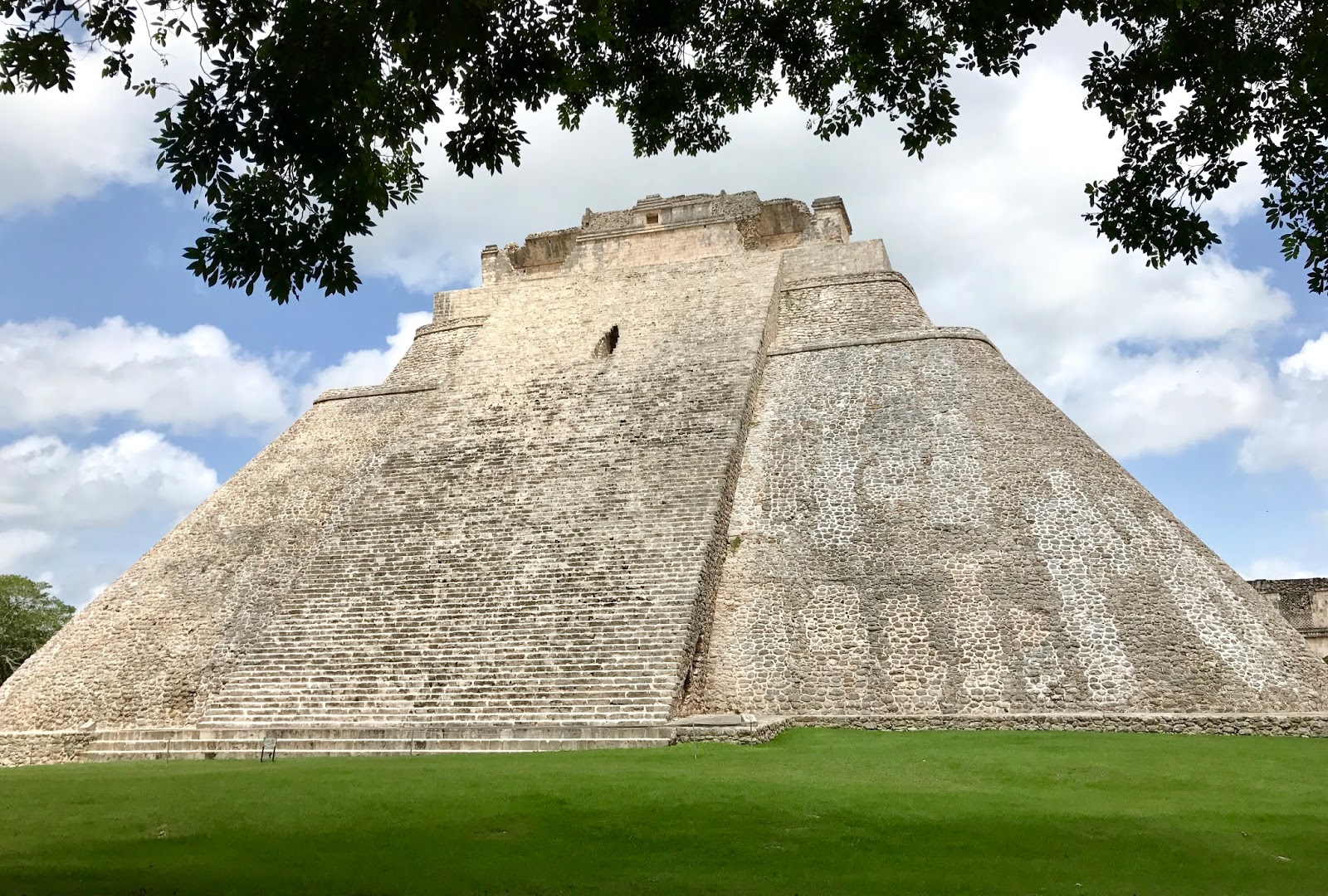
The five Americans, including our tour leader, on the other hand, decided to visit the Mayan ruins of Uxmal and Kabah.  Our guide Jose picked us up at 9 am after we had a sumptuous buffet breakfast at the hotel restaurant.  Jose gave us a quick tour and history of the city.   About an hour later we were in the ruins of Uxmal, a UNESCO World Heritage Site.  Although it's a major Mayan archaeological site, you don't see as many tourists here because it's quite far off the tourists path.  Those who chose to come are rewarded with a rich history of Mayan culture.  The crowd is a small fraction compared to what we saw later at Chichen Itza.  We had to brave the tropical heat to stay focus on what Jose was explaining.  Below are some of the picture highlights:

Pyramid of the Magician

Governnor's Palace

Sign explaining the history and architecture of Uxmal

Our energetic guide Jose


Another view of the Pyramid of the Magician

Sundial in the quadrangle

Nunnery Quadrangle

Close-up of architectural details

More details

Hoop where Mayans play their version of "basketball"

Mayan "basketball" court - 7 against 7


Our small tour group.  I am the "thorn among the roses"
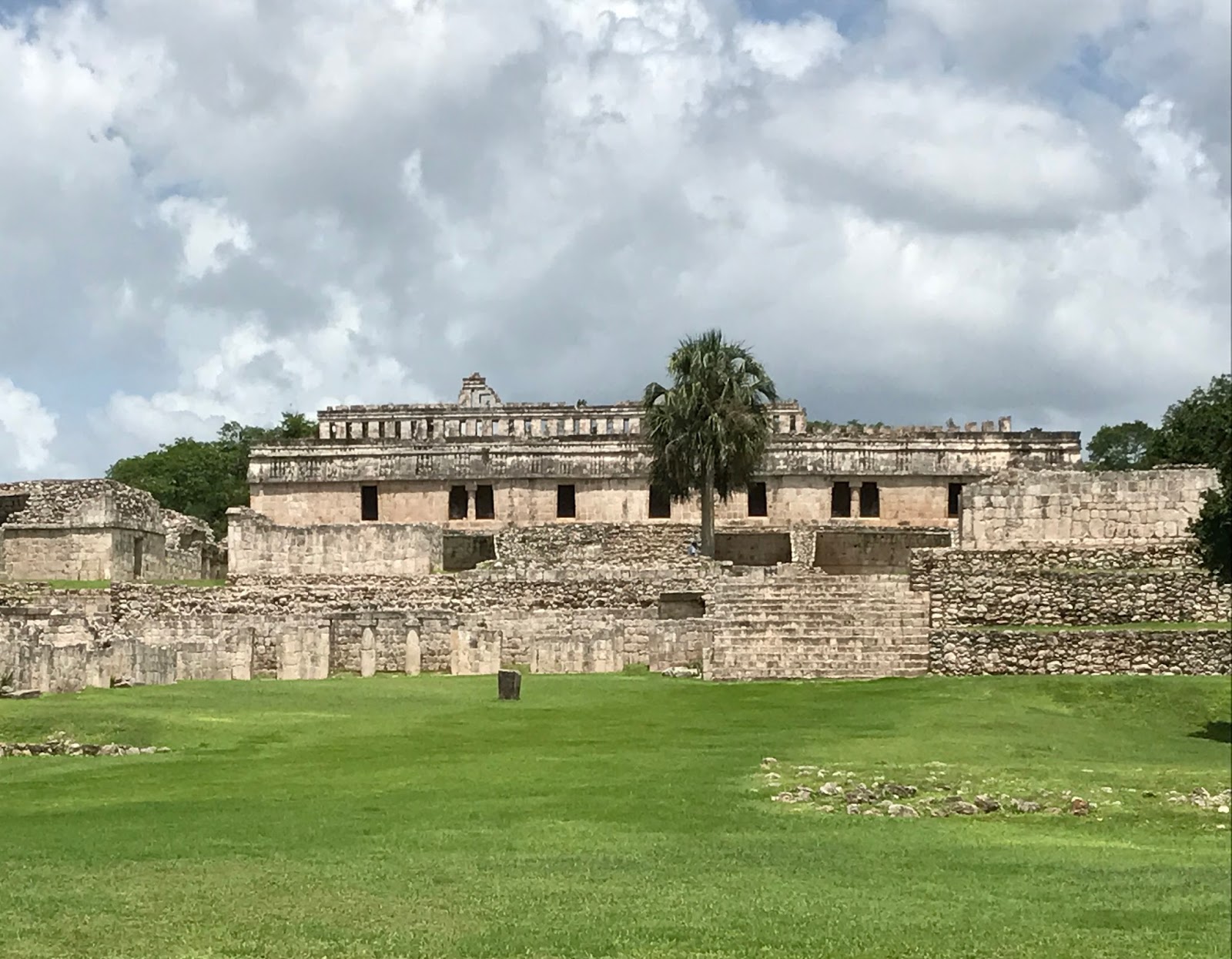
We also visited a smaller archaeological site called Kabah.  Below are some pictures from that site:

Carvings of 2 kings

Codz Coop Palace

Architectural details
Although we spent very little time in the city, I did a quick walk around the zocalo in the morning after breakfast.  The area is not as nice as those in Puebla or St. Cristobal.  Even 2-3 blocks from the city we see fairly run-down areas.  Jose explained to us that some owners abandoned these old buildings.  You can tell that the economy of the city is heavily dependent on tourism.  Some businesses are spoiled by it.  You run into aggressive shopkeepers and promoters trying to drag you into certain stores.  One shop I visited was nonchalant about whether I buy or not.

The next morning we are scheduled to visit the face of Mexican tourism:  Chichen Itza

Wednesday, July 19, 2017

Palenque

Our private van picked us up promptly at 5am.  We were supposed to take a public bus but that'd mean that we'll go all the way from St. Cristobal to Palenque, then get a separate private van to go to the waterfalls.  With the private van option, we had to pay another 250 pesos or about $14.20.  It saves us time and not having to go back and forth.

Until now we've been at places at higher elevation.  St. Cristobal is at 2,200m or about 7,200 ft high.  The days are nice, in the 70s' F, and the nights are cool, sometimes even cold, dropping into the 50s'.  From here onwards to Cancun, we'll be at lower elevation and mostly tropical areas.  You can see the change in vegetation.  You start seeing tropical trees like bananas, papayas, and some sugar-cane.

The first waterfall we stopped at is the Aqua Azul (means Blue Water) Waterfall.  It's a fairly large waterfall area and seems to attract a lot of Mexican tourists.  It actually consist of several waterfalls, some of which have pools of water below where people can swim.

Aquazul Waterfalls

A different part of the waterfall

Swimming in one of the ponds

Boy selling bananas to help the family

Making empanadas, 5 for 20 pesos
The next waterfall we went to is the Misol-Ha Waterfall, about an hour away.  This has a 30-foot drop waterfall.  You can walk behind it and up the steps you come to a small cave, where you have to pay money to get in.  We did not spend a lot of time here.

Misol-Ha Waterfall

Small cave next to the waterfall

We are still in the state of Chiapas.  As mentioned before, there are a lot of Indigenous People (IP) in this state.  They are mostly the descendants of the Mayans who ruled this area before the Spanish arrived, for thousands of years. So, why stop in Palenque?  Because there is a well-known Mayan ruin here.  Many tourists come here for the same reason although it's a little off the beaten path.  On the street where our hotel is, there are a few other touristy hotels and restaurants and I saw many foreign tourists here.

Hotel Xibalba, where we stayed in Palenque
 Unfortunately, I did not feel good when I arrived in Palenque.  I think it's an old sandwich that I ate on the way there.  Our tour leader told us that having stomach problem is a common thing, even among locals.  I've always been able to eat all kinds of street food but I think there may have been some old mayonnaise or stale cheese or ham in the sandwich.

The next day we were to go on a tour of the Palenque ruins, a Mayan ruin dating back to 400-700AD.  I tried braving it but about 2 hours into the tour, I gave up and went back to the hotel to rest.  I had to purge all the bad food from my system and rested most of that day and that evening.  Fortunately, I travel with different types of stomach medication just in case this type of thing happens.  I was able to recover slowly the next day.  Below are pictures of some of the ruins, before I left the tour:


The next morning we walk to the nearby bus station and took an Ado bus to our next destination:  Merida.

Monday, July 17, 2017

San Cristóbal de las Casas

In the evening we took an overnight sleeper bus to San Cristóbal (short for San Cristóbal de las Casas).  I have not taken an overnight bus for a long time.  The last one I took was probably at least ten years ago, from Hamburg to Paris.  On that I bus I sat next to a triple-wide African woman who took half my seat.  I could've used her as my mattress.

This 11-hour bus journey started at 8pm, when it got dark.  We couldn't see outside but we could feel the winding road.  Soon I started getting nauseous.  Later I asked my travel companions and some of them said they were nauseous too.  After a while the road gets better but still a little bumpy.  Except for a few security checkpoints, the bus did not stop.  Half-way through they switched drivers.  They played a movie about Bobby Fischer at the beginning of the trip but most of the way the inside of the bus was dark.  There were Men's and Women's toilets and the seats lean further back than most buses.    Most people slept (I think) or closed their eyes.  Since I usually can't sleep on buses or airplanes, so I couldn't sleep.  I may have dozed off a little bit but I was awake most of the time.  It was a very long and unforgettable evening.

We arrived in San Cristobal early in the morning and checked into the hotel.  Our rooms were not ready so we went out for breakfast, then came back to put our things in the rooms.  We were to spend 3 nights here.

Although I have not heard of the town, by the looks of the number of tourists here, this must be quite a popular tourist spot.  Most activities revolve around the zocalo (or city square).  There were a few pedestrian malls that are lined with shops, restaurants, bars, etc.  One thing this area is known for is amber.  If you saw the first Jurassic Park movie, you will remember that they found a mosquito that had sucked the blood of a dinosaur.  From there they were able to recreate dinosaurs.  (I am probably not factually correct here because I saw the movie a long time ago).  Anyway, it's a tree resin that has been fossilized a very very long time ago.  If you clicked on the link on amber above, wikipedia has some excellent photos of what they look like.

On our first day, we were supposed to rest from our long bus journey.  I took advantage of a laundry near the hotel and have all my dirty clothes, weighing about 2 kilos, washed for 30 pesos ($1.69)!  She even folded them beautifully.  What a treat; not having to wear dirty clothes for more 3 days!

One thing I noticed right away is that there are a lot more Indigenous People (what Americans call Native Americans) here.  Like in many countries invaded by Europeans, the natives are the ones who always ended at the bottom of the economic ladder.  So most of them are peddling souvenirs or food to the tourists.  Even little kids have to do this to help their family.  It's a sad situation.  Chiapas, where San Cristobal is, is one of the poorest states in Mexico and has the most number of Indigenous People.

A Chamula (Indigenous) Church

A bar near the zocaolo

Indigenous People selling fruits and vegetables


An early morning street sweeper in front of a graffiti wall

An Indigenous girl showing the art of hand-weaving

Some of the beautiful work produced by her

Range of souvenirs, again sold mostly by Indigenous people

Cathedral near the zocalo

Protest by the Indigenous people against the Federal Government
We visited two Indigenous communities - the Chamula and Zinacantan.  They are similar but different.  Both are close-knit communities and have their own language.  They run it like their own town and manage their own affairs.  Crime is very low because it's like a commune.  Everyone looks out for each other.  One has a little bit of Catholicism sprinkled with their native religion.  The other has more Catholicism in their religion.  According to our tour guide Cesar, all the people living in this communities are happy where they are.  They allow visitors but they don't welcome them to stay there.  Cesar speaks the language and grew up in the area so most people know him.

On the next day we have the option of going to the Canyon Sumidero, about an hour away and a cooking class.  I opted to just go to the Canyon, which I later regret.  Although beautiful and we did see some monkeys and crocodiles laying on the side of the river, the trip was marred by a floating debris of trash.  The trash were washed down from the various streams feeding into the river.  Most villagers don't hesitate to throw trash randomly, and that's where they ended up.  The boat operators said the government is going to clean it up but everyone's question is why don't you clean it up.  The cooking class was more fun because it was good and there was a lot of food, according to my friends.

Crocodiles sunning on the bank of the river

Tourist boats in the canyon
We had some excellent meals in San Cristobal.  Because it's a tourist town, it was very lively.  We enjoyed the beautiful area around the square.  It was within walking distance from our hotel.  Our hotel was nice and the service was excellent.  We had great breakfasts in the morning.  The only shortcoming was that the wifi was slow, but that's in all of Central America.  The next morning we had to depart at 5 am to go to Pelanque, stopping at a couple of water falls along the way.