Saturday, July 15, 2017

Oaxaca

In the morning we took taxis to the bus station at Puebla, where we took a public bus to Oaxaca (pronounced wa-ha-ka).  It was a 4-5 hour trip on a comfortable motor coach.  Unlike buses in most countries, the buses don't stop at rest stops or truck stops.  I think it's because of security reasons.  There are toilets on the bus but you don't get the opportunity to get off the bus to stretch or to buy some snacks.

We arrived at Oaxaca in the middle of the afternoon, took taxis to our hotel, then immediately walked a few blocks to the market.  Like any markets in many places that I've been to, this market sells almost everything - meat, produce, food, souvenirs, jewelry, etc.  It's an interesting mix.  Around the market there are many more stands that also sell a variety of things.  This is the heart of the people in Oaxaca.  It's where they do most of their shopping, instead of in a big supermarket like in most developed countries.

Mercado de Oaxaca

A happy butcher

Different types of moles' available at the spice shop

Our guide arranged for us to visit a chocolate making store, where they demonstrated how chocolate are made.  Not many people know that chocolate was first grown in Mexico.  It was introduced to Europeans by returning Spanish missionaries in the 17th century.  The cacao trees are not grown in this region because it's too cold for it to survive.  They come from tropical parts of Mexico.  Nevertheless, chocolate has been consumed in this region for several centuries.  You find it in some of the native food and many stores sell chocolate-related products.

Chocolate-making machines
We also went to a mezcal store where we got to sample different types of mezcal.  Mezcal is made from the agave plant.  The heart of the agave plant is cooked, crushed, fermented, then distilled into alcohol.  It is similar to tequila, except that tequila is made from the blue agave plant and produced in the state of Jalisco.  Mezcal is produced mostly in the state of Oaxaca.  There are many retail stores in the city of Oaxaca selling mezcal.  We were given samples of at least 20 varieties, some of them the cream types of different flavors.

Sampling mezcal

Varieties of mezcal

In the evening we walked around the Plaza de la Constitucion, the central square where the local population gather to be entertained, shop or just stroll around.  It is a lively area.  It's nice to see people coming out to meet others and participate in community activities rather than staying indoors to watch TV.

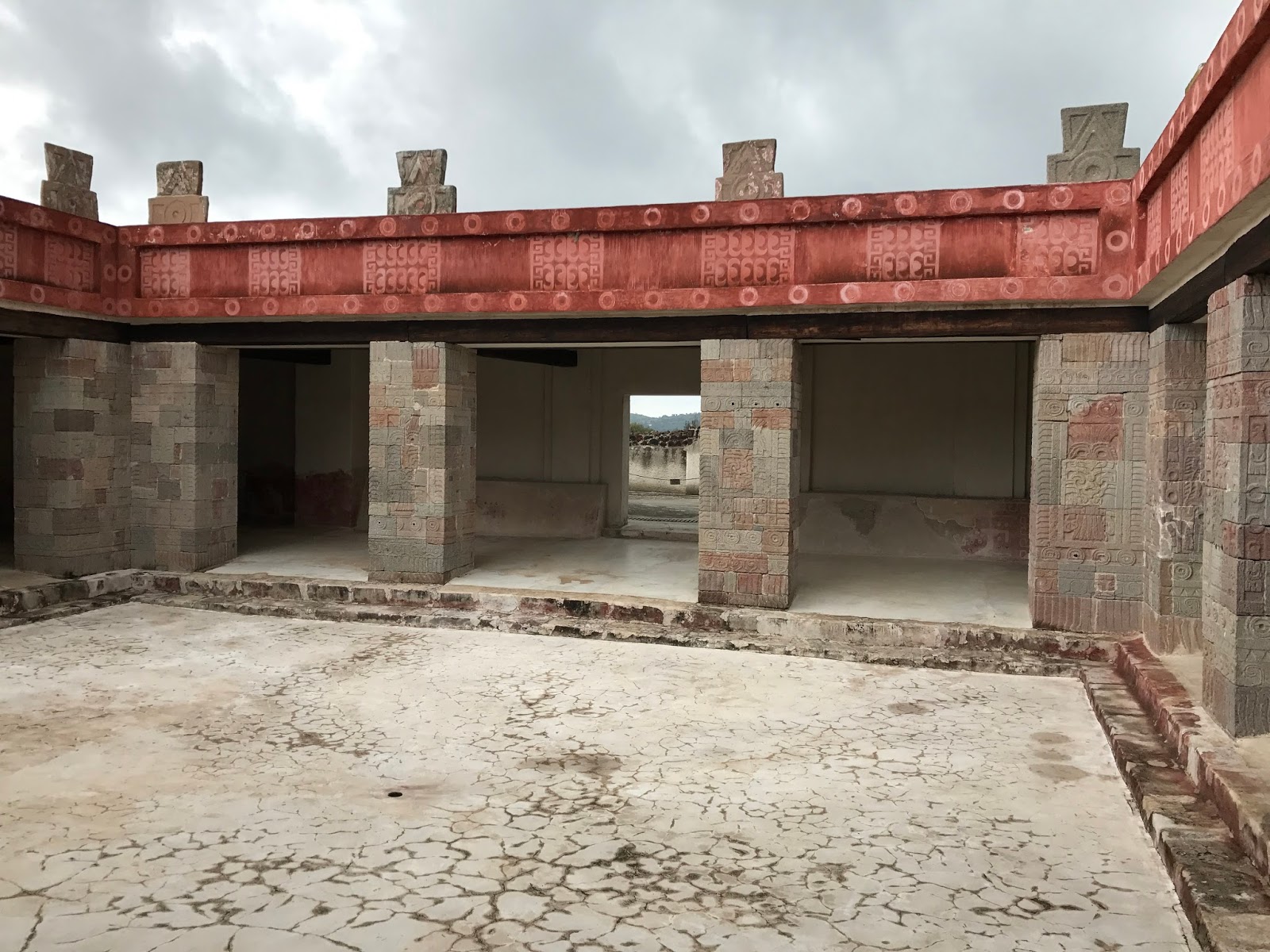
The next morning we were to driven to Monte_Albán, a large archaeological site dating back to 500 BC.

Monte Alban site

One of the pyramids

Stone Carving

Steps up a burial site
 In the afternoon we toured a mezcal distillery and a weaver's shop just outside of town.  We also visited the village of Tule where we saw one of the biggest tree (cypress) in the world.

Supposingly one of the biggest trees in the world

Mezcal distillery

Pit where agave hearts are cooked to make mezcal

Mezcal with crickets as snacks

Weaver with display of natural colors

Entrance to Monte Alban Museum

Wednesday, July 12, 2017

Teotihuacan and Puebla

In the evening on the first day we met with our tour leader Kelli.  Only 4 out of 7 made it to the meeting.  The other 3 were late arriving because of various issues.  Kelli went over the itinerary, dos' and don'ts', what to expect and so on.  Kelli is a young American from the Pacific Northwest.  She has lived in Central America, mainly Guatemala since 2014.  She just joined Tucan Travel about 3 months ago.  She speaks fluent Spanish and is familiar with the places where we'll be going.  There are a total of 7 in the group:  2 ladies from Florida, 1 young lady from Pennsylvania, 1 guy and 2 young ladies from Australia, and myself.

We had an early start at 7am on Day 2.  Our driver and guide picked us up at the hotel in a 12-seater van.  We drove about an hour to our first site:  Teotihuacan.  The city was thought to have been built around 100 BC and was a thriving metropolis with a population of over 100,000 people.  It finally died around 550 AD.  This is one of the better known ancient ruins in the area, showing that there were several ancient civilizations living in the area.  The lesser known ones are difficult to get to and may need a local guide and specialized transportation to get there.  Our tour guide, Juan, gave us an excellent background and history of the area.  We climbed a few of the pyramids.  Two of the major ones are the Sun and Moon pyramids.

Part of a ruin at Teotihuacan
A bird's eye view of Teotihuacan

A building on top of another building

Climbing "sun" mountain


A restored part of a building


Tourists climbing the mounting representing the moon


After Teotihuacan, we drove about 2 hours to the City of Puebla, which means the City of the Angels.    This is an old colonial town founded in 1531.  The historic city center is a UNESCO World Heritage site because of its impressive Spanish colonial architecture.  It is best known for mole poblano, a rich, spicy sauce containing chocolate, cinnamon, nuts plus other hot pepper.  It is usually served over chicken.  We spent 1 night here in a hotel that is about 50 meters from the zocalo.  A zocalo is the main city square of every Mexican town.

There are a lot of activities in and around the zocalo.  On the Sunday we were there, there was a street fair and flea market.  In the evening there was music and other entertainment in the zocolo itself.  The city's main cathedral and municipal offices are also located around the square.  In the evening we had a nice dinner at one of the local restaurants nearby.  As mentioned before, the specialty here is mole poblano, although you can get other types of poblano to go with your dish.  Mole is a type of sauce used in Mexican food that is made from different spices like chili pepper, black pepper, cumin, cinnamon, chocolate, etc.

Enchilada in mole poblano sauce
Mole spices sold in the Market

Antique Shop

Clowning around in Puebla

Woman selling figurines 
A street full of shops near the hotel

The city square or zocalo

The cathedral next to the zocalo

A nearby church

Another nearby church with a different design

A morning vendor selling juice

This street held a flea market the day before

A shrine in the plaza

A multi-hued street in the early morning

A pink hotel and restaurant

Snacks or pastries
Puebla is a lively city that has some beautiful colonial architecture.  Activities, though mostly around the zocalo area, also spread a few blocks away with shops, street markets, colorful buildings.  I find most of the people here, including shopkeepers and street vendors, very friendly.  I asked permission to take pictures many times and was almost always granted.  While we were there on a Sunday, the streets were full of people and music.  I wish we stayed an extra day or two here.

Saturday, July 8, 2017

CIUDAD DE MÉXICO

Mexico City is the capital of Mexico and is the most populated city in Mexico, with a population of about 22 million people in the Greater Mexico City area.  It is located in the Valley of Mexico at an elevation of over 7,000 feet.  I've never been here but I read and heard a lot about the place.  It's crowded, the traffic is bad but there are a lot of interesting places to see.

I flew in on a morning flight from Phoenix.  It's a direct flight on American Airlines, definitely not my favorite airline.  I could fly other airlines but that would mean a stopover in Dallas, or Houston or LA.  Then the trip would take more like 6-7 hours.  We were advised by the tour company to take one of the authorized taxis.  I found them bunched together after I exited immigration and customs.  The prices vary slightly and I picked one that charged me 216 pesos.  Interestingly, I noticed that the Mexicans use the $ sign to denote pesos so $216 would mean 216 pesos, about US$11.80.  As expected the traffic was chaotic.  Like many developing countries no one seem to follow the rules.  It's a matter who is bolder in charging into traffic or cutting into someone's lane.  Amazingly, there are few accidents or road rage.  Every driver expects you to behave the same way.  The taxi took about 45 minutes to get to the Hotel El Salvador, which is located in the Central Historical District.

After a very nice affordable meal, I took a walk around the hotel looking for a bank to get some cash. The streets are teeming with businesses selling cell phones and accessories and other electronic stuff.
As soon as the shops closed, the streets became deserted and quiet.  I stumbled on a beautiful building and found out that it's the Palacio de Bellas Artes.  They have a performance that night by the Ballet Folkorico de Mexico.  Lucky me.  It was a beautiful performance with a lot of Mexican music and dances.  The ticket was only about US$50.

Palacio de Bellas Artes

Ballet Folkorico de Mexico

In the morning I walked about 1/2 mile towards the Historical Center of the city.  Here is the Plaza de la Constitución, the Catedral y Sagrario Metropolitano, the Palacio Nacional, and the Templo Mayor plus other museums.  The main plaza is under some kind of renovation so I stopped at the Cathedral first.  Like in many Catholic countries, the main cathedral always occupy a prominent spot in the city.  There were many Mexican tourists but not as many foreign tourists as I was expecting.  Compared to many countries that I've been to, Mexico is a little behind in promoting its tourism.  It could easily attract many American tourists but fear of being caught in a gunfight with the drug cartels has scared many away.  The Tourist Information booth is staffed with people who don't speak English or has limited English abilities.  After taking some pictures inside and outside the cathedral I met a lady promoting a "free" walking tour.  I've been on many of these tours before and they are usually very informative and a good way to know the city.  It's free but tips at whatever you think the guide is deserving, is expected.

There were about 20 people in our group, from the US, Australia, Korea, Japan, Russia, etc.  The tour took about 2 hours.  We walked through the historic central district.  The guide explained some of the history and pointed out some important landmarks.  The guide did a good job, considering the background noise and her strong Spanish accent.  I could not make out some of the things she said but sometimes it's my fault, having been distracted by some photo opportunities.  Tips ranged from $50 (pesos) to $200.  I don't think our guide was as good as the ones I had in NYC, where the guides are almost professionals.  There, a tip of $20-$25 is expected.

The next couple of days I spent a lot of time walking around the city on my own.  Being an old country there are a lot of historical sites, buildings and museums.   In the middle of the city square is the Templor Mayor, a museum of the pre-Spanish Mexico.  In 1978 while building the subway, construction workers found an ancient Aztec city underneath the current city.  Since then archaeologists have uncovered more artifacts and have a better understanding of Mexico before the Spanish came.  The museum housed a big collection of artifacts, some authentic, some copies.  It's an excellent museum that must not be missed if you come to Mexico City and enjoying learning about its history.

Aztec ruins in front of the Templo Mayor Museum. In the background is the main cathedral

One of the many artifacts at the Museum
I enjoy walking the streets and observing people and their daily activities wherever I go.  I also enjoy eating, especially local food.  Fortunately, I have a strong stomach and can usually handle any kind of street food.  But, I never travel without a supply of Pepto-Bismol tablets in case I overeat or get a little indigestion.  Below are some pictures from the streets in the Centro Histórico (Historic Center) of Mexico City.

Churros are popular, especially at the 24-hour El Moro Churreria

Lots of pastries at the Ideal Pasteleria on Republica de Uruguay street

Organ grinders are everywhere.  They demand donations!

A shrine in the middle of one of many busy shopping streets around the main square

I was invited to ride with a group of 11-person tandem bicyclists around the city center during rush hour.  So much fun!

A trio singing Mexican music in front of the Nike store on Francisco I. Madeiro  pedestrian street.

Metallic art between the Cathedral and Templo Mayor


Street vendor selling popular Mexican food.  

Another artifact at the Templo Mayor

A mural by favorite-son Diego Rivera at the Palacio Nacional

A typical shop on one of the many shopping streets around the city square

I didn't know bras come in so many colors!  I should go to Victoria Secret more often

Public toilets run by private businesses. Cost 5 pesos
Plaza de Santo Domingo, one of the historical squares
I intentionally scheduled 3 days before my tour so that I can walk the streets and enjoy the city.  Early tomorrow morning we are starting on the first leg of our tour, to the ancient city of Teotihucan, then to the city of Puebla, where we will spend the 2nd night.


Tuesday, July 4, 2017

Magical Mexico Tour


Magical Mexico Tour

When I mention to my friends that I am traveling to Mexico, the first reaction is that "it's dangerous."  I've done a lot of reading about travels in Mexico recently.  I feel that it's safe, perhaps even safer than Phoenix.  In gun-happy Arizona, you never know when you will be shot - drive-by shooting, road rage, hold-ups, etc.  I don't think Mexico is any more dangerous than the many places that I've traveled to.  As a seasoned traveler, I am always very observant of what's around me and I know how to stay away from places where I don't think I should be.

This trip is different because I am joining a tour instead of traveling on my own.  Why?  One, because I have a short window for this trip and two, I am not as familiar with Central and South America as I am with Europe and Asia.  So, I decided to travel with a company that I've been watching for a while - Tucan Travel, a British company that offers tours all over the world.  The prices are reasonable because they don't try to pamper with all the comforts that I don't need.  In fact, we'll be taking public transportation for a big part of the tour.  Above, you can see the route that we'll be taking and places we'll be going.

I arrive in Mexico City 3 days before the start of the tour.  Below is the rest of the itinerary.  I hope to update this blog as often as I can but it very much depends on time and availability of wifi.

Day 1 to 1 - Arrive Mexico City

The first day of your tour is simply an arrival day with no pre-organised activities. In order to allow time to relax and see some of the sights you may wish to add pre-tour accommodation.

Mexico City is the world's most populated city with over 20 million people. Founded by Spanish conquerors in 1521, Mexico's capital sits at 2309 metres above sea level and was built on the site of the ancient Aztec capital of Tenochtitlan. The extensive metro system and trolley buses make getting around easy and there is certainly plenty to see and do here.

A good starting point is the main plaza, the enormous Zócalo, where you will find the impressive Catedral y Sagrario Metropolitano, the main cathedral of Mexico City, with a magnificent Latin-Baroque style façade. Remember to look through the glass flooring outside of the church to see the ancient Aztec city beneath. Just behind the cathedral are the Aztec ruins of the ancient Teocali, which were only discovered in 1978. You can also visit the world famous Anthropology Museum and the National Palace where you can see murals depicting the history of Mexico by one of the country's most famous artists Diego Riviera. A museum dedicated to his equally famous wife, Frieda Kahlo, is located in her childhood home in Coyoacán. In the evening you can enjoy a spicy Mexican dinner and maybe a few tequilas in the Zona Rosa while enjoying music performed by a mariachi band.

Day 2 to 2 - Puebla

Before heading to Puebla we take a short bus journey from Mexico City to the ancient site of Teotihuacan where we can enjoy a guided tour. Here you will see an amazing abandoned city built around 300 BC by a civilisation now lost in the mists of time. The historic complex is a fascinating combination of ceremonial pyramids, such as the Pyramids of the Sun and the Moon, the Ciudadela, which are connected by the Street of the Dead, palaces, old temples and the Plaza of the Sun. The buildings are decorated with friezes and other ornate artworks. Heading back to Mexico City we board a comfortable bus to Puebla on a two hour journey. In Puebla you can admire the Spanish colonial architecture and try a mole poblano, a rich spicy sauce containing chocolate, cinnamon and nuts.

We continue to one of Mexico's oldest towns, Puebla, which means "City of the Angels". Set in a valley with a dramatic backdrop of volcanoes and snow-topped peaks, Puebla is a fascinating old colonial town founded in 1531. The historic city centre has been listed as a UNESCO World Heritage site partly due to its impressively preserved Spanish colonial architecture. Puebla is the best place to try mole poblano, a rich, spicy sauce containing chocolate, cinnamon and nuts, as well as different types of hot peppers, often served over chicken.

Day 3 to 3 - Oaxaca

Next on our list is Oaxaca (pronounced wa-ha-ka), a beautiful city bordered by mountains and thick forests, with a very pleasant Plaza de la Constitución where you can eat, drink and watch the world go by. After getting taxis to the bus terminal we will spend 4-5 hours travelling in first class to Oaxaca. Sample tasty street food and admire the colourful colonial buildings in this attractive town.

Day 4 to 4 - Night Bus to San Cristóbal

From Oaxaca we include a guided excursion of Monte Albán, the holy city of the ancient Zapotecs located 400 metres above the Oaxaca valley. There are many structures to explore around the Grand Plaza including numerous tombs, ceremonial altars, tunnels, pyramids and palaces, many decorated by glyphs, paintings and intricate carvings. After enjoying the charms of Oaxaca we take an overnight bus to San Cristóbal de las Casas.

Day 5 to 7 - San Cristóbal

Ascending into the mountainous Chiapas region we arrive at the fascinating colonial city of San Cristóbal de las Casas. Situated in the middle of the highlands, here you will find Mexico's richest example of indigenous culture, as it is surrounded by 21 indigenous villages with distinct languages, dress and customs. Red tiled houses painted in brilliant colours dominate the city, maintaining a delightful provincial charm. There are numerous interesting museums to see such as the Amber Museum, the Coffee Museum, the Maya Medicine Museum, and the 'Na Bolom' Cultural Centre.

We can enjoy an included tour of the nearby villages where you can buy beautifully made local handicrafts and get a true feel for how modern descendents of the ancient Maya people live today. The tour gives you a fascinating insight into their pre-Columbian beliefs and their daily struggle to be heard in what is one of Mexico's most isolated regions.

There is also an option to visit the stunning Sumidero Canyon on a guided speedboat tour along a 30 kilometre section of the Grijalva river to the hydro-electric dam. There are plenty of opportunities to photograph local wildlife such as birds, crocodiles and iguanas. The cliffs towering over the river reach 100 metres at the highest point, which will provide a dramatic backdrop to your pictures.

Day 8 to 9 - Palenque

Next we take a scenic and lengthy bus journey to Palenque. You will pass beautiful views as we travel for just over five hours to the town and ruins of Palenque, famous for the tombs found filled with riches in honour of the renowned Lord Pakal and the Red Queen. This archaeological site houses more than 200 structures including a series of hilltop temples, towers, tombs and pyramids surrounded by steamy jungle. The most important constructions, which date back to the Classical period (400-700 AD) are the Temple of the Inscriptions, the Crypt, the Palace complex, the Temple of the Cross, the Temple of the Foliated Cross, and the Temple of the Sun. Decorated with elaborate friezes, sculptures and inscriptions, Palenque is unquestionably one of the most important Mayan archaeological sites. Paths cutting through the jungle lead to various temples and the gorgeous waterfalls, where over time, strange figures have taken shape in the rock formations. A local guide may offer you the extra option of going on a forest walk where you can see unexcavated ruins enveloped in jungle.

Other attractions near Palenque include the fantastic Agua Azul Nature Reserve with more than 200 small waterfalls, and the incredible Misol-Ha waterfall with a 30 metre drop (optional half day tour includes both these falls).

Day 10 to 11 - Mérida

Today we spend a full day on buses as we head from Palenque to Merida. After a short walk to the bus terminal, we board a first class bus and the journey will take the whole day. Capital of the Yucatan province, the 'white city' of Mérida is a pleasant mixture of colonial buildings, churches and plazas. The markets simply overflow with beautiful weavings, hammocks and batiks, making this a great place to buy handmade crafts and souvenirs. At night the city comes alive with live theatre and concerts. There are many city excursions on offer here, from a comprehensive hop on/hop off bus tour exploring the greater city area to a relaxing horse-drawn carriage tour around the cobbled streets of El Centro and Pasaje Montejo Boulevard. If you want to explore the region near Mérida you could visit the small fishing town of Celestún with its large flamingo population. You could also take a swim in the local 'cenotes' (sen-o-tays), fresh-water swimming holes connected by spectacular limestone caverns and deep underwater rivers once sacred to the ancient Maya, covering the entire Yucatan peninsula.

Day 12 to 12 - Cancún

Before going to Cancun, we travel on a bus to Chichén Itzá, an impressive Maya/Toltec site recently voted as one of the New 7 Wonders of the World. Constructed between the 7th and 10th century AD, Chichén Itzá was a centre of pilgrimage for the Maya for over 1000 years. Among the sights your local guide will point out during the tour of the site are the ball court where the captain of the winning team was beheaded (no incentive to play your best!) and the sacred cenote where treasures and the remains of human sacrifices have been discovered. The most famous attraction is the great Pyramid of Kukulcan, dedicated to the feathered serpent god Kukulcan and built with such precision that a shadow serpent descends down the steps during the equinox. After soaking up the beauty of Chichén Itzá, we have plenty of time to relax on the long bus to Cancun.

Until 1970 Isla Cancún (Cancún Island) had only three residents, the caretakers of the coconut plantation with only 117 people living in nearby Puerto Juarez, a fishing village and military base. The island was home to some of the Caribbean's most beautiful beaches and with the advent of mass market tourism it was an ideal location. Due to the reluctance of investors to bet on an unknown area however, the Mexican government had to finance the first nine hotels.

Today over two million visitors a year, come to Cancún to relax on one of the beautiful beaches in what is now known as the 'hotel zone' and to swim in the crystal clear turquoise waters. If the activity of Cancún becomes too much for you, you can always take a ferry out to the more relaxed Isla Mujeres or arrange a snorkelling or diving excursion.

Day 13 to 13 - Depart Cancún

Your adventure of a lifetime comes to an end today. If you have a late flight or have lengthened your stay by adding post tour accommodation you will have more time to explore the sights.

I stay in Cancún one extra day before returning to Phoenix.